
by David Wilson | Oct 26, 2015 | Daily Paper Summaries
In around five billion years, the hydrogen fuel in the core of the Sun will run out, and our star will begin to die. After swelling up into a red giant, many times bigger than its current size, the Sun will blow away its outer layers to leave a tiny, ultra-dense core, around the size of the Earth. White dwarfs, as these dead, slowly cooling star cores are known, are the ultimate fate for the vast majority of stars in the Universe.
by Meredith Rawls | Aug 4, 2015 | Daily Paper Summaries
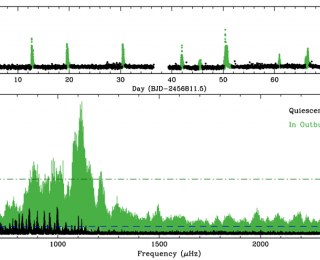
This variable white dwarf pulsates as expected, but it also experiences very bright outbursts. Today’s paper takes us through the discovery and verification of the second pulsating white dwarf with outbursts, and speculates how the pulsations and outbursts may be linked.

by Josh Fuchs | May 20, 2015 | Daily Paper Summaries
White dwarfs in a binary often merge into a variety of interesting phenomena. However, nobody has sought to understand the role that magnetic fields play during the merger. The authors simulate the merging of two white dwarfs with magnetic fields to see what happens.
by David Wilson | Mar 17, 2015 | Daily Paper Summaries
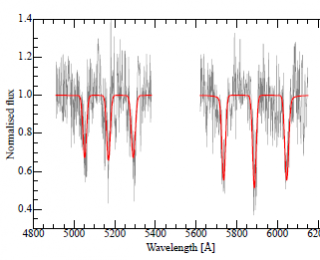
The galaxy is littered with white dwarfs, the burnt out remnants of stars that have run out of hydrogen fuel in their cores, but were too small to explode as supernovae. But far from being lifeless orbs, around a tenth of white dwarfs have powerful magnetic fields, a million times stronger than that of the Sun. How did these magnetic white dwarfs become such strong magnets? And just how many are there. The authors of this paper set out to answer the second of these questions, in the hope that it would shed light on the first.
by Michael Zevin | Dec 10, 2014 | Daily Paper Summaries
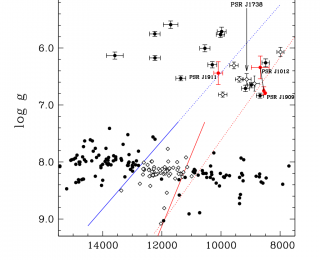
The recent discovery of two pulsating, compact stellar remnants intertwined in a binary system has uncovered a system never-before observed in our Universe, and will offer new avenues for studying the exotic objects involved.
by Josh Fuchs | Aug 5, 2014 | Daily Paper Summaries
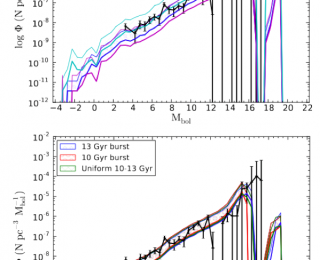
The number and luminosity distribution of white dwarfs stars can be used to help figure out the past history of the Galactic halo.
