• RSS
  • Submit a Guest Post
  • Undergraduates: Submit your Research!
  • Suggest a Paper Topic!
astrobites
  • About
    • About Astrobites
    • Meet the Authors
    • Statement of Inclusivity
    • Copyright & Permissions
  • Latest Research
    • Daily Paper Summaries
    • Classics
    • Undergrad Research
    • Physical Review Coverage
  • Beyond astro-ph
    • Beyond astro-ph Library
    • Interviews
    • Career Navigation
    • Personal Experiences
    • Current Events
    • Teaching with Astrobites
  • Guides
    • EM Spectrum
    • Galaxies & AGNs
    • Spectroscopy and Spectral Lines
    • Adaptive Optics
    • Gravitational Waves
    • Transient Astronomy
    • Astrophysical Software
    • Graduate School
    • Writing a personal statement for grad apps
    • First Observing Run
    • …More Guides!
Select Page

Avoiding a (thermonuclear) supernova

by Sanjana Curtis | Apr 16, 2019 | Daily Paper Summaries

Discovery of a circumstellar nebula with a hot central star – product of a white dwarf merger?

Tiny Stars in a Tiny Orbit: A New Ultracompact Binary

Tiny Stars in a Tiny Orbit: A New Ultracompact Binary

by Aaron Pearlman | Feb 13, 2019 | Daily Paper Summaries

The discovery of the record-setting 38 minute orbit of IGR J17062-6143 makes it the fastest known accreting milllisecond pulsar orbiting in binary system!
Hunting for Variable White Dwarfs in the GALEX Archives

Hunting for Variable White Dwarfs in the GALEX Archives

by Matthew Green | Dec 19, 2018 | Daily Paper Summaries

What secrets are hiding in the archives of the GALEX satellite?
How Many Planets Will We Find Around White Dwarfs?

How Many Planets Will We Find Around White Dwarfs?

by Matthew Green | Oct 4, 2018 | Daily Paper Summaries

We know that white dwarfs have planets, but there are very few that we have detected directly. An upcoming survey may change that.
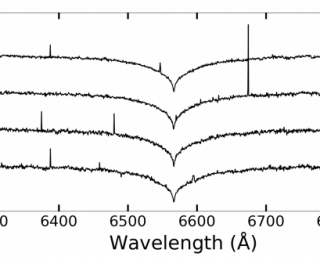
Gravitational Redshift and the Pup: Measuring the Mass of Sirius B

Gravitational Redshift and the Pup: Measuring the Mass of Sirius B

by Daniel Berke | Oct 2, 2018 | Daily Paper Summaries

Measuring a white dwarf’s gravitational redshift can help us figure out its mass, but for one of the closest stars to us (Sirius B) the numbers didn’t match with other methods. Today’s paper investigates the discrepancy.
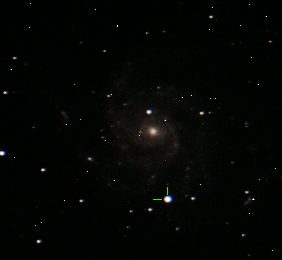
Seeing Red (and Blue): Two Sub-Populations of Type Ia Supernovae?

Seeing Red (and Blue): Two Sub-Populations of Type Ia Supernovae?

by Daniel Berke | Aug 8, 2018 | Daily Paper Summaries

A close examination of thirteen Type Ia supernovae in the earliest days after their initial explosion reveals two distinct sub-populations.

« Older Entries
Next Entries »

Loading

Follow our socials

  • Bluesky
  • Facebook
  • Instagram
  • RSS Feed

More Posts About

AAS AGN astronomy astrophysics binary stars black holes cosmology dark matter dwarf galaxies exoplanets galaxies galaxy evolution gravitational waves habitability JWST Kepler Milky Way observations planetary science planet formation protoplanetary disks radio astronomy simulations solar system spectroscopy star formation stars stellar evolution supernovae theory

Posts by Category

  • Accessibility
  • Applications
  • Beyond
  • Book Reviews
  • Career Navigation
  • Classics
  • Climate Change
  • Course Assignments
  • Crossposts
  • Current Events
  • Daily Paper Summaries
  • Game Reviews
  • Guides
  • Historical Astronomy
  • Instrumentation
  • Interviews
  • Outreach
  • Personal Experiences
  • PRJ
  • Quick Notes
  • Satellites
  • Teaching
  • Undergraduate Research

More Astronomy

  • AAS
  • AAS Nova
  • astro-ph
  • AstroBetter
  • APOD

Read Astrobites in Other Languages

  • Astrobitos (Spanish)
  • Astropontos (Portuguese)
  • staryab (Farsi)

Listen to Astrobites

  • astro[sound]bites

Discover More Incredible Science

  • ScienceBites Network
  • RSS

© 2026 Astrobites | All Rights Reserved | Supported by AAS | Designed by Elegant Themes | Powered by WordPress