
Featured Astrobites
Our latest posts

In the stellar kitchen: how mixing radiation and magnetic fields leads to smaller Population III stars
Today’s bite considers what ingredients you need when simulating the births of the earliest stars in the universe.
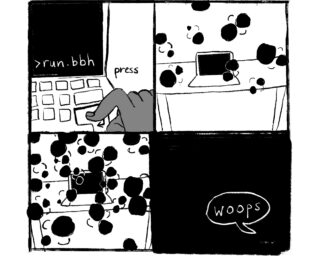
Help, there are too many binary black holes in here!
How does theory overpredict the number of black holes we see? And what can we do about it? Find out in today’s bite!

This just in: Multi-messenger merger made meticulously on massive supercomputer!
In this Astrobite, the authors study the incredible physics of a binary neutron star merger by performing the longest ever simulation on a supercomputer!
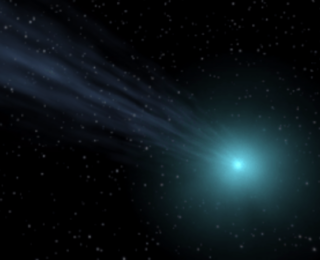
A New Icarus: Disintegrating Rocky Exoplanet BD+054868 Ab
Today’s bite tells the story of BD+054868 Ab, a rocky exoplanet that is being vaporised for getting too close to its host star.
Beyond: The Astronomy Community on Bluesky
Social media is a powerful opportunity to democratize access to academia. The community of astronomers on the Bluesky platform is rapidly growing, and invite you to join them.
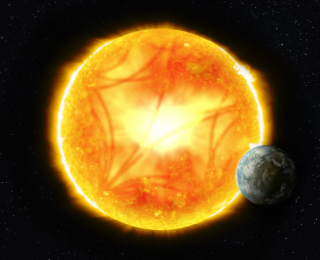
Meteorology, Asteroseismology, and the Brunt-Väisälä Frequency
Today’s bite tells a tale of how 1920s meteorology helps us peer inside pulsating stars.
Beyond astro-ph
Astronomy beyond the research
No Results Found
The page you requested could not be found. Try refining your search, or use the navigation above to locate the post.
Navigating careers in astronomy
Career advice

Science Journalism: What I learned at the AAS meeting
Ever consider a career in science journalism? Here’s some advice on the topic, as well as reflections from someone who got to try it out for a few days!

Careers 101 Workshop
The Monday morning workshop “Careers 101” at the AAS Austin meeting provided a room full of graduate students with several important aspects to ponder when considering our potential career paths, as well as some action advice to follow to develop our careers in the direction that we choose. I blogged a summary of the workshop here, and promised to follow up with some more specific details. I invite comments on this post, if you have any suggestions or advice you would like to contribute related to astronomy career paths. The workshop was organized around a panel, introduced and moderated by Alaina Levine (founder of Quantum Success Solutions). Panelists: Dawn Gelino (NASA Exoplanet Science Institute) Adam Kraus (Hubble Postdoctoral Fellow) Edward Ajhar (NSF Program Officer) Anita Cochran (Assistant Director of McDonald Observatory) Joe Bernstein (Argonne National Lab) Advice (in no particular order): 1. Network. Establish your brand, realizing that at every stage of your career you can be the world’s expert on a niche subject at some level. Find confidence in this. 2. Make yourself stand out. If you are in a collaboration (especially if it is a large collaboration), take ownership of some aspect of the science. 3. Prove yourself by earning your own grants and fellowships. Writing proposals is good experience, even as a grad student or postdoc. 4. Think about what will make you happy. Is an R1 research career, tenure track, what you would enjoy doing? Ask others, do some soul searching. Keep in mind that only 1 in 4 of us will get a tenure track position. Whatever you decide, you CAN change your mind…
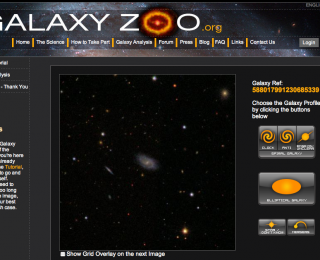
So you need half a million new collaborators?
Kevin Schawinski of Yale University, co-founder of the Galaxy Zoo project, explains how to use crowd sourcing to make sense of enormous data sets.
More posts by category