
Featured Astrobites
Our latest posts
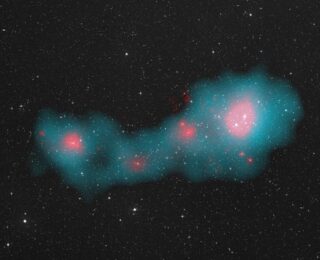
Detecting cold gas in a hot supercluster
The Shapley Supercluster is widely recognised as the most massive gravitationally bound structure in the local universe.The supercluster is made up of 11 galaxy clusters and groups and extends across ~ 260 megaparsecs. At its core, which this paper focuses on, are five clusters. This core hosts several radio haloes,which are caused by shock-heated gas from the Intracluster medium (ICM) and is evidence of ongoing cluster merger activity. This supercluster core is highly dynamically active (full of cluster-cluster mergers), which could influence the evolution of galaxies within the core. This paper examines the evolution of galaxies by observing the cold gas within galaxies (i.e. the neutral hydrogen) and compares several galaxy properties to do so (see also: this previous Astrobite featuring ram-pressure stripped galaxies in the Shapley Supercluster).
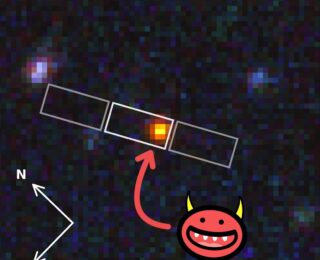
Dawn of the Red Monsters
Today’s bite reports the discovery of the most distant red galaxy ever confirmed!

Exoplanets in a bottle: How laboratory experiments help us understand distant planets
Characterising exoplanet atmospheres is one of the primary challenges for the coming decades and absolutely essential for our understanding of these alien worlds. Join us today as we dive into some of the ways we can study these distant worlds from the comforts of our labs here on Earth.
Wormholes might be more real than we thought
A new solution to Einstein’s general relativity suggests wormholes could be real and traveling through them might be possible.

Tell me why? A case for Human(e) Astrophysics
Artemis, AI, Astronomy, and our place in it. The author asks why do astrophysics at all. To produce results faster, or to turn graduate students into inefficient stand-ins for software? Or because astronomy is one of the most human things we do. It gives us wonder, yes, but also responsibility: to remember the histories of colonialism and militarization tied to our instruments, to use new tools without surrendering judgment, and to insist that people remain the point of the enterprise. The universe is not only something to be computed. It is something to be encountered, interpreted, and loved.
![[Beyond] Code in Astro: how to simulate a Protoplanetary Disc with DustPy](https://astrobites.org/wp-content/uploads/2026/02/DSHARP-320x260.jpg)
[Beyond] Code in Astro: how to simulate a Protoplanetary Disc with DustPy
How do astrophysicists research and model planet formation in protoplanetary discs? Learn how to simulate a protoplanetary disc using DustPy: software commonly used in state-of-the-art research!
Beyond astro-ph
Astronomy beyond the research

Transgender in Astronomy: Interview with Dr. Megan Pickett
For Pride Month, Astrobites is interviewing one transgender astronomer every week. This week we interviewed Dr. Megan Pickett, an Associate Professor of Physics at Lawerence University!

Transgender in Astronomy: Interview with Wichahpi King
For Pride Month, Astrobites is interviewing one transgender astronomer every week. This week we interviewed Wichahpi King, a PhD student at the University of Texas at Austin!

#BlackInAstro Experiences: Logan White
As part of Black Space Week 2025, we interview incoming graduate student Logan White!
Navigating careers in astronomy
Career advice

Ten Ways to Improve Support Resources for Workplace Incivility in Astronomy
Many astronomers unfortunately still experience bullying, harassment, racism, and other incivilities in their careers. It can be hard to find support in these situations, but today’s guest author, Floor Broekgaarden, offers ten suggestions for improvement.
Rise of the First-Gens
In this guest post, Eckhart Spalding interviews two astronomers about their experiences as first-generation college students.
Bridging the gap between astronomy and the space industry
In today’s bite, Emma Louden shares her experience organizing a conference swap between the American Astronomical Society (AAS) and the American Institute of Aeronautics and Astronautics (AIAA).