
Title: On the importance of laboratory experiments for interpreting exoplanet observations
Authors: Maggie A. Thompson
First Author’s Institution: Earth and Planets Laboratory, Carnegie Institution for Science, Washington, DC, USA
Status: Published in Astrophysics and Space Science Journal [open access]
Over the last three decades, we have transitioned from simply discovering that other worlds exist to cataloging them by the thousands. Thanks to space-based telescopes like Kepler and the Transiting Exoplanet Survey Satellite (TESS), alongside a fleet of ground-based observatories, the number of confirmed exoplanets has exploded.
We are now firmly in the era of characterisation. With the James Webb Space Telescope (JWST) providing an in-depth look at planetary atmospheres through transmission and thermal emission spectroscopy, we are finally beginning to see what the atmospheres of these alien worlds are actually made of. In the coming years, this view will only get sharper as the ground-based European Extremely Large Telescope (EELT) achieves first light, allowing us to characterise exoplanets in reflected light and at high spectral resolutions.
One key goal is to take these observations and “connect the dots” between a planet’s atmosphere and its interior. By combining a planet’s bulk properties (like its mass, radius, and orbital period) with its atmospheric composition, scientists aim to link what we see on the outside to the physics and chemistry of the interior. This is particularly essential for understanding super-Earths and sub-Neptunes where the mass and radius isn’t enough information to understand their interiors or formation history. On top of that, these seem to be the most abundant types of planets in the galaxy, yet we have no analogue for them in our own Solar System which makes it difficult for us to study them.
However, our telescopes can only tell us so much. To truly understand these worlds, we need sophisticated modeling tools that are grounded in reality. We’ve talked before about how these models require precise laboratory data to provide the critical inputs and constraints needed to simulate planetary environments. In today’s bite, the author reviews and summarises key areas where laboratory data is essential for filling gaps in our understanding of exoplanet atmospheres and their coupling to the processes in planetary interiors, on the surface and with respect to the possibility of life.
Luckily, there is a multitude of ingenious setups for exploring exoplanets from the comforts of your own lab. This is beautifully illustrated in Figure 1.
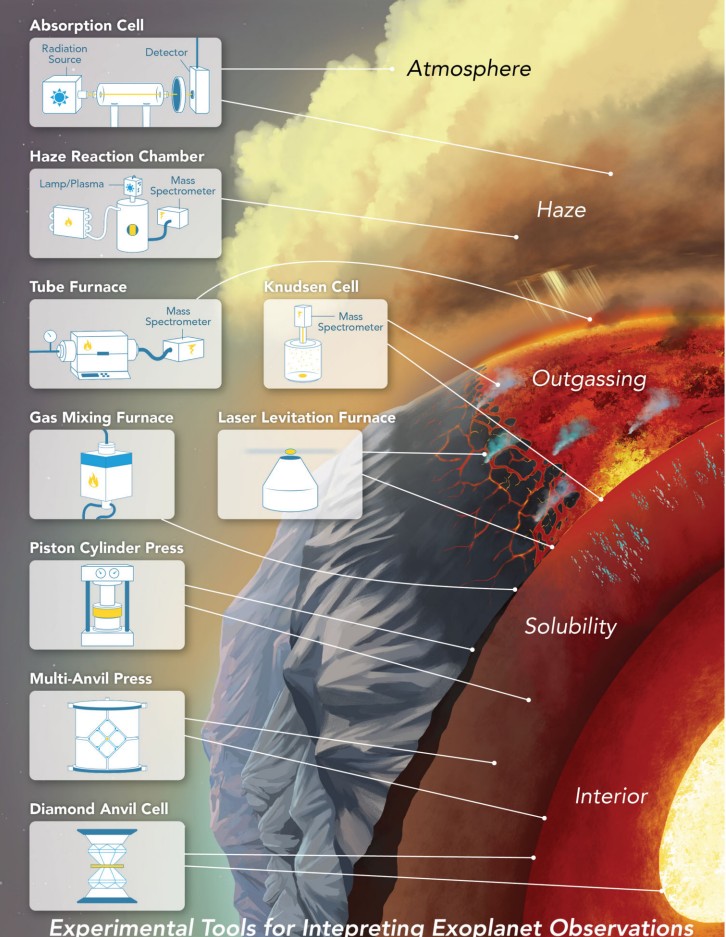
Figure 1: This diagram illustrates the diverse array of laboratory instruments used to simulate and study the various layers of an exoplanet, from its deep interior to the top of its atmosphere. These tools can provide fundamental data for atmospheric, surface and interior characteristics to properly understand exoplanet observations. Illustrated are the schematics of each instrument covered below and the specific planetary regions they probe. The atmosphere is studied using spectroscopic absorption cells to measure gas optical properties and haze reaction chambers to simulate photochemical reactions. The surface and interior-atmosphere connection is explored via heating samples in different furnaces and analysing the gasses with mass spectrometers to measure outgassing and volatile solubility. The planetary interior is recreated using a variety of presses to simulate extreme high-pressure and high-temperature conditions. Figure 1 in the paper.
Connecting the interior and atmosphere
For low-mass exoplanets, atmospheric composition and structure are strongly governed by interior and surface processes. While these planets may initially accrete a primary atmosphere of Hydrogen and Helium, they also develop secondary atmospheres through outgassing during and after accretion. Internal thermal processes, driven by accretion, core formation, and radioactive decay, directly shape the chemical composition of this early secondary atmosphere. To understand these connections, a number of laboratory experiments that constrain how gases escape the interior and dissolve into planetary melts are really useful tools.
To refine outgassing models, researchers have been performing heating experiments on meteoritic samples that serve as analogs for primitive planet-forming material. The setup highlighted in Figure 2 (left) can be used to heat carbonaceous chondrites in a vacuum tube-furnace up to 1475 K while monitoring released gases with a mass spectrometer. In one of these experiments it turned out that water vapor was the most abundant outgassing species, making up about two-thirds of the gas. Carbon monoxide and dioxide made up most of the remaining third as well as sulfur and other trace gases. This gives us an idea of what the building blocks for planet formation contain and provides a starting point for what types of gases we would expect to be outgassing from newly formed worlds.
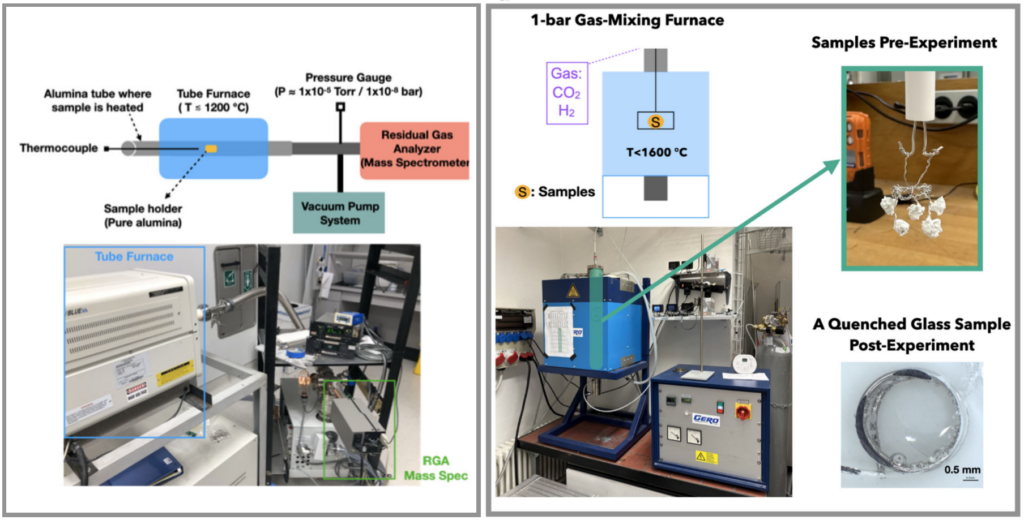
Figure 2: The left part of the figure illustrates the laboratory setup used to measure the types and amounts of gas released when meteorite samples are heated in order to study how young planets can form secondary atmospheres by outgassing. The right part of the figure shows a gas-mixing furnace used to perform water solubility experiments. In this setup, silicate samples are heated to high temperatures and then very quickly cooled into a solid glass sample to preserve the dissolved chemical components for analysis. Adapted from Figure 2 and Figure 3 in the paper.
So these kinds of experiments offer a glimpse into the chemical starting point for young planets and provide some boundary conditions helping scientists build much more accurate models of early planetary evolution. This data is already being used, for instance in atmospheric retrieval codes used to identify which molecular species to include when modeling temperate rocky planets. Similarly, researchers preparing for JWST observations of the rocky world GI 486 b relied on these outgassing experiments to predict which gases would likely dominate its atmosphere.
Beyond outgassing, we have to consider what happens at the planet’s surface. Most rocky planets endure a “magma ocean” phase early in their lives (and some worlds orbit so close to their stars that they sustain molten surfaces for billions of years). On these planets, the atmosphere may be formed by outgassing and what they managed to accrete. How it evolves over time though is governed by a delicate balance of solubility i.e. how easily gases like the water and carbon mono(or di-)oxide can dissolve back into the magma.
To understand this balance, researchers use laboratory tools to melt rock samples until they mimic these conditions. One example is also shown in Figure 2 (right), where scientists used a specialised furnace to melt silicate samples at temperatures reaching 1823 K under atmospheres that simulate early planetary environments. By rapidly cooling these melts into solid glass and using infrared light to scan for trapped molecules, they discovered that at low pressures, water dissolves into the magma as a chemical component called hydroxyl (OH). This tells us something about how essential chemicals for water formation are stored in the planet’s interior during the magma ocean phase, and how the planet can hold onto an inventory of hydrogen despite this particular element’s fondness for just evaporating into space. The results of this particular experiment have already been used in simulations of TRAPPIST-1e, our current best bet for an Earth-like planet in that system. They showed that the atmospheric composition of a young TRAPPIST-1e is strongly influenced by how much of the major atmosphere-forming gases can be dissolved into its interior.
Another novel approach to study molten worlds is to use an aerodynamic laser-heated levitation furnace (ALLF), illustrated in Figure 3.
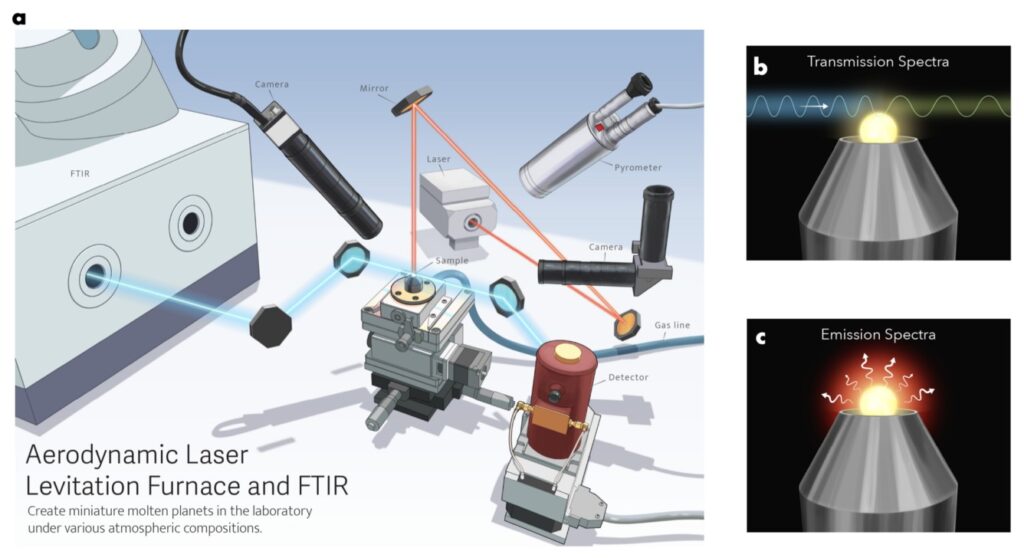
Figure 3: Schematic of the aerodynamic laser levitation furnace (ALLF) and the infrared spectrometer system used to create miniature molten planets. Using a stream of gas to float a rock sample, a powerful laser then heats the floating sample to temperatures exceeding 3000 K. The infrared spectrometer then captures the chemical signals of the gases evaporating from the sample Figure 4 in the paper.
This setup floats a rock sample on a vertical stream of gas, allowing it to be melted by a powerful infrared laser without ever touching a container that could contaminate the results. These tiny molten planets can be heated to over 3000 K and by changing the chemical makeup of the gas stream, you can simulate different types of atmospheres. This furnace is then linked to light-sensing equipment that monitors the vapors bubbling off the melt. By covering the same wavelengths as missions like JWST, this technique gives us a laboratory preview of the atmospheric signatures we might one day detect from actual magma worlds.
Under pressure
While observations of an exoplanet’s mass and radius allow us to calculate its bulk density, these properties are inherently degenerate, as many different interior structures and mineralogies can produce the same result. To better understand a planet’s interior, scientists rely on equations of state (EOS), which describe how the volume or density of specific mineral phases varies under different pressures and temperatures. Getting these equations right is key to infer anything about exoplanet interior structure and composition. They are built using laboratory data from experiments that measure material properties at extreme conditions. A variety of experimental techniques are used to simulate these high pressure-temperature (P-T) environments, including compression tools such as piston-cylinder presses, multi-anvil presses, and diamond-anvil cells that all squeeze samples to incredibly high pressures. Some experiments using these tools have shown that large amounts of hydrogen can dissolve in silicate melts at high P-T conditions and produce water which will influence the interior structures of sub-Neptunes such as K2-18b.
Hazy atmospheres
While interior and surface processes set the initial conditions for planetary atmospheres, their observable signatures are also strongly shaped by processes happening in the atmosphere. Our ability to properly interpret these signatures relies heavily on the quality of our atmospheric models. These, in turn, depend on the accuracy of their physical and chemical input data. This data includes essential properties like gas opacities, the rates of photochemical reactions, and the structural properties of aerosols. Because exoplanets often have higher temperatures, different pressures, and unique radiation environments, we cannot rely on models based on modern Earth-like conditions but must turn to laboratory experiments.
In these atmospheres, mixtures of different gases interact in ways that change their spectral signals. For example, when dominant gases collide with other molecules, they can “broaden” spectral lines, altering the total opacity of the air. This directly impacts how molecular abundances are retrieved from observed planetary spectra. To measure this effect and others, researchers often use absorption cells where a radiation source is coupled to a cell or cavity containing a gas mixture, which is then connected to a spectrometer to observe how the light is absorbed, see Figure 1.
As evidenced by Earth’s atmosphere over time and that of Saturn’s moon Titan, aerosols (solid particles) produced in a planetary atmosphere can play a critical role. Unlike clouds, which form from condensation, these “photochemical hazes” form when UV light breaks apart gas molecules (like methane or nitrogen) and these fragments react to build complex molecules that grow into solid particles. They tend to obscure spectral features, making atmospheric composition of exoplanets harder to determine from observations. To study this, scientists use temperature-controlled reaction chambers where gas mixtures are exposed to energy from UV lamps or plasma discharges to create haze analogues. These chambers often include optical windows for monitoring or specialised surfaces to collect the haze material for further study. Once these laboratory hazes are created, they are analysed with a suite of specialised tools. Mass spectrometers determine their chemical composition, while atomic force microscopy (AFM) is used to measure the size of the individual particles. Other tools, like pycnometers, calculate the density of the haze, while various spectrometers measure its optical properties from the UV to the infrared. These laboratory measurements help us connect ‘real’ hazes to their observed effects in exoplanet spectra.
Looking ahead
Thus, a wide range of laboratory techniques is essential for interpreting observations of exoplanet atmospheres. These experiments provide the fundamental data needed to link a planet’s observable atmosphere to the physics and chemistry of its surface and interior.
As next-generation ground and space based telescopes prepare to search for life on rocky worlds in the habitable zone, this laboratory foundation becomes even more critical. To accurately assess potential signs of life in atmospheric data of (exo)planets, we must understand how gases behave in environments completely different from modern Earth. Ultimately, prioritising these ground-truth laboratory datasets is the only way to ensure the discoveries of the coming decades are properly interpreted.
Astrobite edited by Flavia Pascal
Featured image credit: Hannes Grobe and ESO/L. Calçada/SpaceEngine @ Wikimedia Commons. Images spliced with NanoBanana.
