
Title: EGS-z11-R0: a red, dust-rich galaxy at Cosmic Dawn
Authors: Giulia Rodighiero, Andrea Ferrara, Michele Catone, Lorenzo Napolitano, Paolo Cassata, Giovanni Gandolfi, Emiliano Merlin, Andrea Grazian, Alvio Renzini, Laura Bisigello, Marco Castellano, Pablo G. Pérez-González, Borja Pérez-Díaz, Edoardo Iani, Carlotta Gruppioni, Steven L. Finkelstein, Anton M. Koekemoer, Alessandro Bianchetti, and Francesco Sinigaglia
First Author’s Institution: Department of Physics and Astronomy, Università di Padova
Status: Submitted to Astronomy & Astrophysics [open access]
The James Webb Space Telescope (JWST) has enabled astronomers to pull back the curtain on the first few hundred million years of the Universe’s history. This new view is reshaping our understanding of how early galaxies evolved.
Blue vs. Red
One of the most surprising discoveries by JWST has been the high number of massive galaxies found at redshifts greater than 10 (or when the Universe was less than 500 million years old). This newly discovered population of galaxies appears very blue in color, earning them the nickname “blue monsters.” How these galaxies grew so large so early in the Universe’s history is still an open question, but the observed blue color wasn’t too surprising. Prior to JWST’s launch, it was predicted that very early galaxies would appear bluer due to the high amount of UV radiation from young stars and the lack of dust build-up. Galaxies get dustier over time as processes like stellar winds and supernovae enrich the galaxy with heavy elements. The dust then absorbs UV light from stars and remits it in the infrared, making galaxies appear redder. But when the Universe was only 500 million years old, galaxies wouldn’t have had much time to build up dust, so we wouldn’t expect them to appear red. That’s what makes the object in today’s bite so interesting!
Red: NIRSpec’s Version
The authors of today’s bite report the discovery of the most distant red galaxy ever confirmed: EGS-z11-R0 at a redshift of z = 11.45. This galaxy was discovered serendipitously in public JWST data taken with the spectroscopic instrument NIRSpec. The blueness vs. redness of a galaxy is measured using the galaxy’s UV continuum slope, which is how the UV brightness of a galaxy changes with wavelength. It’s described using the variable β. Most z > 10 galaxies have β < -2.2, indicating a bluer, less-dusty galaxy, but for this galaxy, β > -1.5. This makes EGS-z11-R0 the reddest galaxy ever confirmed at this redshift. Figure 1 illustrates how this galaxy’s β vs absolute UV magnitude differs from the expectation for high-z galaxies (dashed lines in Fig 1).
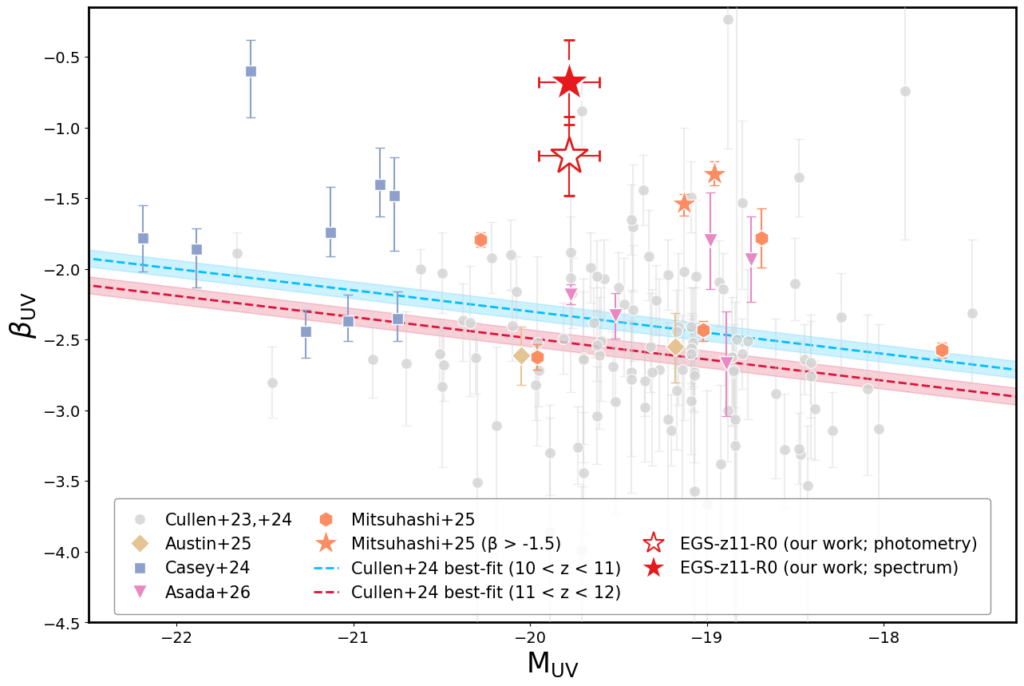
There are two main ways a galaxy could get this red so early: 1) lots of dust or 2) photons from hot, massive stars interacting with the galaxy’s dense gas. In the first scenario, the galaxy would have had to undergo very rapid star formation in order to build up enough dust to redden the galaxy’s light. In the second scenario, the red color is produced by ionizing photons emitted by hot stars or an accreting supermassive black hole (AGN) that are absorbed and reemitted by the galaxy’s gas at longer (redder) wavelengths.
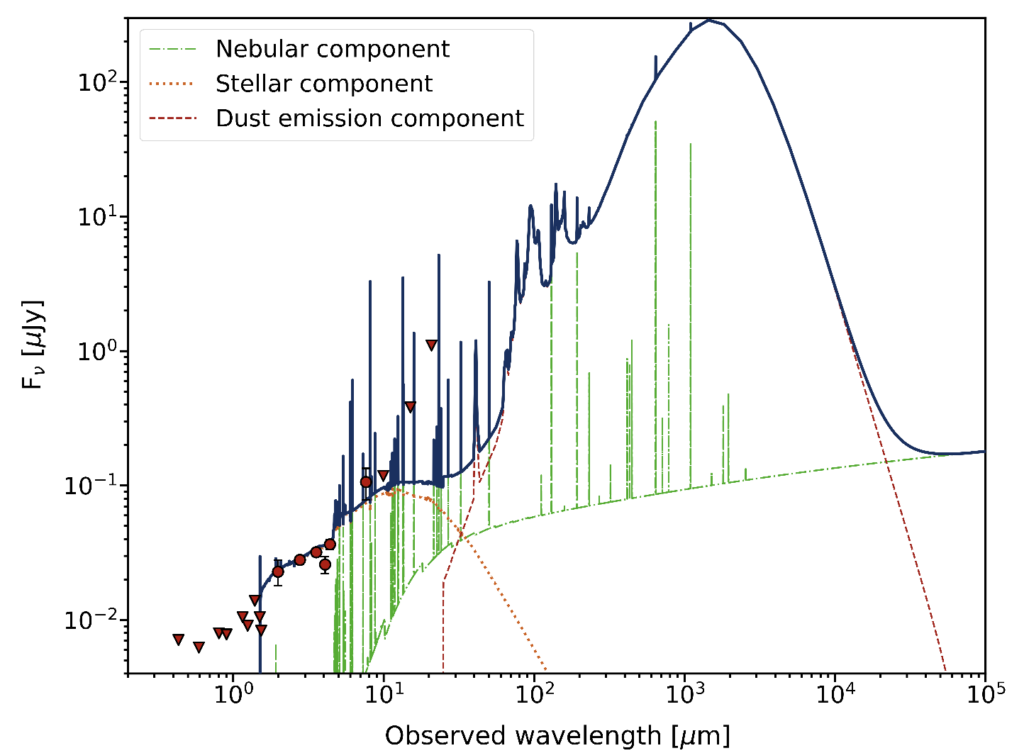
In order to distinguish between these two scenarios, the authors use a technique called SED fitting. An SED, or spectral energy distribution, is the amount of energy emitted by a galaxy at different wavelengths. You can read more about SED fitting here. The main idea is that you build a mock galaxy using parameters like the number of stars, how fast stars are forming, the amount of dust, is there an AGN etc. You then compare the mock galaxy’s SED to the observed galaxy’s SED and tweak those parameters until they match. Now you have a good idea of what ingredients make up your observed galaxy. The authors of today’s bite found that a significant amount of dust is required to reproduce the observed galaxy’s SED (see Figure 2). While the mystery of the galaxy’s red color is solved, that still leaves the question, “where is all this dust coming from?”
Meet the Red Monster
The observation of EGS-z11-R0 proves that very dusty galaxies already existed only 500 million years after the Big Bang. The authors believe this galaxy may represent a new population in the early Universe: Red Monsters. Proposed as progenitors to JWST’s blue monsters, red monsters are thought to undergo a short phase of very rapid star formation. These galaxies quickly assemble a large amount of dust, giving them their red color. A red monster then transforms into a blue monster when the build up of radiation pressure in the galaxy pushes out the dust, clears our line of sight, and reveals the young, blue stars in the galaxy’s center. Additional observations are needed to confirm this theory of early galaxy evolution, but the discovery of EGS-z11-R0 is another example of how JWST is continuing to challenge our ideas of what the Universe’s first galaxies looked like.
Astrobite edited by Jared Bull
Featured image credit: Rodighiero et al. 2026
