
Featured Astrobites
Our latest posts
Meet the AAS Keynote Speakers: Dr Stella Offner
Today we interview Dr. Stella Offner, who is a professor at the University of Texas at Austin and one of this year’s #AAS245 Plenary speakers!
Astrobites at AAS 245: Day 1
Astrobites coverage of Day 1 of AAS 245!
Meet the AAS Keynote Speakers: Dr. Giada Arney
Today we interview Dr. Giada Arney about her work on the astrobiology for her plenary lecture at #AAS245!
Meet the AAS Keynote Speakers: Dr Maria Drout
Today we interview Dr. Maria Drout, assistant professor at the University of Toronto and one of this year’s #AAS245 Keynote speaker!
Meet the AAS Keynote Speakers: Dr Aaron Meisner
Today we interview Dr. Aaron Meisner, research astronomer at NOIRLab and one of this year’s #AAS245 Keynote speaker!
Meet the AAS Keynote Speakers: Dr. Paolo Soffitta and Dr. Martin Weisskopf
Today we interview Dr. Paolo Soffitta and Dr. Martin Weisskopf about their work on the IXPE mission for their HEAD Bruno Rossi Prize Lecture at #AAS245!
Beyond astro-ph
Astronomy beyond the research
No Results Found
The page you requested could not be found. Try refining your search, or use the navigation above to locate the post.
Navigating careers in astronomy
Career advice
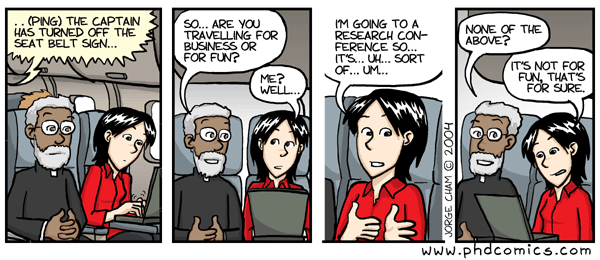
How to Attend your First Conference
Last month I attended my first conference as a graduate student — I went to Extreme Solar Systems II (joined by my fellow Astrobites authors Courtney, Ellie, Lauren, and Sukrit). I learned a lot about what to do (and what not to do!) from my experiences during the conference.
Applying for the NSF: Our own experiences
In this post, some of the astrobites authors share their experiences applying for the National Science Foundation (NSF) Graduate Research Fellowship Program (GRFP). In a previous astrobite, we discussed the application process and materials. Applications for the 2012 fellowship are now open (at http://www.nsfgrfp.org/) and the deadline for astronomy is November 15th. Ellie: My officemate at the time was the first to read my essays and probably had the biggest impact (thanks Anna P!) She helped me structure my essays so that they presented my accomplishments clearly and concisely, such that a hurried reader would easily be able to get a sense of who I am and what I’ve done. The result was that my essays had a thesis, a conclusion and topic sentences for each paragraph. My advisors also read them; one memorable piece of advice they gave me is to say “I” instead of “we” when talking about my research project. I also asked an exoplanet expert to check the facts in the proposed research essay (who kindly obliged despite having only just met me). On that subject – I wrote my project proposal on a different area of astronomy than I had done my undergrad research. That meant I spent a lot of time on astro-ph, familiarizing myself with totally new material; additionally, I made sure to point out that the skills I had learned were applicable to a new subject. I think that it would have been helpful to enlist the aid of someone familiar with exoplanets early on, but the benefit of going at it myself is that I really had to read the papers and think about…
Getting Out of a Research Slump
Odds are, if you’re doing research, you’ve experienced a research slump. The bad news is that this is fairly unavoidable: it happens to everyone. The good news is that there are tricks you can try to help get yourself out of the slump and become more productive and efficient. Read on to find out more!
More posts by category