
Featured Astrobites
Our latest posts
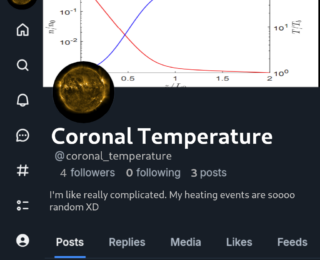
Following the coronal temperature profiles of stars
Recent models seem to replicate some funky properties of the Sun’s outermost atmosphere. Today’s authors investigate what that could mean for other stars!
Hello 2025! What’s up for the New Year?
Amid grand fireworks displays around the globe, as the world ushers in yet another round trip around the Sun, many landmark milestones and exciting events are lined up in astronomy and space exploration in 2025. Today’s bite summarizes what to expect for this year.

Bubbles and Tunnels: Unveiling the Secret Structure of Our Galaxy
The solar system is surrounded by a region containing only a low density hot gas called the Local Hot Bubble. Today’s paper uses new observations from eROSITA to map out the shape of the bubble and learn more about its properties!
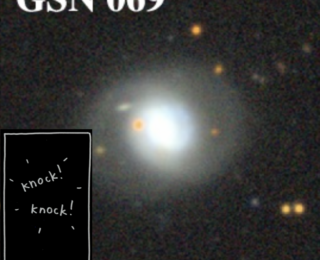
Who’s Home? A Supermassive Black Hole & its Tiny Friends
Can you spot the quasi-periodic eruptions? Come to today’s SMBH party to check out what the host galaxy has to do with these cosmic beasts!
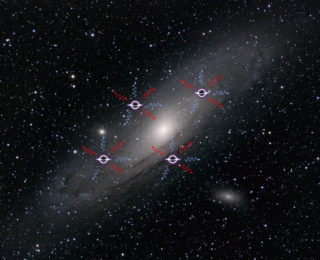
A Light in the Dark: Looking for Bright Black Holes as Dark Matter
If extremely low-mass primordial black holes are lurking in our galaxy, they should glow white hot with Hawking radiation. Today’s authors explore whether we can use this fact to tease out their presence.
Beyond: The SuperComputing Conference (for Astronomers)
One Weird Trick To Leave Academia Forever And Fight Your Way Into The Tech Job Market
Beyond astro-ph
Astronomy beyond the research
No Results Found
The page you requested could not be found. Try refining your search, or use the navigation above to locate the post.
Navigating careers in astronomy
Career advice
Running your first SPH simulation
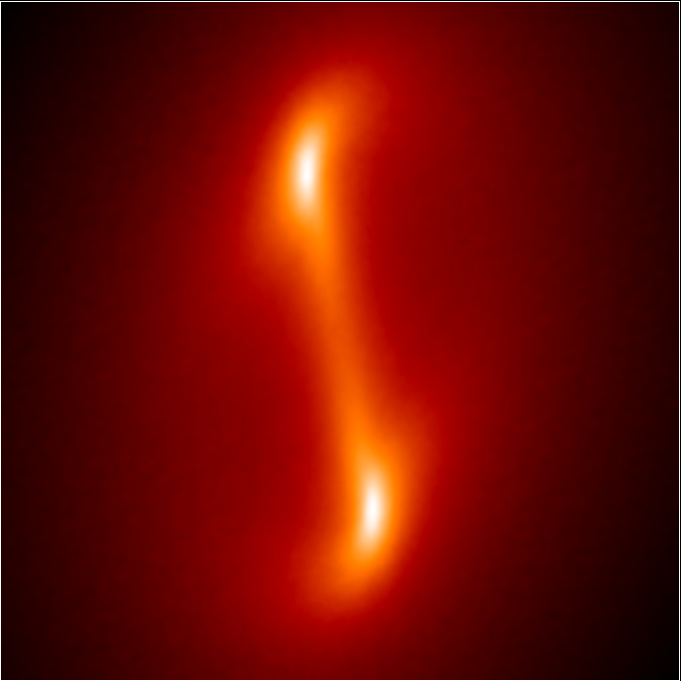
Today’s astrobite will be a sequel to a post I wrote a few months ago on using the smoothed particle hydrodynamics (SPH) code Gadget-2. In the first post, I went over how to install Gadget and showed how to run one of the test cases included in the Gadget distribution. Today, I’d like to show how to set up, run, and analyze a simple hydrodynamics test problem of your own. Perhaps one of the oldest topics in astrophysics is the study of binary stars. In 1767, the British natural philosopher John Michell used an early form of statistical analysis to show that the number of closely separated pairs of stars in the night sky is far higher than what one might expect from a randomly distributed field of stars. How do these binary pairs form? Modern astrophysics offers several answers, and in today’s post, we will focus on one possible mechanism: the direct formation of a binary star pair by the collapse of a rotating isothermal sphere of gas. We will approach this problem using a formulation first proposed by Alan Boss and Peter Bodenheimer in 1979 and later modified by Andreas Burkert and Peter Bodenheimer in 1993. The so-called standard isothermal test case models the gravitational collapse of a one solar mass, spherical, rigidly rotating molecular cloud with a small-amplitude m = 2 density perturbation. If we wish to simulate the collapse, we first need to set up the initial conditions for the simulation. You can obtain initial conditions files from the following url: http://ngoldbaum.net/astrobites/SICtest.tgz. You can also generate your own initial conditions using the supplied codes. To summarize, the…
AAS #218: Boston or bust
Over the past three and a half days, I joined astronomers from all over the world for the 218th meeting of the American Astronomical Society. The AAS holds two major meetings every year, one in the winter and one in the summer. This year’s summer conference in Boston just wrapped up and in this astrobite I’ll report on two of the talks I attended.
Jonathan Fortney: Scientific Temperament
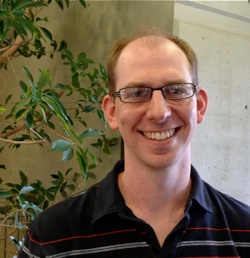
Today I have the pleasure to introduce one of our faculty members here at UC Santa Cruz to the Astrobites community. Jonathan Fortney is an expert on the atmospheres and interiors of giant planets and has a unique perspective on the process of science in a newly emerging field. Instead of a specific scientific topic, Jonathan wanted to impart some wisdom on the criteria he uses to choose a research topic to work on.“For my scientific temperament I needed a field that was more controversial, more open-ended and new, where quick was useful and sloppy did not matter too much because it would all change soon anyway.” –Ed Salpeter (ARAA, 2002, 40:1–25)When scientists write about their own work and their careers, you can learn a lot from their experience. Given all the writing that scientists do, it is unfortunately rare for someone to actually write about the science they do, rather than just reporting results and ramifications. There is precious little written about why a certain problem was chosen or why the astronomer found it interesting in the first place.From time to time I like to read through what I call the “looking back on my career” article in the Annual Review of Astronomy and Astrophysics. There is one of these every year. They get a famous astronomer to write about the highs (and lows?) of their careers. I’ve read a several of these, from giants in the field like Ed Salpeter and Al Cameron. You get a good feel for what the exciting questions were at various points of their careers, and how that changed the focus of…
More posts by category