
Featured Astrobites
Our latest posts

The Oldest Starlight
What if some of JWST’s most extreme high-redshift galaxy candidates aren’t galaxies at all, but the explosive deaths of the very first stars?

Global Calm, Local Chaos: How AGN-Driven Cosmic Rays Reshape Galaxies from the Inside
Massive galaxies all seem to end up quiet and quenched—but the physics inside them can look wildly different. This story explores how AGN-driven cosmic rays reshape galaxies from the inside out, changing local conditions without altering their ultimate fate.

It’s a bird! It’s a plane! It’s a neutrino observatory calibration source!
Title: Radio emission from airplanes as observed with RNO-G Authors: The RNO-G Collaboration S. Agarwal, J. A. Aguilar, N. Alden, S. Ali, P. Allison, M. Betts, D. Besson, A. Bishop, O. Botner, S. Bouma, S. Buitink, R. Camphyn, J. Chan, S. Chiche, B. A. Clark, A. Coleman, K. Couberly, S. de Kockere, K. D. de Vries, C. Deaconu, P. Giri, C. Glaser, T. Glüsenkamp, H. Gui, A. Hallgren, S. Hallmann, J. C. Hanson, K. Helbing, B. Hendricks, J. Henrichs, N. Heyer, C. Hornhuber, E. Huesca Santiago, K. Hughes, A. Jaitly, T. Karg, A. Karle, J. L. Kelley, J. Kimo, C. Kopper, M. Korntheuer, M. Kowalski, I. Kravchenko, R. Krebs, M. Kugelmeier, R. Lahmann, C.-H. Liu, M. J. Marsee, Z. S. Meyers, K. Mulrey, M. Muzio, A. Nelles, A. Novikov, A. Nozdrina, E. Oberla, B. Oeyen, N. Punsuebsay, L. Pyras, M. Ravn, A. Rifaie, D. Ryckbosch, O. Schlemper, F. Schlüter, O. Scholten, D. Seckel, M. F. H. Seikh, J. Stachurska, J. Stoffels, S. Toscano, D. Tosi, J. Tutt, D. J. Van Den Broeck, N. van Eijndhoven, A. G. Vieregg, A. Vijai, C. Welling, D. R. Williams, P. Windischhofer, S. Wissel, R. Young, A. Zink First Author’s Institution: Erlangen Centre for Astroparticle Physics (ECAP), Friedrich-Alexander-University Erlangen-Nürnberg; Deutsches Elektronen-Synchrotron DESY Status: Published in the Journal of Instrumentation [open access] Neutrinos: Long-Distance Travelers If, in the middle of an intercontinental flight, you’ve ever looked out your window over, say, Greenland and wondered how this trip still isn’t over…just remember that your long-distance travels have nothing on the neutrino’s. This particle only very rarely interacts with other matter, so it can travel far across…

I Survived a Type Ia, and All I Got Was This Kick Velocity
Some type Ia supernovae involve a companion star that somehow survives the energetic explosion. What can we learn from these companions?

Low, Low, and Lower: A Binary Ultracool Dwarf System is Detected at 340 MHz
The lowest mass stars have been well-studied across the mid and high frequency radio bands. However, lower frequencies can reveal larger-scale magnetic structures and may even be the key to the first direct radio detection of an exoplanet. Learn about the first detection of a low-mass ultracool dwarf–one or both stars in a binary system–at the low frequency of 340 MHz!

Astrobites at AAS 247: Day 4
Astrobites covers the final day of AAS 247.
Beyond astro-ph
Astronomy beyond the research
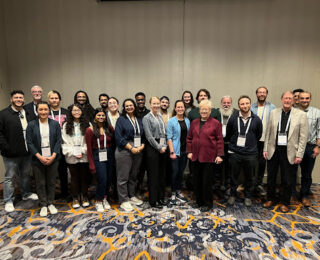
Deepening Broader Impacts: Mentorship, DEI, and Career Advancement at AAS 245
From Tyler Smith: The National Osterbrock Leadership Program (NOLP) is an initiative that equips early-career astronomers with the tools to integrate mentorship, leadership, and diversity, equity, and inclusion (DEI) into their professional practices. Catch their session at #AAS245.

AAS Diversity Committee Wrapped 2024
In the leadup to AAS 245, we asked the AAS diversity committees what they’ve been up to for the past year!

Beyond: The SuperComputing Conference (for Astronomers)
One Weird Trick To Leave Academia Forever And Fight Your Way Into The Tech Job Market
Navigating careers in astronomy
Career advice
Meet the AAS Keynote Speakers: Prof. Jocelyn Bell Burnell
Today we interview astronomer Dr. Jocelyn Bell Burnell for her plenary talk at #AAS240!
Meet the AAS Keynote Speakers: Prof. Jane Greaves
We chat with Professor Jane Greaves about her path to discovering phosphine on Venus! Learn more at her Fred Kavli plenary lecture at #AAS240!

Developing an inclusive culture for LGBTQ+ physicists
People of all identities deserve a supportive and welcoming climate to work and learn in. Today’s article and paper, in Physics Education Research, discusses the impacts of department climate on LGBTQ+ people in physics.
More posts by category