
by Will Golay | Jan 12, 2026 | Daily Paper Summaries
The lowest mass stars have been well-studied across the mid and high frequency radio bands. However, lower frequencies can reveal larger-scale magnetic structures and may even be the key to the first direct radio detection of an exoplanet. Learn about the first detection of a low-mass ultracool dwarf–one or both stars in a binary system–at the low frequency of 340 MHz!
by Will Golay | Dec 22, 2025 | Daily Paper Summaries
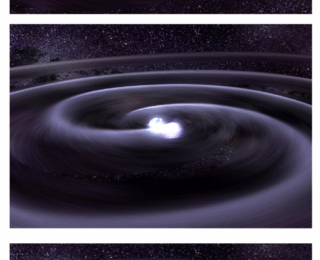
Half of all stars are in binaries. Stars that end their lives as the most massive white dwarfs often also have another distant star orbiting an inner binary. Could these tertiary stars play a role in merging the inner binaries into remnant objects that emit fast radio bursts?

by Will Golay | Dec 16, 2025 | Daily Paper Summaries
Light is composed of an electromagnetic wave, encoding information about its specific orientation. Learn how observing polarized optical light from one of the most extreme types of events in the universe enables us to study the origin of its light!
by Will Golay | Dec 11, 2025 | Daily Paper Summaries, PRJ
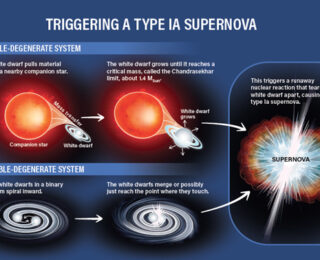
How standardizable of a candle are Type-1a supernovae? Learn how differing initial conditions causing a white dwarf to exceed the Chandrasekhar limit and explode might reconcile independent measurements of the Universe’s expansion rate and history.

by Will Golay | Nov 19, 2025 | Daily Paper Summaries
We’ve known about pulsars for more than fifty years, but what about other kinds of repeating radio sources? Learn how this white dwarf binary might be the first peek into a new class of radio lighthouses!
