
Title: Effects of Varied Cosmic Ray Feedback from AGN on Massive Galaxy Properties
Authors: Charvi Goyal, Sam B. Ponnada, Philip F. Hopkins, Sarah Wellons, Jose A. Benavides, Kung-Yi Su
First Author’s Institution: TAPIR, California Institute of Technology, Mailcode 350-17, Pasadena, CA 91125, USA
Status: Submitted to PASP (available on Arxiv)
For decades, astronomers have grappled with the quenching problem: although theory predicts that massive galaxies should keep forming stars, observations reveal that many are instead “red and dead,” producing very little new starlight. This means something is stopping gas from cooling and collapsing into stars more efficiently than expected. While energetic feedback from stars and supermassive black holes is known to play a key role, exactly how these processes shut down star formation in the most massive galaxies remains an open question.
One leading candidate for this powerful feedback is active galactic nuclei (AGN), supermassive black holes that actively swallow matter and release enormous amounts of energy. How this energy is transferred to the surrounding gas, however, is still not fully understood. AGN can affect their host galaxies not only through radiation and fast outflows, but also by producing vast numbers of cosmic rays: high-energy particles that interact strongly with the interstellar gas. In this study, the authors explore whether different cosmic ray properties can reproduce the observed behavior of massive galaxies, and whether these comparisons can help pin down how cosmic rays move through and influence galactic gas.
To explore this idea, the authors use high-resolution cosmological “zoom-in” simulations from the Feedback In Realistic Environments (FIRE-3) project. In these simulations, a fraction of the energy released by accreting supermassive black holes is injected into galaxies as cosmic rays. The study compares two models for how these particles move through galactic gas: the CD model, where cosmic-ray transport depends only on particle rigidity (how easily magnetic fields can bend their paths), and the VD model, where transport also responds to local gas conditions. By simulating galaxies across a wide range of masses and varying the efficiency of cosmic-ray injection, the authors examine how cosmic rays shape the large-scale evolution of massive galaxies.
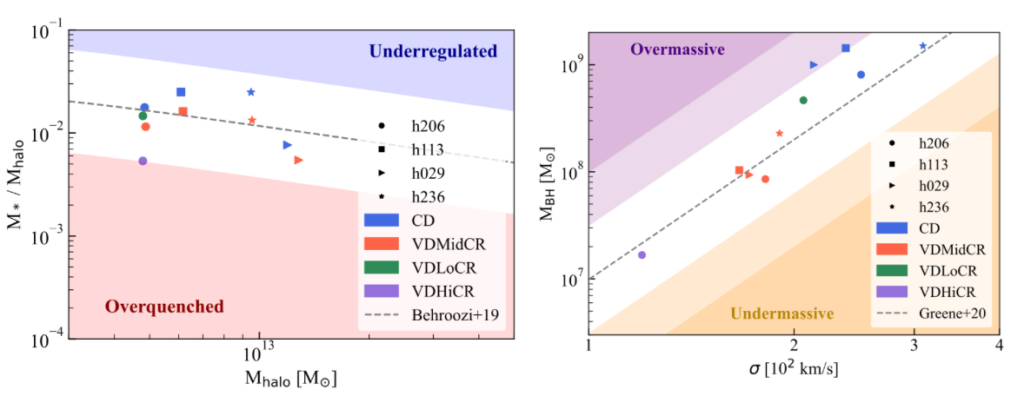
Figure 1. Global scaling relations for the simulated galaxies. The left panel shows the stellar mass–halo mass relation, while the right panel shows the black hole mass–velocity dispersion (M–σ) relation, for different cosmic-ray transport models (CD, VDLoCR, VDMidCR, and VDHiCR, shown in different colors) and halo masses (h206, h113, h029, and h236, shown with different markers). All models produce realistic supermassive black hole masses and closely follow the observed empirical scaling relations, regardless of the details of cosmic-ray transport.
At the biggest-picture level, the simulated galaxies behave much like real ones. Regardless of the details of cosmic-ray physics, they follow well-known observational trends, such as how stellar mass relates to dark matter mass surrounding the galaxy and how a galaxy’s central black hole mass correlates with the motions of its stars. Importantly, all of these galaxies are either already quenched or in the process of shutting down star formation, no matter which cosmic-ray model is used. In Figure 1, the authors also zoom in on the VD transport model, testing cases where only a tiny fraction (0.01%, called LoCR), a moderate fraction (0.1%, MidCR), or a larger fraction (0.3%, HiCR) of black hole energy is converted into cosmic rays. Surprisingly, these global relationships barely change. Neither the choice of transport model (CD versus VD) nor the efficiency of cosmic-ray injection leaves a clear imprint on these large-scale trends. In other words, looking only at global galaxy properties is not enough to tell different cosmic-ray feedback mechanisms apart.

Figure 2. Radial profiles of the volume-weighted cosmic ray energy density (top panel) and gas number density (lower panel) at different snapshot times. The VD (green, orange, and purple) models have increasingly flatter profiles over time compared to the CD (blue) model in both the CR energy and gas number density. Surprisingly, the model with highest CR injection efficiency does not produce the highest CR energy density. This radial profile shows that the detailed CR transport physics and injection rate can produce gas properties distribution varying by orders of magnitude.
While the different models look nearly identical when viewed through global galaxy trends, their internal gas properties tell a very different story. Figure 2 reveals how both cosmic-ray energy density and gas density change with distance from the galaxy center over time. By the final snapshot, these quantities can differ by orders of magnitude between models. This dramatic spread suggests an exciting possibility: detailed observations of gas and cosmic rays inside galaxies, rather than just their overall masses, could help distinguish between different cosmic-ray transport models and injection efficiencies.
A closer look shows that the radial trends of cosmic-ray energy density and gas density has similar trends, which makes sense. Cosmic rays exert pressure on their surroundings, and that pressure is tightly linked to how gas is distributed. The real surprise comes from the model with the highest cosmic-ray injection efficiency, VDHiCR, which does not end up with the highest cosmic-ray energy density. The reason is that injecting more cosmic rays also strengthens feedback, which in turn suppresses gas falling onto the central black hole and reduces the total energy available to produce cosmic rays. This non-linear behavior highlights a self-regulating loop in AGN activity, where more powerful feedback ultimately limits itself.
Taken together, these results highlight both the promise and the challenge of understanding how cosmic rays shape massive galaxies. While different cosmic-ray models can all reproduce the broad, global properties of quenched galaxies, their internal structures and energy distributions can look strikingly different. This means that the key to unlocking cosmic-ray physics may lie not in galaxy-wide averages, but in detailed, spatially resolved observations of gas and cosmic ray energy inside galaxies. By connecting these small-scale signatures to simulations, studies like this bring us closer to uncovering how supermassive black holes regulate themselves—and ultimately decide when galaxies stop forming stars.
Astrobite edited by Shalini Kurinchi-Vendhan.
Featured image credit: the Feedback In Realistic Environments (FIRE) collaboration.
