
Prospecting for C IV at high redshifts

Prospecting for C IV at high redshifts

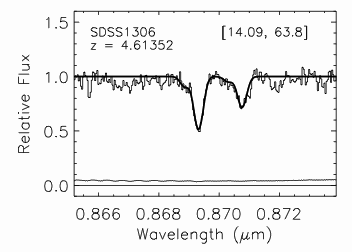
As the light from these distant objects propagates towards us, it encounters metals in the intervening IGM that superimpose absorption lines on the quasar’s spectra. By looking for metal absorption lines in the spectra of high redshifts quasars, we can learn about the metal content of the IGM. This paper by Simcoe et al. considers the spectra of 7 quasars with redshifts greater than 5.5. The moderate-resolution, near-infrared spectra were obtained over the past year with the FIRE spectrograph.
A Galactic-Scale Disappearing Act: Lyman-Break Galaxies at z ~ 8-9

A Galactic-Scale Disappearing Act: Lyman-Break Galaxies at z ~ 8-9

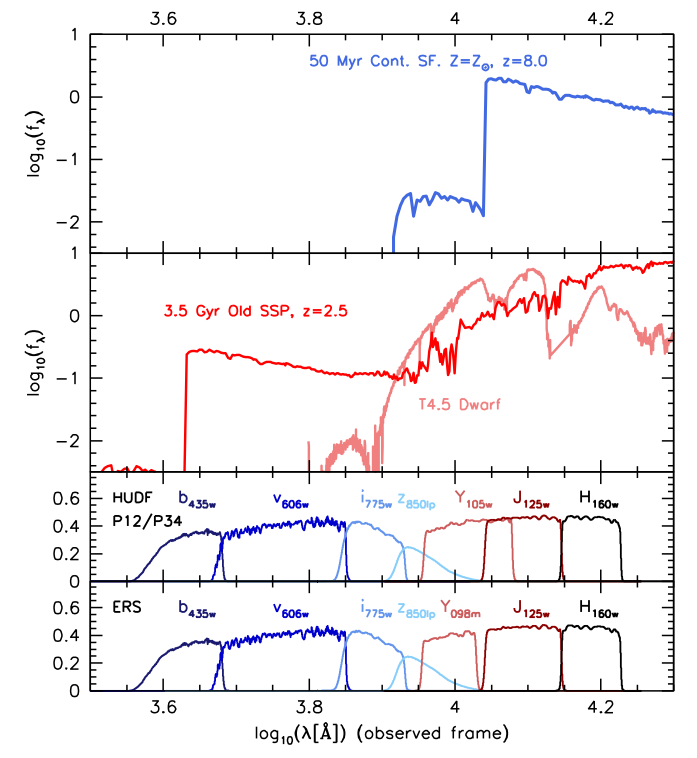
Neutral hydrogen is very effective at absorbing radiation with wavelengths shorter than 91.2nm. This has become known as the Lyman limit. In this study, the authors use the Lyman-break technique to search for galaxies with z ~ 8 – 9. They use the latest Hubble WFC3 near-infrared data to look for large (Y-J) colors or, “Y-drops”, in a larger field than previous studies due to the camera’s larger field and better infrared sensitivity.