
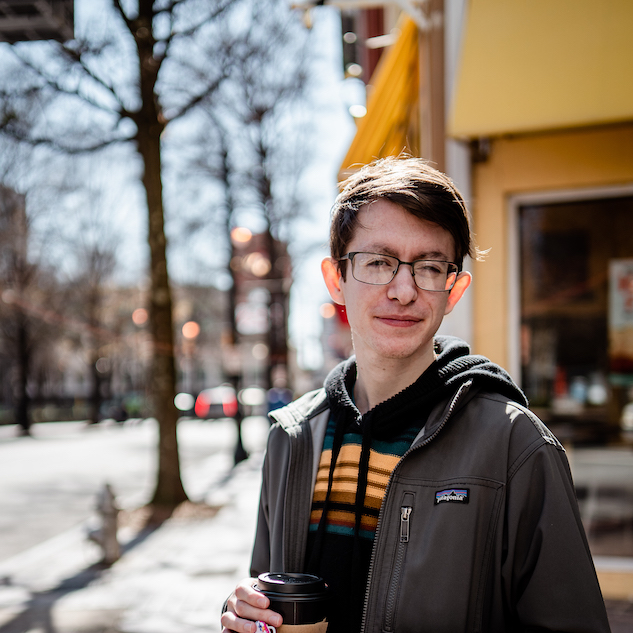
Welcome to the Astrobites Transgender in Astronomy series! To celebrate Pride Month this year, Astrobites will be publishing an interview with one transgender astronomer every week highlighting their experiences both in the field of astronomy and as a transgender person in today’s society. This week’s interviewee is Dr. Eliot Halley Vrijmoet, a postdoctoral teaching and research scholar at Smith College in Massachusetts! Eliot uses he/him pronouns.
A Balancing Act
Eliot began his journey not as an astronomy student, but as a budding physicist at Reed College in Portland, Oregon. Reed didn’t offer any astronomy classes, so he had to get creative when exploring the cosmos. “I wasn’t able to get any exposure to astronomy except looking stuff up on Wikipedia and thinking ‘this seems like the coolest part of physics’” Eliot explains. “As I was nearing the end of my degree, I thought astronomy was really cool and that I wanted to stay in academia.” However, his lack of formal education and research experience in astronomy worried Eliot. Would he even be accepted into a graduate program? At this point, he also started to think that he was transgender. It quickly became a balancing act between his future and his identity. “As I was writing my undergrad thesis, I thought it would be cool to apply for grad school, but I didn’t want to do it right then because again, I didn’t think I had the profile for it and this was right around the time I was trying to figure out all the coming out stuff. It was challenging and frankly, too many things on my plate to worry about.”
Eliot was determined though, and decided to pursue a Master’s degree after taking a gap year. After applying to several schools, he was accepted into San Diego State University (SDSU). “I had reached out everywhere I had applied to, because I was worried about my legal documents not matching up with what I identified as. I was very impressed with SDSU’s response, so it seemed like a good match both in terms of the program and the environment.” The month before he moved to SDSU, he was also able to get top surgery. “I knew from the moment I woke up after the surgery that it was the right thing to do. It was really a new experience being so sure about something.” He spent his first semester of grad school in recovery as a research assistant. After two years of grad school at SDSU, Eliot went on to finish his Master’s and get his PhD from Georgia State University in Atlanta.
Billiards in Space
While at SDSU, Eliot started working on binary stars. He liked it enough that, when he got into the Georgia State PhD program, he settled on working on astrometry. “I really liked classical mechanics, so for me, it was kind of like thinking about billiard balls in space and that was perfect because I liked the simplicity of it.” Eliot is an expert in ground-based astrometry and is a part of the RECONS (Research Consortium on Nearby Stars) group. He works on astrometric data of low-mass stars in the Solar Neighborhood, providing new insights into the star systems like discovering their companions and determining their orbits. “Astrometry is a very fun technique for taking data because you switch targets every 20 minutes or so. You have to figure it out on the fly, so it’s a fun game.”
Finding the Joy
When starting both his Master’s and PhD, Eliot had doubts about his experience in a new environment. “It was interesting going to a new place because with new people, you never know what they’re going to perceive you as. I got into this terrible habit of focusing on others’ perceptions of me and my gender. It was a very hard habit to let go of. […] I was still trying to figure out how people were reading me, even though they were getting the pronouns right.” On the topic of his PhD advisor Dr. Todd Henry, Eliot said that “He responded to my questions like a peer, rather than in a punitive way, and this helped shift my views on authority in a positive way. We ended up going to Chile to observe for ten nights straight, and we had a lot of very good conversations. He was doing his best to learn everything, so we really connected.”
E.H.V. : “The rest is kind of history. I got deeper into my research and I really liked it. There’s hardly anyone doing astrometry. I didn’t appreciate it at first, but now it’s so interesting to be one of the only people who do it. It’s going to be super fun next year with Gaia Data Release 4 and time-series astrometry. I got to learn cool, niche skills, delved deeper into mentorship with the other graduate students, got married to my partner, {and} my parents were becoming very supportive. I really was starting to enjoy life.”
After graduating with his PhD from Georgia State, Eliot is now a postdoctoral teaching and research fellow at the Five Colleges Consortium located in Massachusetts’ Pioneer Valley Region. He primarily works at Smith College, where he continues his astrometric work and teaches hands-on observational astronomy. This year, while entering into his final year at Smith, Eliot and his partner are also expecting a baby. “I said I wanted to have a child someday and people would say ‘isn’t that the opposite of what you’re trying to do?’ They would see it as being trans was trying to get to a certain destination. Whereas for me, I’ve always been kind of in-between, gender wise. It’s always felt very natural. I was very stressed at first, because I was worried about what I was going to wear and how that would affect how well I passed. […] in practice, it’s actually been very smooth! It’s been very cool, you know, I just feel like I’m living life and I don’t feel the need to be hiding or disguising who I am. It’s been really freeing.”
Advice for students:
“It’s a lot different doing all this now than when I started coming out 15 years ago. The general public is so much more aware of transgender people and this has had an amazing effect when coming out to people. People here ask me directly about these issues now and it’s amazing. It’s something that never would have happened 15 years ago. As the younger generation gets older and older, we’re only going to get more and more people who are aware and care about these issues. And the other thing is, so much of success in this field is based on persistence. Not giving up, whether it’s your project, your program or anything else. You can really set yourself up for future success, not by being the best, but by continually showing up. It’s hard to keep showing up, but it’s the best way to get people to go to bat for you, even when you’re not in the room. I would implore people to keep on going at things, even if it feels like it’s going terribly, because even the terrible things count.”
Edited by Drew Lapeer and Sahil Hegde
Featured photo credit: Dr. Eliot Halley Vrijmoet

Congratulations on your work and the new addition – so great to hear about your journey. Thank you for sharing.