
Authors: Sunao Sugiyama, Masahiro Takada, Naoki Yasuda, and Nozomu Tominaga
First Author’s Institution: Kavli Institute for the Physics and Mathematics of the Universe (WPI)
Status: Available on arXiv [open access]
Primordial Black Holes (PBHs) aren’t like the black holes that we’re used to — while typical black holes form from the death of massive stars, PBHs are a theoretical type of black hole that formed from the collapse of primordial density fluctuations in the very early universe. These black holes could be as lightweight as an asteroid! PBHs have never been definitively observed, but they could be a non-negligible fraction of what makes up dark matter.
But if these black holes are so tiny, how can we ever hope to observe them? The answer is microlensing. When a PBH passes in front of a background star, the PBH’s gravitational field would act like a tiny magnifying glass and briefly increase the background star’s brightness. By observing this brief jump in brightness, we can learn more about the object that caused it. Today’s authors observed the Andromeda Galaxy for nearly 40 total hours to search for microlensing events caused by PBHs.
The authors used the Subaru Telescope’s Hyper Suprime-Cam (HSC) on ten nights spanning from 2014 to 2020. HSC’s field of view is roughly the same size as Andromeda on the sky, which means that observations with HSC maximize our sensitivity to microlensing events in that galaxy.
During each night of observations, the authors took successive 90-second exposures of Andromeda. For each star that changed in brightness during the night, they created a light curve, which is a graph of the star’s brightness over time (like in Figure 1).
Bad data, variable star, or primordial black hole lensing?
However, microlensing definitely isn’t the most common reason that a star would change in brightness — a star can also flicker in images because of bad atmospheric conditions, or the star could just be a variable star (which intrinsically changes in brightness over time). So how can we tell these effects apart from PBH microlensing?
If a star was microlensed by a foreground PBH, its light curve should have a single peak and be symmetrical on either side of it (like the purple line in Figure 1). The authors of today’s paper got rid of any light curves that didn’t follow this pattern.
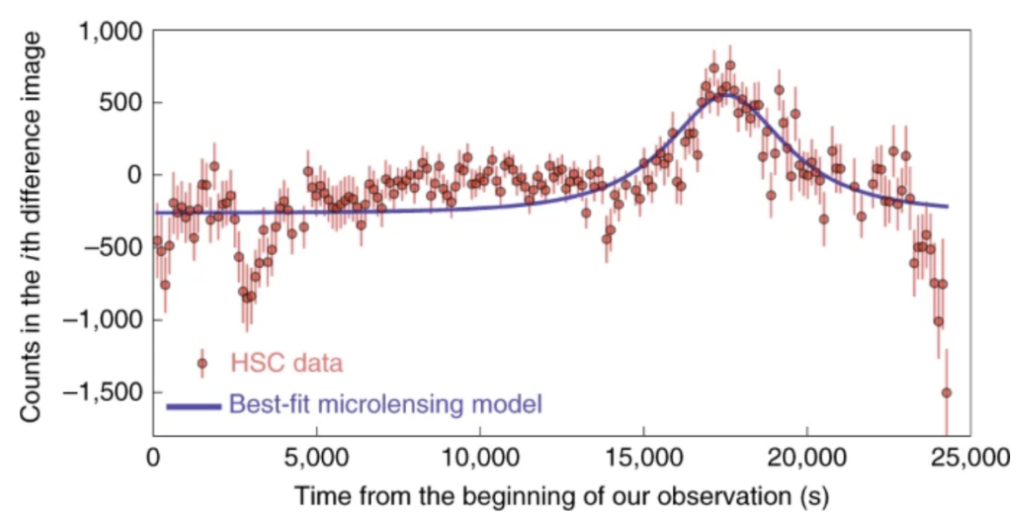
In order to remove the light curves impacted by weather, they calculated the correlation between features in the light curve and the atmospheric seeing. The authors tossed out any light curves that showed a high degree of correlation.
It’s incredibly unlikely that the same star could have gotten microlensed by not just one, but two PBHs during the ten observation nights. So if a star showed multiple brightness peaks, it was probably a variable star — today’s authors removed these events from their sample as well.
Finally, the authors required that each microlensing event should magnify their star’s baseline brightness by at least 1.34x. After going through their ten days of data, today’s authors found a total of twelve possible PBH microlensing events!
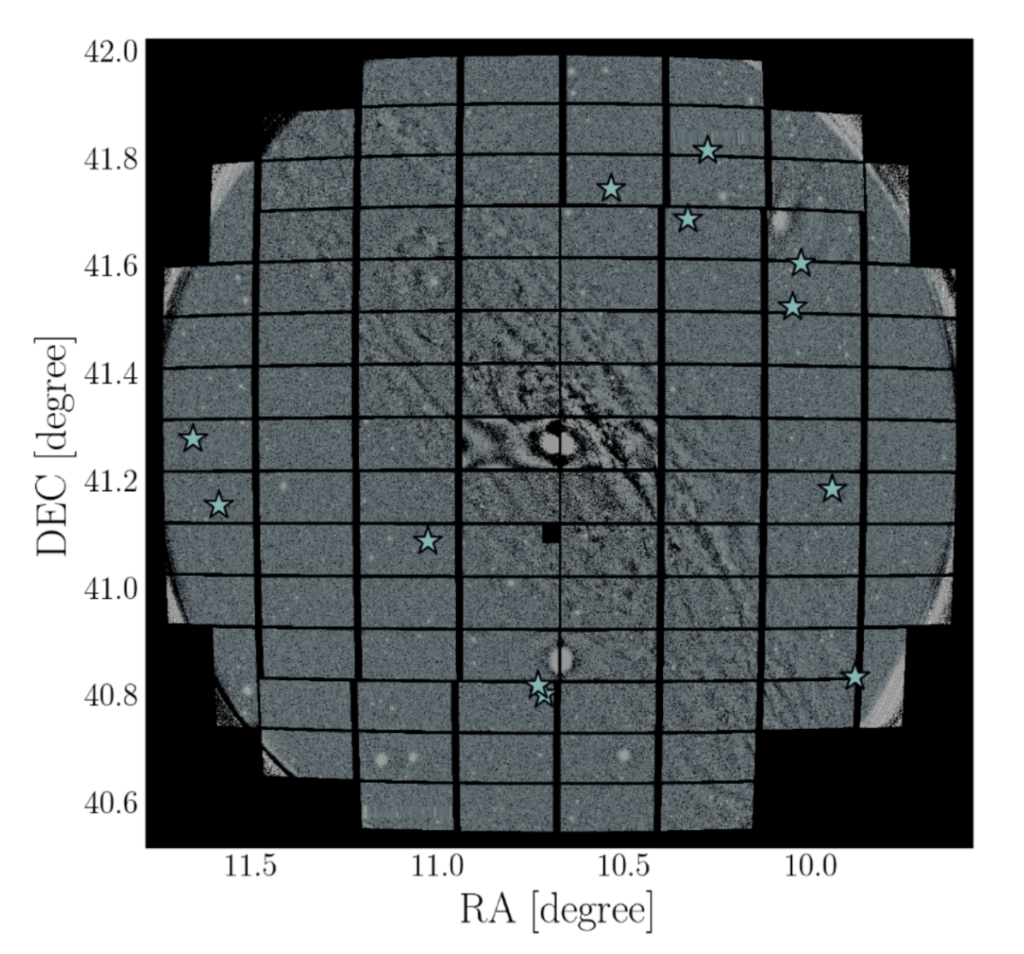
The number of PBH microlensing events can tell us about the abundance and the masses of PBHs
In order to compare the authors’ observations with our theoretical expectations, the authors had to estimate the efficiency of their detection strategy. They did this by creating mock light curves of microlensing events and seeing whether or not they were able to correctly identify them, and then used this to perform completeness corrections on the number of PBHs they observed.
The authors were able to use the shapes of the observed light curves to estimate the masses of the PBHs. If all twelve of the PBH microlensing events that they detected were real, this would point to the masses of PBHs being between 10-7 to 10-6 solar masses, and PBHs would account for 1% to 10% of dark matter. If all of their microlensing events were false positives, we’d only be able to place an upper limit on the abundance of PBHs, which is shown in Figure 3.
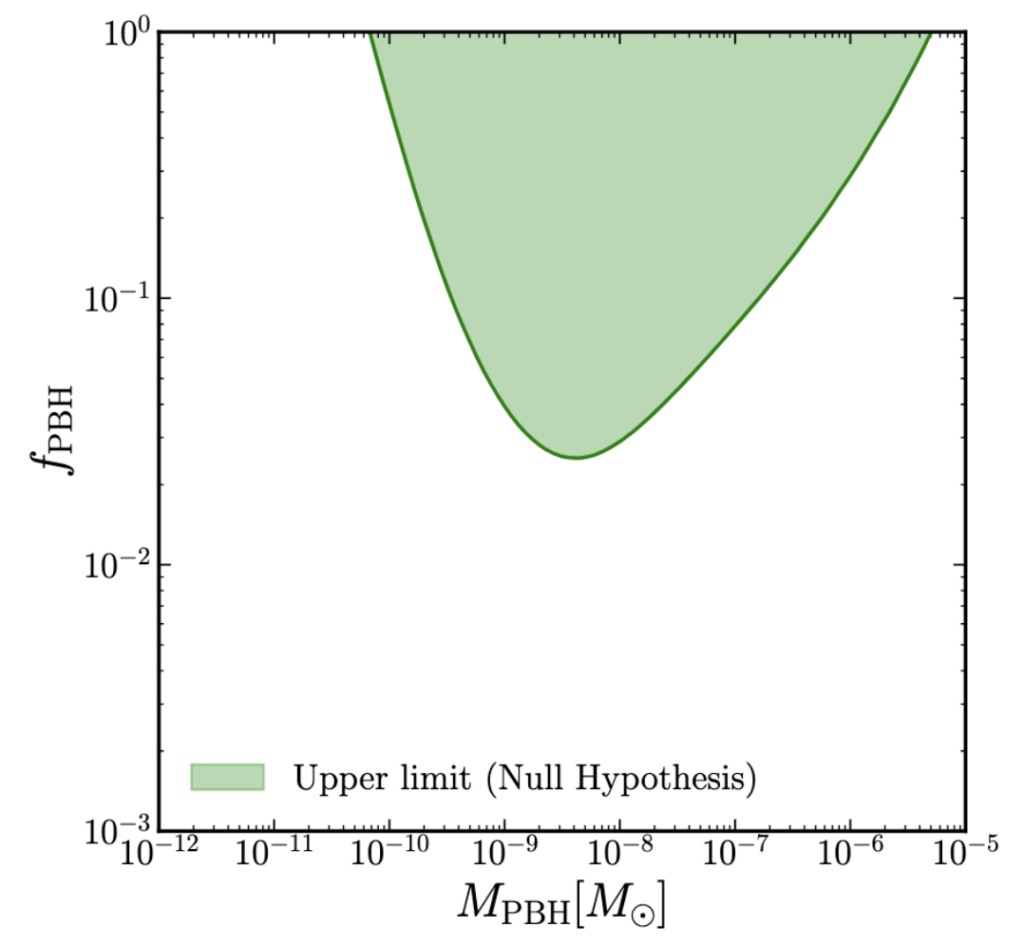
However, these numbers don’t agree with upper limits placed by previous PBH microlensing surveys carried out with the Subaru Telescope and the Optical Gravitational Lensing Experiment (OGLE), and it’s unclear exactly why this is happening.
Future telescope surveys will provide the perfect opportunity to observe PBH microlensing
One caveat of today’s study is that the authors only observed Andromeda with an r-band filter. Microlensing occurs in all wavelengths of light, so having observations with multiple filters would have allowed today’s authors to more accurately remove variable stars from their sample. Also, this study’s microlensing detection method relied on pixel-level differences in brightness, which can be very dependent on atmospheric conditions.
Regardless of these caveats, today’s paper shows that monitoring nearby galaxies for microlensing events can be a powerful way to detect the influence of PBHs, and future surveys with the Nancy Grace Roman Space Telescope and the Vera C. Rubin Observatory will allow us to further explore the existence of PBHs.
Astrobite edited by: Veronika Dornan
Featured image credit: Brody Wesner/Wikimedia Commons
