
Paper title: Resolving the black hole sphere of influence in a hyper-luminous obscured quasar at redshift 4.6
Authors: Mai Liao, Roberto J. Assef, Chao-Wei Tsai, Manuel Aravena, and collaborators
First Author’s Institution: National Astronomical Observatories, Chinese Academy of Sciences, Beijing, China
Status: Submitted, on Arxiv
Observations show that the mass of a galaxy’s central supermassive black hole (SMBH) is tightly linked to properties of the galaxy itself, like how massive it is or how fast the stars inside it move. This suggests that black holes and galaxies grow together, termed co-evolution (read more here), influencing each other’s growth over time. If our black hole mass measurements are off, it could throw off our whole picture of how galaxies and their black holes coevolved over billions of years. In today’s paper, the authors attempt to directly measure a bright SMBH formed just 1.3 billion years after the Big Bang.
In active galaxies, the supermassive black hole (SMBH) is surrounded by an accretion disk that shines brightly as material spirals in. Surrounding this disk is the broad-line region (BLR), a zone of fast-moving gas clouds emitting broad spectral lines. These clouds respond to changes in the light from the accretion disk, but not instantly.
When the brightness of the accretion disk changes, the emission lines from the BLR also change, but with a time delay. This delay corresponds to the light travel time between the disk and the BLR, giving astronomers a way to measure the distance, or size, of the BLR. This technique is called reverberation mapping (read this bite).
By combining the size of the BLR with the speed of the gas (inferred from the width of the emission lines), astronomers can estimate the mass of the black hole using basic physics. Over time, they found an empirical relationship between the accretion disk’s luminosity and the BLR’s size. This led to the development of single-epoch mass estimation: with just one observation of the disk’s brightness and the gas speed, you can estimate the black hole’s mass. However, this method assumes that the empirical relationship between luminosity and BLR size holds for all black holes, even at different redshifts; an assumption that might not always be valid.
Another method looks at the sphere of influence (SoI), where the black hole’s pull is stronger than anything else, and uses the motions of stars or gas there to weigh it. This method is direct, as it is just Newtonian gravity. We’ve been able to do both kinds of measurements for black holes up to a redshift of about 2, and it turns out that reverberation mapping might be making black holes look heavier than they are!
Thanks to ALMA, astronomers can now try to measure the SoI of black holes at redshifts > 2 using far-infrared light, because lines like [CII] are some of the brightest signals we can see from galaxies. But there have been problems. So far, no one has clearly detected the black hole this way; probably the black holes are smaller than predicted by the single-epoch measurements, or the gas around them often moves in complicated ways due to mergers and outflows. Another possibility is that the gas close to the black hole is over-ionized, leaving less [CII] gas to emit light. These difficulties suggest that the best targets for this kind of measurement are very bright, heavily obscured quasars with massive black holes. Brightness would make the signal stronger, obscuration would protect the gas from being over-ionized, and a bigger black hole would have a larger SoI, making it easier to detect.
The new study focuses on a fascinating target: WISE J224607.6-052634.9 (W2246-0526 for short). This quasar is the most luminous obscured quasar known when the universe was just 1.3 billion years old. W2246-0526 is a chaotic mess: it’s in the middle of a cosmic merger, with streams of dust and gas connecting it to three neighboring galaxies. Its extreme brightness and thick layers of dust make it ideal for [CII] observations; the dust shields the gas from being over-ionized. Single-epoch measurements indicated that the black hole weighs about 4 billion times as much as the Sun.
The authors of the paper created elliptical annuli around the source to gather spectra at progressively larger radii. They then fitted multiple Gaussian functions to model the velocities of the rotating galaxy and outflowing gas. As shown in Figure 1, the influence of the SMBH becomes dominant within a radius of 1.15 kpc. The models that best capture the data suggest that the SMBH mass is approximately 6 billion times that of the Sun, a value notably larger than the previous single-epoch estimate.
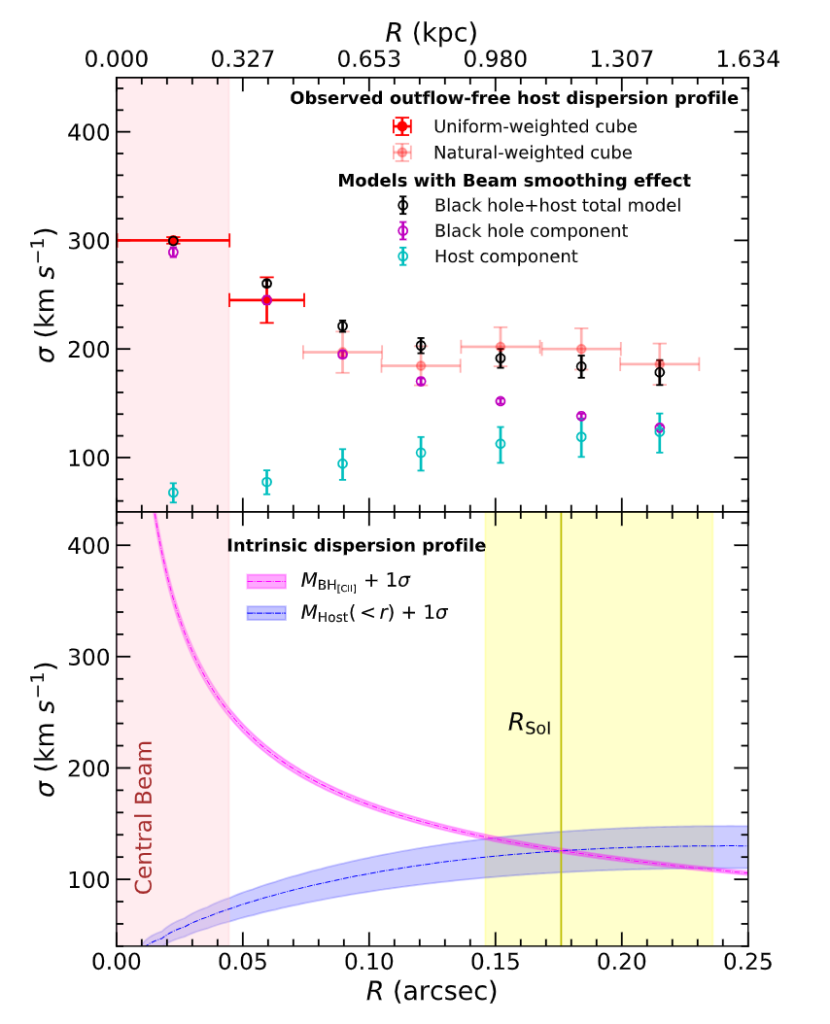
This is exciting because it’s one of the first successful direct measurements of a supermassive black hole’s mass in the early universe! Though there are still big uncertainties, it shows that, at least for very massive and obscured quasars, we can test the single-epoch measurements we’ve been relying on. With this, we’ll be able to weigh more of these cosmic monsters and piece together the epic story of how black holes and the galaxies they live in grew up together.
Astrobite edited by Maggie Verrico
Feature Image credit: NASA, ESA and J. Olmsted (STScI)
