
Paper Title: Episodic super-Eddington accretion as a clue to Overmassive Black Holes in the early Universe
Authors: Alessandro Trinca, Rosa Valiante, Raffaella Schneider, Ignas Juodžbalis, Roberto Maiolino, Luca Graziani, Alessandro Lupi, Priyamvada Natarajan, Marta Volonteri, Tommaso Zana
First Author’s Institution: Como Lake Center for Astrophysics, Dipartamento di Scienza e Alta Tecnologia, Università degli Studi dell’Insubria, Como, Italy
Status: Submitted to Astronomy & Astrophysics [open access]
What Do We Mean by “Overmassive”?
Astronomers have been studying black holes, objects with such high densities that their gravitational fields are strong enough to prevent light from escaping, for decades. They agree that nearly every known galaxy has a supermassive black hole in the center – a black hole a million or more times more massive than the sun. Astronomers are using advanced telescopes, such as the James Webb Space Telescope (JWST), to look back into the very early universe and study galaxy formation and early evolution. Surprisingly, astronomers have found supermassive black holes in the early universe, and even more surprisingly, they’re much bigger than we expected.
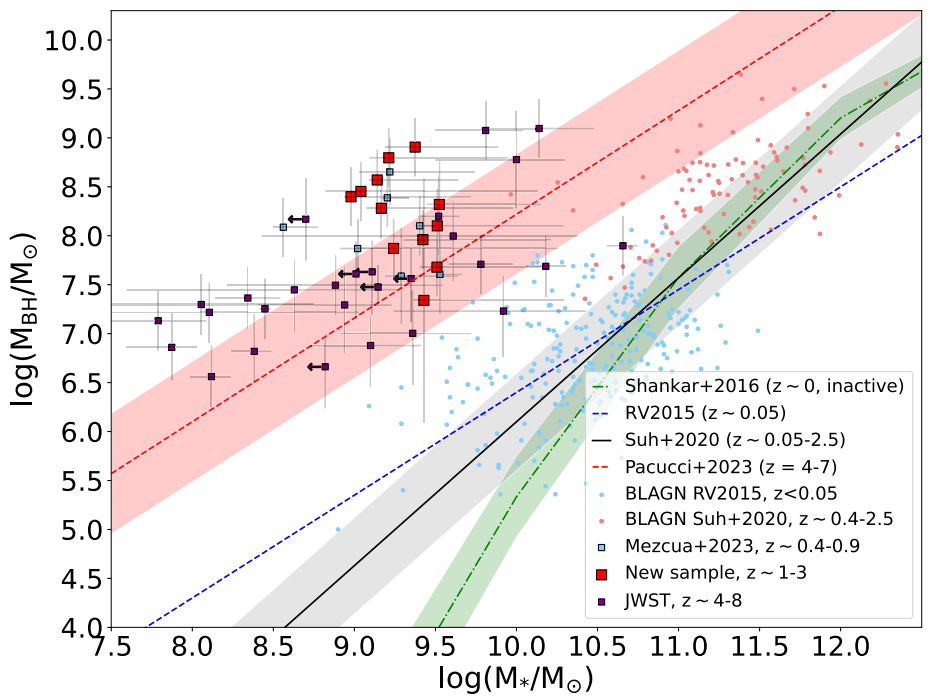
But what exactly do we mean by “big” and “bigger than expected”? For that, we need to look at a well-known relationship between galaxies and their central (supermassive) black holes, known as the MBH–M* relation, shown in Figure 1. The figure highlights that there is a pretty clear correlation between the mass of a galaxy and the mass of its central black hole. However, recent JWST observations suggest that galaxies in the early universe do not lie along this relation. Instead, they tend to lie above and to the left of the local relation, indicating that their black holes are overmassive relative to what the local relation would predict.
So how did these black holes become overmassive? That’s the question today’s authors investigate. There is a theoretical limit to how quickly black holes can grow through accretion called the Eddington limit. Material falling towards the black hole releases its gravitational potential energy as radiation, and the Eddington limit is the point where this radiative energy exerts an outwards pressure that balances the gravitational pull on the infalling material behind it. Too much accretion leads to too much radiation, which slows down further accretion. However, it’s possible that a black hole could accrete at super-Eddington rates for short periods of time. For example, if the accretion is in the form of a disk with radiation jets that direct the radiation away from infalling material, or if a smaller fraction of the gravitational potential energy is converted into radiation, this could lead to conditions where super-Eddington accretion is possible.
Semi-Analytic Modeling
This work relies on the Cosmic Archaeology Tool (CAT), a semi-analytic model for galaxy and black hole growth in the early universe. A semi-analytic model is a model that uses simple but physically-motivated relationships to describe physical phenomena. Instead of performing full cosmological simulations to study these processes in detail, a semi-analytic model often uses the relationships found from simulations to estimate quantities such as star formation rate, gas cooling, and black hole accretion rates. These models can be tuned with measurements from observations to constrain certain parameters.
Today’s authors consider two pathways to forming black holes in the early universe: light seeds and heavy seeds. Light seeds are black holes that form from the deaths of the first generation of stars, called Population III stars. Heavy seeds, also called “direct collapse black holes”, can form from the collapse of very massive stars. Light seeds typically have masses of tens to hundreds of solar masses, where heavy seeds can be hundreds of times more massive. Note that the exact cutoff for “light” vs. “heavy” seeds is a bit arbitrary and will likely depend on which paper you read. For this paper, light seeds can have masses of a few hundreds of solar masses, while heavy seeds have masses of at least 100,000 solar masses.
Once black holes are formed, the authors consider two models for accretion. The first is the Eddington-limited model where black holes cannot accrete above the Eddington limit. The second is the super-Eddington model where black holes are allowed to accrete above the Eddington limit during galaxy mergers, which brings a large supply of gas to the central black hole. The galaxy merger also correspondingly increases the star formation rate as new gas becomes available to form stars.
Feeding Frenzies
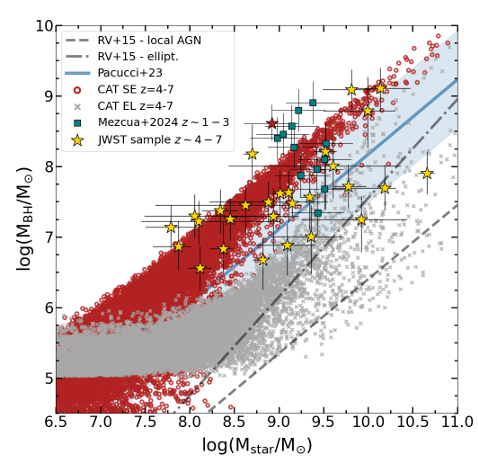
Today’s authors produce two main findings on super-Eddington accretion and overmassive black holes. First, they find that both Eddington-limited and super-Eddington accretion are capable of producing overmassive black holes, as shown in Figure 2. However, it is more likely for super-Eddington accretion to produce an overmassive black hole, which makes sense because black holes can grow more quickly. It’s also worth noting that Eddington-limited accretion can only produce overmassive black holes in galaxies with very few stars because the black holes tend to be less massive.
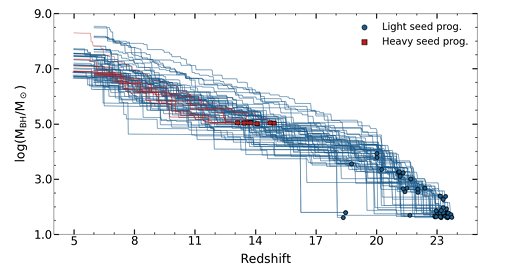
The second main finding is that heavy seeds and light seeds can both produce the same range of final black hole masses, shown in Figure 3. This means that, if all we know is the mass of the black hole at a particular time, it may be all but impossible to determine what the black hole’s seed mass was – it could have been produced by either a light seed or a heavy seed. This plot also highlights that, according to their model, a majority of black holes observed today (~85%) originated as light seeds, while only ~15% originated as heavy seeds. Note that one of the criteria for heavy seeds is that their surrounding halo must be massive enough to form a heavy seed, which doesn’t happen until a redshift of z ≈ 15.
Another important result from this study is that even though most – if not all – black holes will undergo super-Eddington accretion, these growth spurts are very short lived (typically about a million years). This is quantified using a parameter called the duty cycle, which describes how often the black hole is actively accreting as an active galactic nucleus (AGN); today’s authors find that most black holes have a duty cycle of just a few percent. Since their supermassive black holes are only actively accreting a few percent of the time, a similar fraction of black holes are the only ones that exhibit such rapid accretion at any given time. This conclusion agrees with observational evidence of supermassive black hole accretion.
The authors note that while this semi-analytic model can provide valuable insights with limited computational costs, full simulation studies of black hole seeding, galaxy mergers, accretion, and their interplay are necessary to fully understand them. Further modeling of accretion in AGNs and the radiation this produces will also be critical for interpreting observational results from telescopes like JWST, which could change the implications of today’s results.
Astrobite edited by Skylar Grayson
Featured image credit: Wikimedia Commons

