
Title: New Constraints on DMS and DMDS in the Atmosphere of K2-18 b from JWST MIRI
Authors: Nikku Madhusudhan, Savvas Constantinou, Måns Holmberg, Subhajit Sarkar, Anjali A. A. Piette, and Julianne I. Moses
First Author’s Institution: Institute of Astronomy, University of Cambridge, Cambridge, UK
Status: Published in The Astrophysical Journal Letters, Open Access
The exoplanet K2-18 b is making headlines once again. In 2023, a group of researchers led by Nikku Madhusudhan reported on the first tentative detection of a possible biosignature in the atmosphere of K2-18 b, but it was of low statistical significance. A couple years later, this group is now back with new evidence supporting the existence of biosignatures on K2-18 b, this time with a 3σ significance. While the authors do not claim to have robust proof of life on this foreign world, Madhusudhan stated in interviews that this detection provides “the strongest evidence to date of possible biological activity on an exoplanet”. This paper has garnered much media attention for skeptics and alien enthusiasts alike and has led to several concerns raised by other experts in the field. This astrobite will summarize the results of this paper, answer important questions like “are there aliens?” and “how bad does this biosignature smell?”, and discuss some critiques it has drawn.
Using the JWST Mid-Infrared Instrument (MIRI), the authors obtained a transmission spectrum of K2-18 b, which shows how much starlight is absorbed by the planet’s atmosphere as it passes in front of its star. Because every atom and molecule has a unique pattern of wavelengths it absorbs, this transmission spectrum is like a “fingerprint” of every chemical species that exists in an exoplanet’s atmosphere. However, these spectral signatures are very faint and dominated by the much brighter stellar spectrum, making it impossible to detect these chemical species by simply looking at the spectrum. In order to overcome these difficulties, the authors use the common technique of performing an atmospheric retrieval. This technique compares the real spectrum with unknown properties to many model spectra with known properties by using Bayesian inference in order to constrain the chemical and physical parameters of a planet’s atmosphere. They create model spectra with 20 different molecules, including dimethyl disulfide (DMDS), dimethyl sulfide (DMS) and other compounds considered to be potential biosignatures. Using a nested sampling algorithm, i.e. a computational method for Bayesian model comparison, the authors find that data are inconsistent with a model spectrum with a featureless atmosphere, but instead are favored by models that have either DMS/DMDS. The nested sampling algorithm computes the parameter posterior distributions for each of the free model parameters, and finds that out of all the molecules considered, only DMDS and DMS are well constrained (see Figure 1). They conclude that the data therefore only shows notable evidence for these two biosignatures.
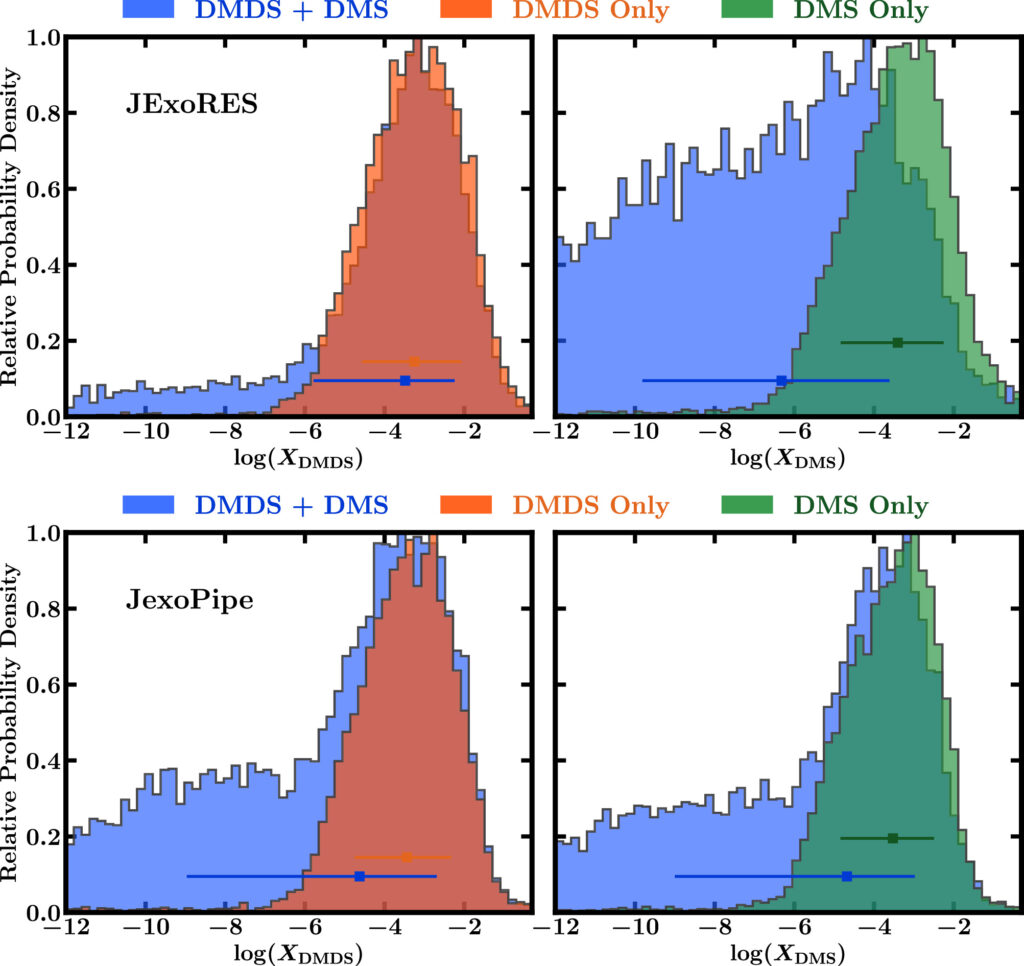
The authors claim that DMDS/DMS are some of the most reliable biosignatures as they present no evidence of alternate abiotic (i.e. non-living) sources. Here on Earth, DMDS is emitted by bacteria, fungi, plants, and animals, while DMS is emitted by marine algae and phytoplankton, making it the most abundant biological sulfur. These sulfur compounds have strong, unpleasant odors often compared to garlic and rotten eggs—and if they exist in K2-18 b’s atmosphere, any hypothetical life forms there would need a high tolerance for stink. So if there exists alien life (with potentially peculiar noses?) on K2-18 b, the authors think we are on the right track to finding it. Other scientists, however, are wary of these claims.
In order to claim that alien life exists, scientists will have to (1) make a robust detection of an atmospheric biosignature and (2) provide evidence that this biosignature has no abiotic sources. Both of these points are called into question by other experts in the field. In a paper recently submitted to arXiv by a group of exoplanet scientists in response to this paper, they claim that Bayesian model comparison does not always translate into robust detections of chemical species in an exoplanetary atmosphere. This is because combinations of different molecules can create highly degenerate models, and because not every combination of molecules is explored in any given atmospheric retrieval, it is certainly possible that the data can be well constrained by different sets of models. In their rebuttal paper, they explore a wider range of possible atmospheric models, and find that models without potential biosignature gases fit the data equally well if not better. Their best-performing model, shown in Figure 2, demonstrates that model spectra including CH4, CO2 and C3H4 fit the data better than one with DMDS/DMS alone. Furthermore, even if DMDS was robustly detected, other scientists have been able to produce it in laboratory simulations of Earth’s early atmosphere with completely abiotic sources.
While this detection might not yet pass the “smell test” as definitive proof of alien life, this paper and the debate it has sparked highlights the importance of understanding and improving upon our current atmospheric models when hunting for biosignatures in distant atmospheres. For now, it seems that K2-18 b will remain a tantalizing target—a world that might harbor life, or just really bad gas.

Astrobite edited by Ansh Gupta
Featured image credit: NASA
