
Title: Prospect for biological evolution on Hycean worlds
Authors: Emily G. Mitchell and Nikku Madhusudhan
First Author’s Institution: Department of Zoology, University of Cambridge, Cambridge, UK
Status: Published in Monthly Notices of the Royal Astronomical Society [open access]
Earth is a planet with a lot of water. The oceans cover around 71 % of the planet’s surface with an average depth of about 4 kilometres. The largest of these oceans is the Pacific. Setting out from the shores of Columbia and heading west, you will have to sail close to twenty thousand kilometres before reaching any significant landmass – halfway around the world in an almost literal sense. In fact, the Pacific Ocean is so expansive that it can fit all the landmass of the entire Earth – from the biggest continent to the smallest island – and still have room to spare. It is safe to say that the oceans of Earth are enormous, and with the continued slow drift of the continental plates, even bigger oceans existed in the past and may exist in the future.
Now imagine if the oceans expanded to cover all of the Earth’s surface. Imagine an ocean spanning the entire surface of the planet. Getting there? Now make the Earth twice its size, and you are getting close to the vastly, hugely, mind-bogglingly big oceans that might make up hycean planets.
Planet-spanning oceans
A hycean planet is a hypothetical type of planet where an enormous ocean spans the entire planet beneath an atmosphere of hydrogen (the name hycean comes from hydrogen and ocean). They are thought to occupy the region in between super-Earths and mini-Neptunes with radii ranging from slightly larger than Earth to 2.5 times that. Figure 1 provides a number of temperate exoplanets that inhabit this parameter space, and a number of them are within the boundaries where they may be hycean planets.

Figure 1: Properties for a subset of exoplanets that have equilibrium temperatures between 200 and 600 kelvin and a composition that is close to that of a possible hycean world. Theoretical models from mass-radius inferred compositions are shown with the regions where hycean planets are allowed in shaded colour. The term “Dark Hycean” refers to planets that are close enough to their parent star to be tidally locked, with one side always facing the star and the other in perpetual darkness. Figure 1 from the paper.
One example of a possible hycean planet is K2-18b, which, with the recent possible detection of molecules that may be associated with life, has caused quite a debate among the astronomical community.
Though the existence of these worlds is far from certain, their larger sizes and extended atmospheres, compared to rocky planets of similar mass, make them easier to observe during transits, where the atmospheres can be studied and hopefully provide a clue to their nature.
Modelling biological evolution on hycean planets
The presence of liquid water is often seen as a sign that life could exist. Again, no hycean planet has been confirmed to exist, and even if they do, they may not be able to support life at all. But the prospect of so much liquid water and with atmospheres that can be studied with current telescopes means the hycean worlds are enticing targets in the search for life.
While we do not currently know how life on Earth came to be, our leading theory is that the ocean is where a lot of the story of evolution takes place. So let’s join in on today’s authors as they try to speculate on what the evolution of Earth-like life might look like on a hycean planet.
Now, the authors assume that the availability of resources is not a limiting factor. The H2-rich atmospheres of hycean worlds could provide an ample source of organic prebiotic molecules, and other elements required for life may be met through a combination of external and internal sources. If life first arises in these alien seas, then what kinds of unicellular organisms could have evolved by a given time, i.e., what are the origination times for different major groups as compared to Earth?
To investigate this, the authors model evolutionary rates and how much time is needed for each major branch across the tree of life to appear. They use a simple birth-death model where species evolve and go extinct with a given probability and without any big, sudden, reduction or increase in the number of species. In this way, their aim is for the most conservative (i.e. slowest) rate of evolution. The evolutionary rates are modelled on the basis of metabolic rates, which, apart from the body size of the organism, are highly dependent on the temperature of the environment. Metabolism is impacted by temperature because temperature will change the rate at which all biochemical/physiological reactions occur within an organism, thus speeding up rates of biochemical reactions. While this is in principle a simple relationship, it has been shown to fit with empirical evidence, especially for unicellular life and extremophiles. In all, this should mean that once life has originated, the chance for complex life is greater on warmer planets because of an increased evolutionary rate. This is especially interesting since most hycean candidates currently known are expected to be warmer than Earth, and the extended atmosphere and expansive ocean are great for circulating and storing heat.
To illustrate how evolutionary rates change with temperature over planetary timescales, the authors calculate the evolutionary rates for an example organism (Aquifex) that is a good analogue to some of the first suggested life on Earth, see Figure 2.
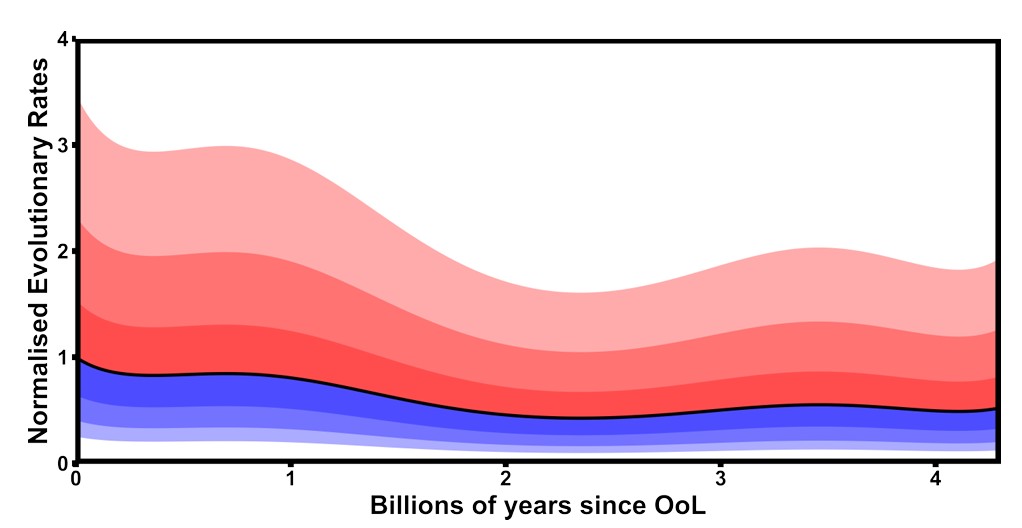
Figure 2: The figure shows the effect of temperature on the normalised evolutionary rate of a sample organism throughout Earth’s history. The black line indicates the rate at the currently best estimate for the median temperature through time, while the shaded regions are increases and decreases in temperatures at 5, 10, and 15 K. Time is measured in billions of years since the origin of life (OoL). Figure 2 in the paper.
An increase in temperature leads to a sharp increase in the predicted evolutionary rate. On the contrary, a marginal decrease in the ocean temperature significantly lowers the evolutionary rate.
Generalising this to other key groups, which are known to be abundant in Earth’s oceans and are key producers of biosignature gases in the Earth’s atmosphere, the authors find similar results, shown in Figure 3.
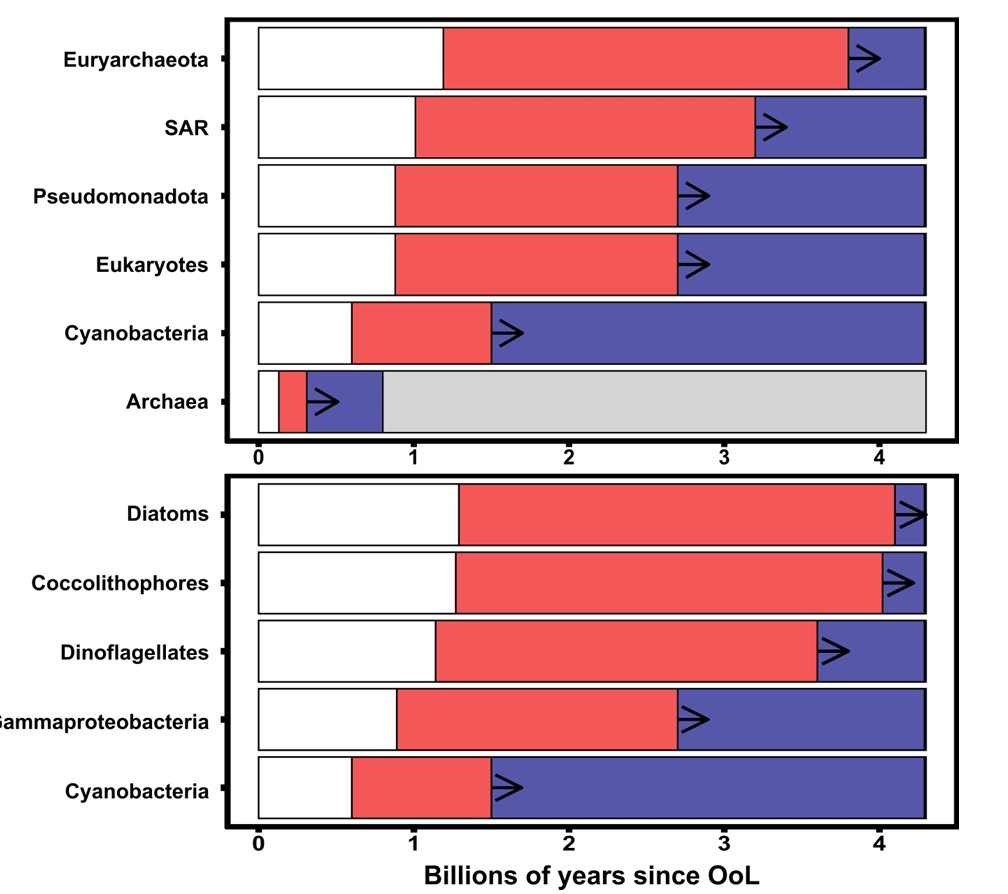
Figure 3: Effect of temperature on origination times of major groups of organisms in the Earth’s oceans. The origination time on Earth is marked with a forward arrow. The red and blue indicate the origination time for the same group on an ocean planet that is 10 K warmer and 10 K cooler, respectively. Cyanobacteria, in part responsible for some of the biosignature gases in Earth’s atmosphere, appear around 1.5 billion years after the origin of life (OoL). By increasing the average global temperature by 10 K, the model predicts that the steady evolution at an increased rate leads to the group appearing as early as 0.6 billion years after OoL. Lowering the temperature by 10 K instead results in a predicted origination time close to the current age of the Earth (i.e. much later). Figure 4 from the paper.
In general, the authors conclude that even a slight increase in ocean surface temperatures compared to Earth’s surface temperature over planetary timescales can lead to significant changes in the evolutionary rates and origination times of important species. All of them, especially the ones that originated later on Earth, have significantly earlier times of origin than for colder ocean temperatures – that is, if the ocean is warmer, the organism group originates earlier and if it is colder it appears much later. The shorter origination times in warmer oceans may, in turn, have significant implications for the potential of biological evolution. Considering the large diversity of planets in exoplanetary systems, many of which are warmer than Earth, these findings suggest that microbial life, at the very least, could have evolved much earlier on these exoplanets compared to Earth – assuming such life forms existed in the first place.
The authors note that the model should not be extended to more complex multicellular organisms and not beyond the 313 K limit, where anything but the hardy extremophiles is unlikely to survive. They also note that the continued availability of the necessary building blocks was a critical assumption that should be considered in another study. But the results still indicate that a large range of evolutionary rates and origination times is possible even within a relatively narrow temperature range. Even candidate hycean worlds orbiting stars significantly younger than the Sun, such as K2-18b, could host microbial life capable of producing biosignatures, as evolution may just be that much faster on planets with a slightly warmer ocean.
To sum it up, despite some general assumptions, the results show that surface temperature changes can really affect how quickly life evolves and how different groups of organisms develop. Warmer planets might have more complex life early on, while cooler ones could have simpler life, even as they age. This difference in complexity could make it easier or harder to detect life, with warmer planets more likely to show clear signs of life in their atmosphere.
Astrobite edited by Sowkhya Shanbhog
Featured image credit: Pablo Carlos Budassi @ Wikimedia Commons

If you travel West from Columbia you quickly reach New Jersey. I suspect you mean Colombia.
Although someone attending Columbia might sometimes feel oceans apart from New Jersey, I believe you are completely right!
Reminds me of the book by Sagan and another author, ” Intelligent life in the Universe” publ ca 1969
Intelligent Life in the Universe by Iosif Shklovsky, translated from Russian by Paula Fern and expanded by Carl Sagan in 1966. To think that when the book was published, the idea of extra-solar planets and the search for life was seen as somewhat quirky and even career suicide by some astronomers. And today we have thousands and thousands of worlds – with the possibility of detecting signs of life within reach in the coming years/decades. For anyone interested, the book was digitized by the Internet Archive in 2012 for anyone to read.