
Title: A Glimpse of the New Redshift Frontier Through Abell S1063
Authors: Vasily Kokorev, Hakim Atek, John Chisholm, Ryan Endsley, Iryna Chemerynska, Julian B. Muñoz, Lukas J. Furtak, Richard Pan, Danielle Berg, Seiji Fujimoto, Pascal A. Oesch, Andrea Weibel, Angela Adamo, Jeremy Blaizot, Rychard Bouwens, Miroslava Dessauges-Zavadsky, Gourav Khullar, Damien Korber, Ilias Goovaerts, Michelle Jecmen, Ivo Labbé, Floriane Leclercq, Rui Marques-Chaves, Charlotte Mason, Kristen B. W. McQuinn, Rohan Naidu, Priyamvada Natarajan, Erica Nelson, Joki Rosdahl, Alberto Saldana-Lopez, Daniel Schaerer, Maxime Trebitsch, Marta Volonteri, Adi Zitrin
First Author Institution: Department of Astronomy, The University of Texas at Austin, Austin, TX 78712, USA
Status: Submitted to ApJL

The James Webb Space Telescope has opened up a new era of early-universe astronomy. Of particular interest is the hunt for the first galaxies, those that formed just a couple hundred million years after the Big Bang. But finding these early galaxies has proved to be somewhat of a challenge. While there have been many bright galaxies discovered by JWST at a redshift (z) greater than 10, no galaxies at z>15 have been confirmed to date. Today’s paper goes hunting for these very high-z galaxies, looking at the GLIMPSE field, home to strong lensing cluster Abell S1063, shown in Figure 1.
The process of identifying galaxies at high redshifts is not exactly a simple one. In this paper, all the sources in the field are slowly winnowed down through a series of steps with the ultimate goal of finding extremely high-z galaxies.
Step 1: Cut galaxies by color
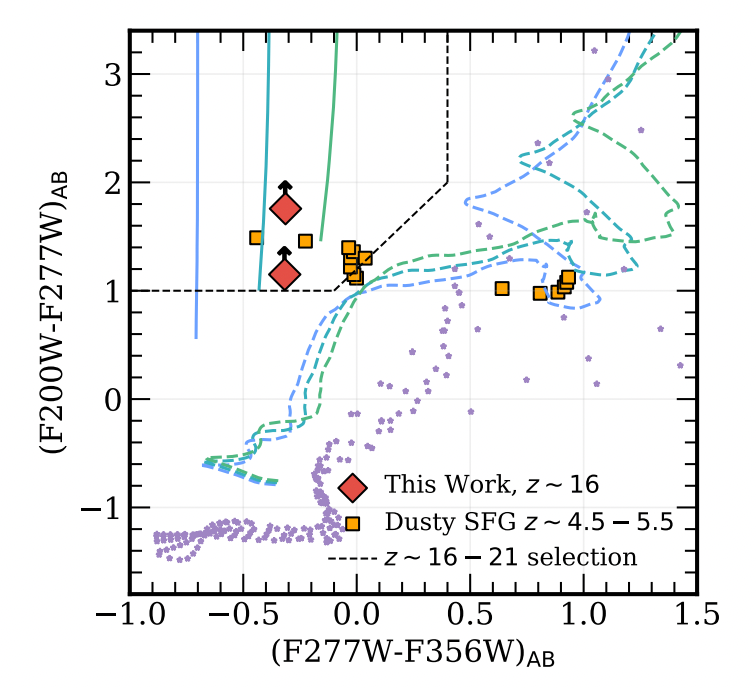
Cutting galaxies by color is a means of finding the Lyman break. High-energy light is absorbed by neutral hydrogen in the galaxy and the space between the galaxy and us. Thus, when you look at a galaxy’s spectral energy distribution (SED), there is a drop-off at short wavelengths, a “break”. For distant galaxies, the location of this drop-off gets redshifted, allowing for an estimation of a galaxy’s distance. By comparing how bright sources are between two consecutive filters, we can look for steep drop-offs that are caused by the Lyman break. Figure 2 shows a color-color plot (subtracting the brightness between different filters), where the dashed line shows the region galaxies must be in to be considered Lyman-break galaxies at these high redshifts. In the whole field, they detect 38 objects in this region.
Step 2: Calculate redshift
However, this isn’t the end of the story. Color isn’t the only way to estimate distances to galaxies, as we can also use photometric fitting codes. These codes compare observations to templates of what we would expect galaxies to look like at different redshifts and see which ones fit best. This allows for an estimation of the redshift of each source identified in the field. All sources that the photometric fitting codes thought were at z>16 were cross-referenced against the 38 color-identified objects, which narrowed it down to 8 high-z candidates.
Step 3: Hunt for imposters
But wait, there’s more! Both of these methods (looking at colors and calculating redshift photometrically) are susceptible to false positives. Lower-redshift galaxies, particularly star forming dusty galaxies, can look just like high-z sources. This is apparent in Figure 2, where z~4.5-5.5 dusty galaxies can also be found in the color-selected Lyman-break region. Thus we need to explore the possibility that the sources might not be at high redshifts at all. In this paper, they do this by fitting their 8 sources with a low-z dusty starburst template, finding only five galaxies that match the high-z template better than the starburst template.
Step 4: Keep significant detections
On the last five sources, they make one final cut, only keeping those that aren’t at the edges of their observation and thus have strong signals, where they can be confident we’re actually detecting something and it’s not just a hot pixel or noise. So, after all of that, they are left with only two z>16 candidates in this field.
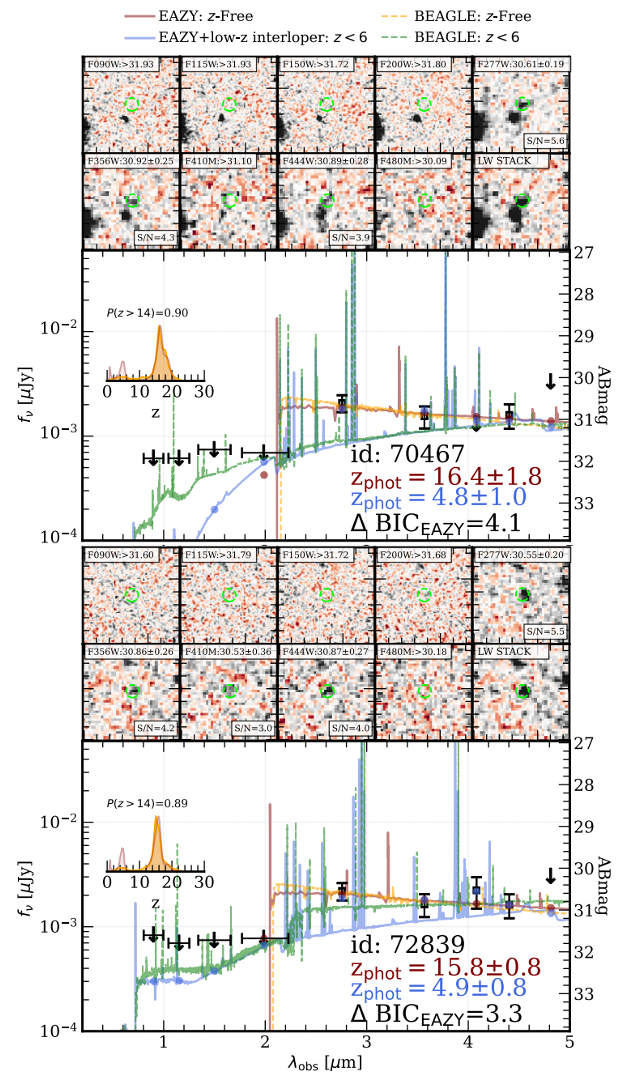
Figure 3 shows the images and SEDs of each of these candidates, given the wonderfully poetic names of 70467 and 72839. While there is still a lot to learn about these candidates, with the JWST data presented in this paper we can uncover some things about the galaxy properties. Both sources appear to be compact, but still resolved, with effective radii of roughly 200 pc. These observations can also tell us about the UV-brightness of the two candidates, finding that they are most likely dominated by extended stellar emission, as opposed to active galactic nuclei activity. In general, these galaxy candidates are not very UV-bright, which is somewhat surprising, as JWST has found many bright galaxies at z~12-14. However, it is not out of the question that galaxies at this slightly earlier epoch are just fainter than we expected, and then formed stars and increased in brightness relatively quickly.
Overall, these results mark the finding of potentially some of the first galaxies in the universe. But for now, they remain candidates. The photometric data has served its purpose, allowing us to find these candidates and get some information about their properties, but now we need targeted spectroscopic observations to get a more accurate determination of their redshift.
Astrobite edited by Bill Smith
Featured image credit: ESA/Webb, NASA & CSA, H. Atek, M. Zamani (ESA/Webb)
