
In this series of posts, we sit down with a few keynote speakers of the 246th AAS meeting to learn more about them and their research. You can see a full schedule of their talks here and read our other interviews here!
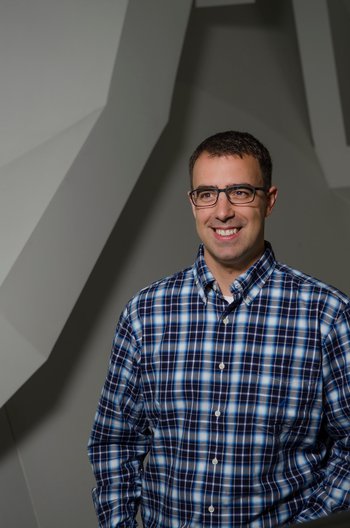
Dimitri Mawet is the David Morrisroe Professor of Astronomy at Caltech and a Senior Research Scientist at the NASA Jet Propulsion Laboratory. He works on instrumentation and exoplanet research, with a focus on using coronagraphy and high-resolution spectroscopy to find and characterize exoplanets.
“Not a traditional path”
Mawet grew up in a small, rural village outside of Liège in Belgium. He told me his path to astronomy was “not really a traditional path.” He attended the University of Liège, where he studied civil engineering before continuing on to a Master’s degree in engineering physics. His research involved developing coronagraphs for the James Webb Space Telescope and the European Southern Observatory’s Very Large Telescope Planet Finder (now called SPHERE). Coronagraphy is an observational technique in which one blocks out the light from a central object, allowing light from a dimmer companion object, like an exoplanet or low-mass star, to appear in the image. Coronagraphy was first developed to observe the Sun’s corona, a hot, diffuse outer layer that’s only visible to the naked eye during solar eclipses. Nowadays, in addition to solar physics, coronagraphy is often used for direct imaging of exoplanets.
After graduating, Mawet entered a Ph.D. at the University of Liège. He received a Marie Curie fellowship to study for two years in France, first at the Paris-Meudon Observatory and then at the Institut d’Astrophysique Spatiale d’Orsay. In Paris, he worked on development of the four-quadrant phase-mask coronagraph. These coronagraphs use destructive interference to block out the light of a bright central star, enabling observations of faint companion objects. The four-quadrant phase-mask coronagraph is a mask composed of four quadrants which apply a phase shift to the incoming light. (Imagine a sine wave – a “phase shift” means shifting it left or right on the x-axis.) The phase shift causes the light from the central object to destructively interfere, dimming its image. Light from the companion source is less affected by the phase shift, making it possible to observe even a faint companion object without it being dominated by the brighter star.
In the second year of his Marie Curie Fellowship at the Institut d’Astrophysique Spatiale d’Orsay, Mawet continued his work on starlight suppression techniques using “nulling interferometry,” or techniques using destructive interference. He remained for a year as a postdoctoral researcher at the University of Liège, then moved to the United States, where he worked as a NASA postdoc at the Jet Propulsion Laboratory (JPL) in Pasadena for two years. After the 2010 decadal survey, which was “gloomy for exoplanet science and direct imaging in particular,” he decided to leave JPL to work for the European Southern Observatory’s Very Large Telescope (VLT) in Chile. Mawet called the decision “…a risky move in hindsight, but I think it paid off.”
As an Operations Staff Astronomer for the VLT, Mawet was responsible for helping astronomers from across the world with observations and using the telescope, as well as operating the telescope for larger surveys. Of his job at VLT, Mawet said, “It was an amazing learning experience for me because it was completely different from what I had done before.” A typical contract for an Operations Staff Astronomer at VLT was around 100 nights a year, and when he was scheduled, Mawet had to commute seven hours from Santiago to the VLT in the Atacama Desert. He told me “the environment is very hostile to human life… I gained a lot of respect for people who do their entire careers at observatories.” Even with the extreme environment and late nights, Mawet told me, “I would do it all over again.”
Characterizing Exoplanets at Caltech
After four years working at VLT, it was time to move on. During his tenure, Mawet had traveled to California often to collaborate with scientists at JPL to continue developing technology for coronagraphy. Missing his old research, Mawet “… took another risk and applied to two jobs, one at Space Telescope [Science Institute in Baltimore] and one at Caltech.” He took the job in California in 2015, now as both a professor at the California Institute of Technology and a senior research scientist at JPL.
Mawet has spent the past ten years building a large research group of postdoctoral researchers, graduate students, and undergraduates. Many of his undergraduates come from the Summer Undergraduate Research Fellowship, or SURF, program at Caltech. This is a program for upper-level undergraduates at Caltech and other approved programs which pairs undergraduates with faculty members for supervised, funded research projects. Mawet told me he’s hosted over fifty undergraduates through this program. He’s also had a large cohort of graduate students, four of whom have graduated in the past fifteen months. “It’s been really wonderful being here at Caltech and working with an amazing team of grad students, postdocs, and undergraduates,” he said.
Mawet and his group work on instrumentation for the Keck Planet Imager and Characterizer (KPIC), which they use to directly observe and characterize exoplanets. Lately, he’s been thinking about ways of getting high-resolution spectroscopy of exoplanets. This type of high-resolution data can be very informative about the chemical makeup of exoplanets, but it comes at a cost: the higher the resolution, the more you have to disperse the total light of an exoplanet, making each individual pixel dimmer. For an already dim source like an exoplanet, it can be really challenging to get enough light to get high-quality spectroscopy like we get for stars. One of his students, Katelyn Horstman, has been using high-resolution spectroscopy to develop a new method to detect moons around exoplanets. She wants to use the radial velocity technique, which has traditionally been used to detect exoplanets around other stars, to identify the characteristic gravitational “tug” on exoplanets from their so-called “exomoons.” (See her proof-of-concept paper here.) Mawet will talk more about the future of exoplanet science with KPIC at his AAS Plenary Lecture on June 11.
Advice to Undergraduates
Throughout our conversation, Mawet emphasized the role of “measured risks” in his career, whether that was moving to Chile to work at the European Southern Observatory or applying to a job as a professor at Caltech. “It had never crossed my mind that I would one day be a professor,” he said.
For undergraduates, Mawet emphasized that the biggest barrier to entry is graduate school. He advised getting a good foundation in physics, as most graduate programs will have their students take fundamental astronomy courses anyway. He emphasized the importance of undergraduate research, either at one’s home institution or through summer programs like SURF. “Try to make sure there’s a record of that research,” he said. For undergraduates who don’t have the opportunity to do research, he recommended seeing things like class projects as an opportunity to demonstrate one’s abilities that can be included in an application essay. When applying for graduate school, Mawet encouraged applicants to “demonstrate your appetite for research, your grit, and your motivation for astronomy.”
To hear more about exoplanet characterization with KPIC, tune into Dimitri Mawet’s Plenary Lecture at 11:40 a.m. AKDT on Wednesday, June 11 at #AAS246!
Edited by: Neev Shah
Featured Image Credit: AAS
To hear more about exoplanet characterization with KPIC, tune into Dimitri Mawet’s Plenary Lecture at 11:40 a.m. AKDT on Wednesday, June 11 at #AAS246!
Edited by: Neev Shah
Featured Image Credit: AAS
