
Title: A black hole in a near-pristine galaxy 700 million years after the Big Bang
Authors: Roberto Maiolino, Hannah Uebler, Francesco D’Eugenio, Jan Scholtz, Ignas Juodzbalis, Xihan Ji, Michele Perna, Volker Bromm, Pratika Dayal, Sophie Koudmani, Boyuan Liu, Raffaella Schneider, Debora Sijacki, Rosa Valiante, Alessandro Trinca, Saiyang Zhang, Marta Volonteri, Kohei Inayoshi, Stefano Carniani, Kimihiko Nakajima, Yuki Isobe, Joris Witstok, Gareth C. Jones, Sandro Tacchella, Santiago Arribas, Andrew Bunker, Elisa Cataldi, Stephane Charlot, Giovanni Cresci, Mirko Curti, Andrew C. Fabian, Harley Katz, Nimisha Kumari, Nicolas Laporte, Giovanni Mazzolari, Brant Robertson, Fengwu Sun, Bruno Rodriguez Del Pino, Giacomo Venturi
First Author’s Institution: Kavli Institute for Cosmology, University of Cambridge
Status: Submitted to Nature [open]
The Search for Black Holes after the Big Bang
Black holes are among the most fascinating and mysterious objects in the Universe because they challenge our understanding of how galaxies came to be, with origins going back to the very early cosmos. With the advent of the James Webb Space Telescope, astronomers have discovered more and more massive black holes within the first two billion years after the Big Bang. Most models of galaxy and black hole formation are designed based on observations of the nearby Universe, and do not necessarily accurately describe the distant, early cosmos. These recently detected black holes are unexpected in terms of their observed properties, introducing new questions about the formation of these ubiquitous, accreting, and energetic sources for observational and theoretical astrophysicists to explore. So, how did black holes form in the first place?
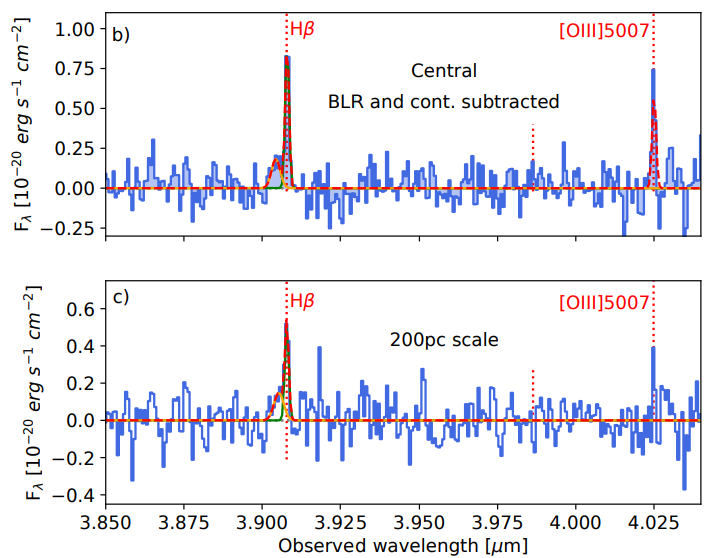
Figure 1: The spectra of QSO1 around the [OIII] and Hβ emission lines, in both the central regions and further out from the galaxy. While the Hβ line is strong, the [OIII] line unexpectedly weak, suggesting a different theory for how this black hole formed. Figure 1 (b-c) in the original paper.
Today’s paper focuses on the peculiar case of an active black hole called QSO1, located in Abell 2744, also known as Pandora’s Cluster. First identified by James Webb at a redshift of z ≈ 7—just 700 million years after the Big Bang—QSO1 harbors a black hole more than three times the mass of the one at the center of the Milky Way, despite residing in a relatively low-mass galaxy.
What also sets QSO1 apart is that it has very weak [OIII] emission while still exhibiting a strong Hβ line (Figure 1). These emission lines are powerful tracers of gas that is ionized by active black holes as well as star formation. The extremely low [OIII] to Hβ ratio found in QSO1 is rare at such high redshifts, and can only be explained by the low production of metals in the interstellar medium of the galaxy (astronomers like to refer to all elements other than hydrogen and helium as “metals,” including oxygen here). QSO1 may have formed in a way that theoretical models don’t yet account for, leading to its high black hole mass and low metallicity.
Possible Origins of Abell 2744’s Black Hole
One theory for the formation of black holes is that they begin as small “seed” black holes, often formed from the collapse of massive stars or directly from dense gas. These seeds grow by accreting surrounding matter, sometimes at super-Eddington rates—faster than the theoretical limit—which may have been the case in the chaotic environments of the early Universe. Such rapid growth may explain how a black hole like QSO1 formed so quickly after the Big Bang. Another possibility is that some black holes originated even earlier, as primordial black holes, born from density fluctuations in the infant universe.
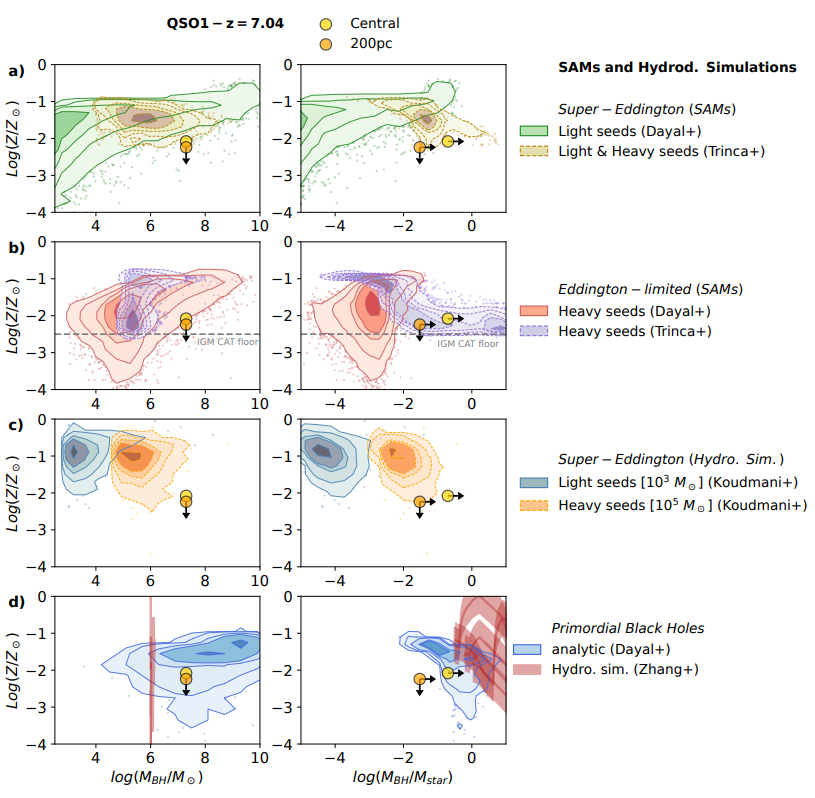
Figure 2: The metallicity–black hole mass relation for QSO1, measured in the central regions of the galaxy as well as further out, compared to theoretical data from semi-analytic models and hydrodynamical simulations. Each row tests a different hypothesis for where QSO1 came from: from light versus heavy seeds, through super-Eddington versus Eddington-limited accretion rates, or from primordial formation. Figure 3 in the original paper.
In order to understand how early black holes might have formed, the authors of today’s paper compared the masses and metallicities of QSO1 to results from theoretical models that are based on different formation pathways (Figure 2). Semi-analytic methods and hydrodynamical simulations are two key approaches used in theoretical studies; whereas the former uses simplified, analytic prescriptions on top of dark matter simulations, the latter numerically evolves all the relevant physics for galaxy formation. Figure 2 shows where QSO1 lies in the distribution of high-redshift black holes formed from light or heavy seeds, through Eddington-limited or super-Eddington accretion rates, or from primordial beginnings. Models that assume that black holes seed and grow through super-Eddington accretion rates actually struggle to capture the mass and metallicity range of QSO1. Meanwhile, models that invoke primordial black hole formation do pretty well!
Exploring How Black Holes First Formed
It is possible that our current theories for galaxy formation may need additional physics that would lead to the low metallicities observed in QSO1: evolutionary processes that might lead to more gas inflows or suppress star formation could also be important. In addition, what we thought we knew about black hole seeding and growth might not be enough. According to today’s paper, only primordial black holes could effectively lead to such high masses as QSO1 at high redshifts.
What’s more, it is probable that the early Universe is full of many more massive black holes like QSO1 that do not quite fit the present paradigm. Understanding QSO1’s origins could shed light on a broader population of early black holes. Astrophysicists will continue to explore diverse formation pathways to piece together the full story of black hole and galaxy co-evolution across cosmic time.
Astrobite edited by Margaret Verrico.
Featured image credit: Abell 2744, also known as Pandora’s Cluster, by NASA.
