
This week is #BlackSpaceWeek: Black in Astro’s annual event dedicated to celebrating and amplifying Black excellence in space-related fields. In 2025, the specific theme of the week is “Weaving the Universe Together” and events include virtual mixers, policy panels, storytelling sessions, and more. Read on to learn how rising Ohio State University senior and Simons-NSBP Scholar Phoenix-Avery Sarian weaves community within and beyond academic astronomy, and head here to pick up the thread of a cosmic dance.

Phoenix-Avery Sarian’s journey in astronomy has been marked by her strong support systems, a point that the Baltimore-born rising senior at Ohio State University was adamant about emphasizing.
Her interest in astronomy began when, as a child, her mother purchased her first telescope and became the first member of her astronomy support system. Phoenix “could not see out of it, but it was still the principle of the telescope that [she] liked,” and her mother continued to nourish her interests by providing astronomy books and frequent trips to the space exhibit at the Maryland Science Center.
It wasn’t until 10th grade, while researching career paths during COVID, that Phoenix realized astronomy was something she could make her profession. Once she made this realization, she again sought help from her community. “I feel strongly that I had support systems both from non-STEM and STEM teachers who said, ‘Look at this resource, maybe this would be useful for you.’ or, ‘You should look at that and apply to this.’ So I always had that support system, even within high school, to go into astronomy and astrophysics.”
After researching various undergraduate programs, she landed on the astronomy program at Ohio State. Phoenix shared that she had entered OSU with some amount of trepidation, as no one else from her high school had come to the university. Additionally, the majority of students in her high school were Black and Hispanic, and she felt pressured to assimilate to the predominantly white university. She shared that she experienced microaggressions at the university, and also struggled with adapting to college in her first year. “I didn’t know how different it was going to be from the courses in high school, and it got to a point in my 1st year that I was on academic probation.” But Phoenix knew from experience what to do in this situation: seek out support amongst her professors and peers. That is exactly what she did, and she credits that support with helping her get through these experiences.
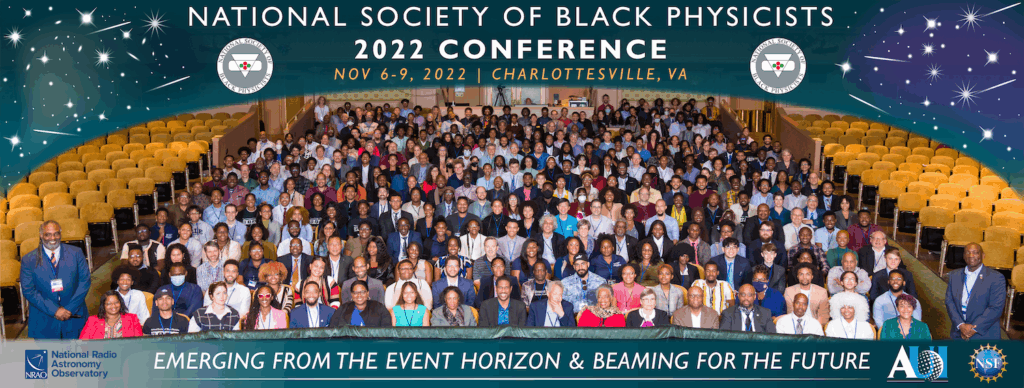
She also found community in the National Society of Black Physicists (NSBP). “My very first semester, I was able to go to the National Society of Black Physicists Conference in Virginia. I had struggled my first semester, but it was so amazing to see so many different people who looked like me achieving and going beyond in the field…especially the women there. It made such a big difference. And I had a lot of talks with the older physicists there about their experiences. It was a very beautiful thing to see.”
The support Phoenix received carried her through her initial struggles, and she rode the wave all the way to research projects in multiple subfields. The summer after her freshman year, she participated in the REU program at UC Santa Cruz, led by Dr. Enrico Ramirez-Ruiz and Deana Tanguay as well as working with OSU graduate students Caprice Phillips and Anusha Asnodkar on brown dwarf spectral classification. As part of research programs at OSU, she also completed a project on muon decay and participated in astronomy education research, developing learning resources such as “Choose Your Own Adventure”-style lessons and even appearing on a podcast about brown dwarfs with University of Arizona professor Dr. Brittany Miles.
Phoenix also hasn’t forgotten the importance of the support and community that was instrumental to her own journey, and pays it back through service to the department. She is one of the first undergraduate representatives for the department’s DEI committee, partners with the OSU Astronomical Society, and is the chair of the Undergraduate Majors/Minors in Astronomy and Astrophysics Committee. She shared that, in all of these roles, she is able to bridge gaps between different groups’ experiences, assess department climate, and share her own perspective as a Black woman in the department.
She has also found support and fulfillment in several places outside astronomy. She is minoring in both Education and Portuguese, and is active in the Brazilian Student Association and the Spanish and Portuguese Language Club. She is an educator at Columbus’s Center of Science and Industry (COSI), teaching groups of all ages about astronomy and other sciences, running demonstrations, and developing some exhibit materials. “I didn’t know I was going to be interested in learning Portuguese, going to Brazil and Portugal, and creating [educational] material. I didn’t know I was going to be interested in teaching kids about science in the museum and wanting to potentially be a teacher, or that I’d have all these different opportunities. I had a very narrow path of what was going to happen for me, and even though it went differently all the way, it’s very beautiful how that transpired, and how that grew.”

The outreach that Phoenix is perhaps most passionate about is Foster Love, a non-profit organization “committed to improving the way children experience the foster care system for the better.” Phoenix shared that, during high school, she lost her mother and spent time in the foster care system. She emphasized that foster care looks a little different for everyone, but one thing that seemed consistent was the assumption that children in the foster system don’t have aspirations. “I think there are a lot of assumptions of foster care: a foster youth does not care about their education, or they don’t have priorities. And I know that those aspirations do lie deeply within that person. There just needs to be a better support system of, ‘Okay, how can we better fund you? What exactly do you need? Do you need a new laptop? Do you need tutoring? Do you need this or that?’ I’ve seen so many dreams and aspirations from those around me when I was in the group home, and when I was in the foster home. But the resources were just not presented at the right time, or a youth didn’t know about them.” Through Foster Love, she now advocates for scholarships and opportunities for foster youth, who are disproportionately underrepresented in higher education, with only 3-4% of foster care children completing a 4-year degree. She is also a recipient of Foster Love’s Family Fellowship.
This summer, Phoenix is again expanding her community across state lines at the Flatiron Institute’s Center for Computational Astrophysics in New York City. She is working as a Simons-NSBP Scholar with Dr. Will Coulton and Dr. Fiona McCarthy on cosmic microwave background research. In the fall she will begin applying to graduate programs, though she is also considering applying for other roles, including museum positions across the US and teaching programs in Brazil. About the decisions she’ll soon be making, she shared “I’m very happy, very blessed, for the opportunities that my parents gave me before they passed away, and for the bonus family I have of friends that keep me pushing forward. I never imagined the plethora of amazing opportunities that I had coming.”
Reflecting on her time as an undergraduate, Phoenix again emphasized the importance of having people behind you. “If I asked, ‘Could I see myself in this position?’ three years ago, I would say hell no! And I’m so happy with the support system that I have from the past, present, and even those who will support me in the future. None of this would have happened without my support system, and that’s why I advise undergrads who are coming into the space, especially Black undergrads. It’s going to be rough, but find your people, and I feel that it makes a difference.” She also advises being curious and taking chances. “You will find things that you never thought you had an interest in.”
Astrobite edited by: Luna Zagorac
Featured image credit: BlackInAstro
