
Title: Clouds can enhance direct imaging detection of O2 and O3 on terrestrial exoplanets
Authors: Huanzhou Yang, Michelle Hu, and Dorian S. Abbot
First Author’s Institution: Department of the Geophysical Sciences, University of Chicago, Chicago, U.S.A.
Status: Accepted for publication in The Astrophysical Journal [open access]
In the hunt for life beyond Earth, studying exoplanet atmospheres is one of our most powerful tools. The atmosphere of an exoplanet acts as a window into its environment and allows astronomers to take a guess at what processes are shaping the planet’s climate, chemistry and thus, its potential for habitability. The gases present in the planet’s atmosphere imparts a unique spectral fingerprint on the light that passes through it and allows us to identify what gases might be present and look for possible signs of life.
The James Webb Space Telescope is already hard at work looking at distant worlds and gathering spectroscopic data for us to analyse. It has already observed several exoplanets and recorded the light that passed through their atmosphere. This has not only sparked a debate over what could be interpreted as the first possible signs of biological activity but has also given us a glimpse of worlds that are remarkably different from our own.
However, the JWST is limited to mostly observing the atmospheres of planetary transit exoplanets. That means planets that orbit close to their host star and are more or less directly edge-on, as viewed from us, so that they transit across the face of the star. The only planets that the telescope is able to observe directly are big, young and hot planets further from their central star, at distances more resembling those of the outer planets in our Solar System, like Saturn or Uranus. If only we had a telescope powerful enough to image a potentially habitable planet directly and analyse the light reflected from it.
The Habitable Worlds Observatory
This is where the Habitable Worlds Observatory (HWO) will come in. Now, I know what you are thinking. Why must astronomers always look towards greener pastures bigger telescopes when we already have perfectly functional space telescopes in orbit or practically on the launch pad? Well, it is true that the next flagship space telescope from NASA, the Nancy Grace Roman Space Telescope is designed to directly image exoplanets and analyse their atmospheres. But space telescopes can take decades to plan and are often built on lessons learned from previous missions. Roman, with its 2.4 meter primary mirror and coronagraph will be able to observe Jupiter-sized planets at similar distances and will get us some of the way, for sure, but not all the way. At three times the mirror size, HWO, NASA’s proposed successor to Roman and planned for the 2040’s will carry the torch even further and be able to directly image Earth-like planets in the habitable zone, where liquid water can exist on the surface.
But it might be cloudy tomorrow
This brings us to today’s paper. If the HWO is going to potentially observe Earth-analogues, we might expect it to run into the same issue that plagues everyone living in the UK for most of the year – clouds. Clouds in the atmosphere of an exoplanet can sometimes cause trouble when trying to analyse the light. Cloud particles scatter different wavelengths of light differently and cloud variability creates dynamic changes in the observed brightness that can make it hard to know what exactly you are looking at. Clouds can also mean varying levels of opacity to look through depending on cloud composition and can hide underlying atmospheric properties such as water content beneath a thick cloud layer. For transmission spectroscopy, even a thin layer of clouds can disrupt the measurements as the light has to travel a long distance through the atmosphere. However, for direct imaging, the effect of clouds is perhaps more nuanced. While a thick cloud deck will block the signal from whatever gas lies beneath it, it will also increase the overall albedo of the planet and make it easier to detect the gas above. This means that cloud height and type are both critical variables in understanding atmospheric properties of exoplanets, which is what the authors of today’s paper set out to investigate.
To understand how clouds affect the ability to detect signs of life on distant Earth-like planets, the authors used computer simulations. They focused on two gases, molecular oxygen O2 and ozone O3. Both gases are often seen as biosignatures, although their astrobiological significance has been debated. The authors first used a tool that simulates how a telescope like the HWO might observe an Earth-like planet around a star 15 parsecs away. This tool predicts how light bounces off a planet’s surface and atmosphere, and whether the two gases would show up clearly in the reflected light. Next, they created realistic cloud conditions using a cloud microphysics model. This model calculates how clouds might form and behave depending on factors like surface pressure or how much sunlight the planet gets. With this they were able to change things like cloud height and particle size. They then combined the two tools: adding the simulated clouds into the observations model and built a mathematical model to help explain what they saw in the simulations. The sketch for their model can be seen in Figure 1.
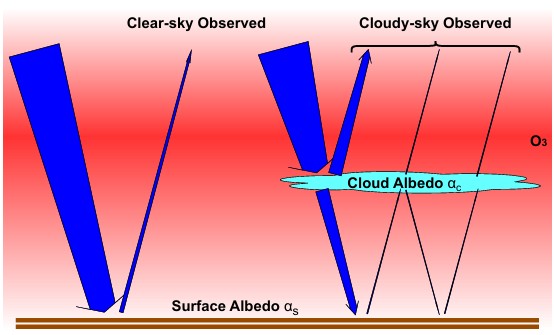
Figure 1: Clouds can affect the amount of reflected light (albedo) from the imaged planet. Depending on the cloud height and particle size, this can have a big impact on the observability of different species of gas in the atmosphere. Here the blue arrows indicate the amount of light entering the atmosphere and being reflected. The arrows get thinner from tail to head, representing absorption in the atmosphere. Depending on the presence of clouds, a varying amount is reflected back. The red colour indicates the assumed distribution of ozone O3 which is concentrated at a high altitude. Figure 4 in the paper.
A cloudy sky can actually be a good thing
The researchers discovered that low clouds can actually make gases like oxygen and ozone easier to detect, because these clouds reflect more light without blocking the gases above them. On the other hand, high clouds can make it harder since they can hide the gases from view. They tested different cloud types using real data from Earth as seen in Figure 2. They looked at five common cloud types—like stratus (flat and low), cirrus (high and wispy), and deep convective clouds (tall, thunderstorm-like) and compared them to their model clouds (labelled as CARMA in the figure).
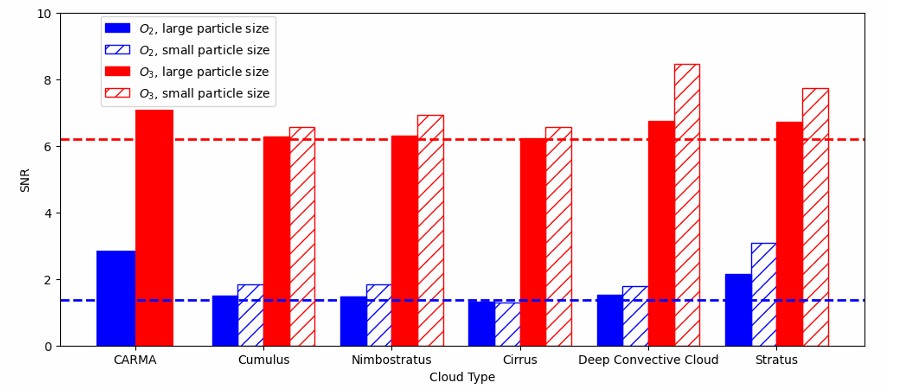
Figure 2: The figure shows how different types of clouds affect our ability to detect oxygen (blue) and ozone (red) on an Earth-like planet. The dashed lines show the results without clouds, while the bars show what happens when clouds are present. Solid bars represent larger cloud droplets, and striped bars represent smaller ones, which reflect more light. The figure shows that most cloud types—especially low clouds like stratus and thick storm clouds—actually make it easier to detect these gases, particularly when droplets are small. Only high, thin clouds (cirrus) slightly reduce oxygen detection, and even then, the effect is small. This is the paper’s main finding: while clouds can block light in some observation methods, for direct imaging of reflected light, they often help us see signs of life better. The cloud types are based on real Earth data while the authors simulated cloud model is labelled as CARMA. Figure 7 in the paper.
They found that most clouds improved detection, especially if the cloud droplets were small (as they reflect more light). Stratus clouds and deep convective clouds gave the strongest boost to detection, because they have a lot of water and are either low (stratus) or extend through many layers (deep convective). Ozone saw the biggest bump in detectability as it is concentrated higher in the atmosphere which means that it is in the region above most clouds where the increased reflection from the cloud layer below makes it easier to spot. This means that unlike the case for transit spectroscopy where clouds interfere with the detection of gases, for direct observations of the reflected light, clouds may actually be a good thing. This insight into the role of clouds in exoplanet atmospheres not only refines our current understanding but also helps guide the design of future telescopes, like the HWO, and our search for life on these remote worlds.
Astrobite edited by Maria Vincent
Featured image credit: Kasper Zoellner (using MS Paint)
