
Today, we want to highlight a subject that’s close to many astronomers’ hearts: the potentially disastrous threat to the night sky at the Paranal Observatory in Chile, home of the renowned Very Large Telescopes. Earlier this year, ESO rang the alarm bell on plans having been set up to build a large industrial complex by AES Andes, a Chilean energy distribution and production company, in close vicinity to the Paranal Observatory site. The proposed site is so close to Paranal that much of what makes this location nearly perfect to observe the night sky could be compromised by the construction and presence of this complex.
As a part of our Climate Change series, we had the fantastic opportunity to have an interview with Laura Ventura at ESO and ask her about various aspects of this situation. Laura Ventura is an astrophysicist working in outreach and science communication for roughly 25 years, about 20 of which at ESO. She is currently head of Communications at ESO in Chile, where she is responsible for internal and external communication between and from ESO’s various sites in Chile (e.g. Paranal Observatory, La Silla Observatory, the Vitacura headquarters). In this role, she has followed the looming problem for the Paranal site very closely. This bite is an overview of the interview with Laura and the problem ESO is facing.
The status quo
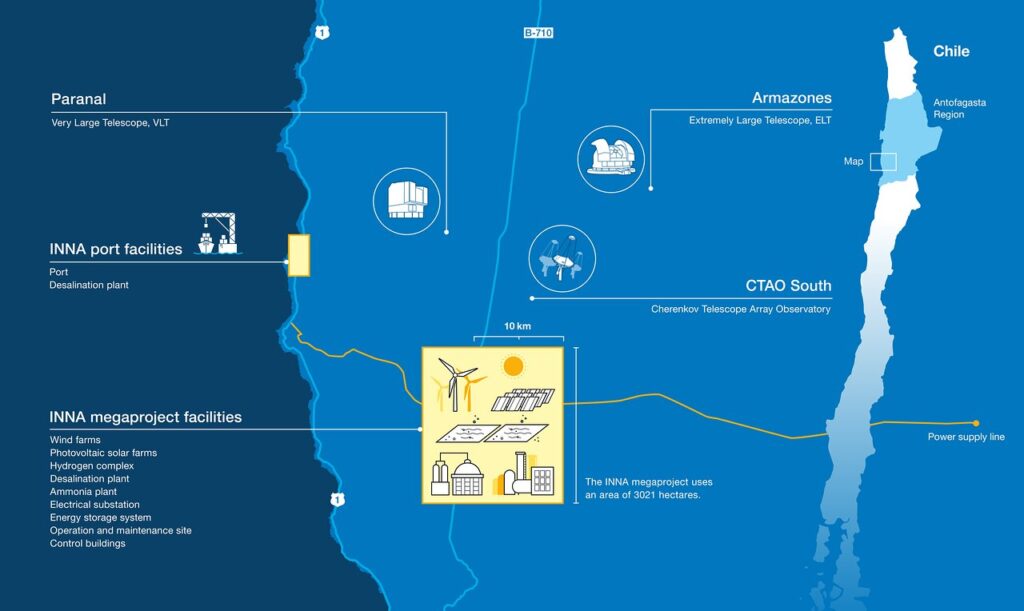
In late 2024, the company AES Andes submitted their plans to the Chilean authorities to construct an industrial megaproject for the production of green hydrogen and ammonia, abbreviated INNA. The location of the megaproject would be in close proximity to several of ESO’s foremost observatories (see Fig. 1): in closest distances are the Paranal site (10km), the Cherenkov Telescope Array Observatory South (CTAO-S) (5km) and the Extremely Large Telescope (ELT) (15km), where these latter two sites are currently still under construction. A first analysis by ESO in 2025 raised serious concerns to the observatories and the equipment there. A second, more in-depth, technical analysis (see here for a summary) reveals that the INNA project could have a severe and lasting impact on the nearby observatories. In light of this, ESO has submitted the report on this latter analysis as a Citizens Participation Process to Chile’s governmental instances, which will take several months to be processed.
The effects on the Observatories
The Paranal site is one of the very best observing sites for optical astronomy on the planet, but there is still some presence of light pollution: a wind farm in the vicinity, nearby cities and other minor industrial sites do have an impact on Paranal’s sky.
The proposed INNA megaproject, however, will have a far more drastic impact on the local night sky. The megaproject is planned to occupy an area of 3000 hectares (roughly the size of the Valparaiso municipality), the project will have major wind farms, solar panels, green hydrogen and ammonia plants, and a port. This wide range of facilities and equipment, both during construction and in their operation, will have major consequences for the three neighbouring observing sites: Paranal, CTAO-S and Armazones (ELT). From ESO’s technical report, which are based on the submitted plans for the INNA project and an own, independent analysis, there are four main categories of severe effects on observability at ESO’s facilities:
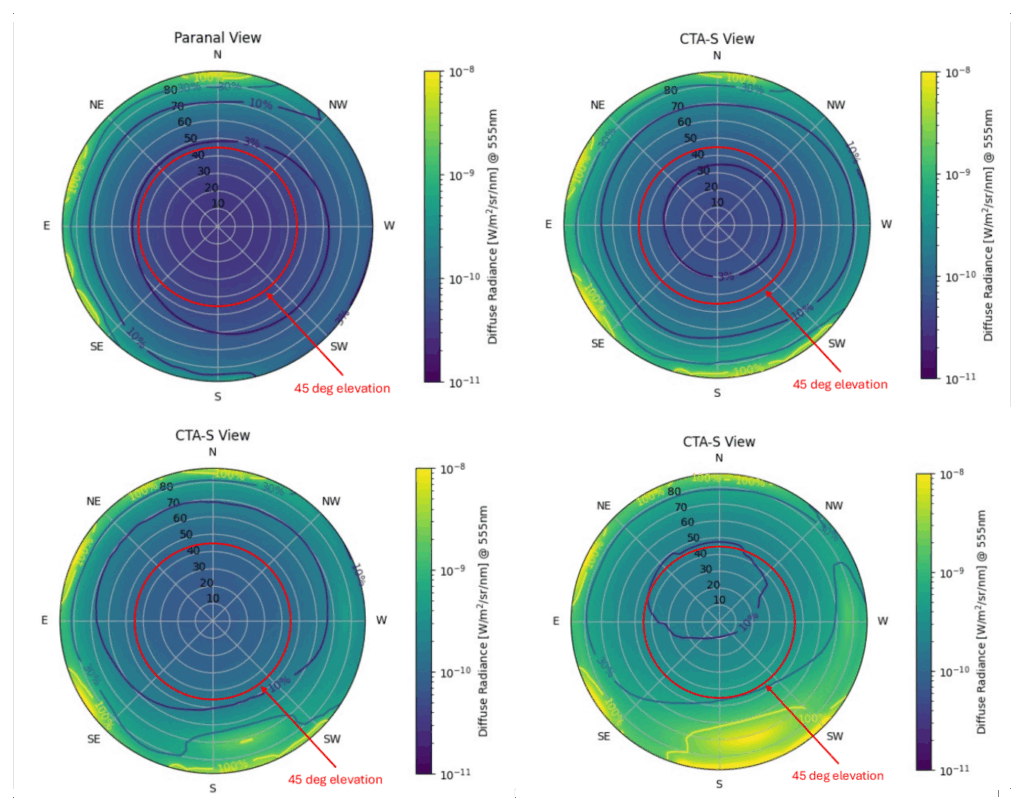
- Light Pollution: An obvious issue, a large industrial site has a lot of lighting at night. The analysis from ESO has used the state-of-the-art ILLUMINA models to simulate the light pollution from INNA at the neighbouring observing sites: VLT, CTAO-S (see Fig. 2 for some results) and ELT. When relying on the light output submitted by AES Andes’ construction plans, the increase in artificial light on these three sites is somewhere between 5 and 55%. However, in order to conform to Chilean industry standards, the plans for INNA would need their lighting output increased by roughly a factor five compared to their current submission. In that case, the brightness at the observatories would be increased somewhere in between 23 to 269%. This would be the end of the site’s near-perfect night sky. With these calculations, the observing quality at the three sites will go below the standards the International Astronomical Union (IAU) recommends for professional observatories.
- Microseismic Noise: ESO’s instruments have impressive capabilities, having been at the base of some of Astronomy’s most amazing discoveries in recent decades. They are also highly sensitive, and need well-controlled circumstances in order to function well. Vibrations coming from the INNA site will have a very negative impact on the instruments as well. The turning of the planned wind turbines alone will already affect the instrumental precision at ESO’s observatories, and will cause vibrations so heavy it passes the operation limit of the VLTI and the ELT. Any construction work with heavy machinery, operation of pumps, transport, etc. will only worsen this problem.
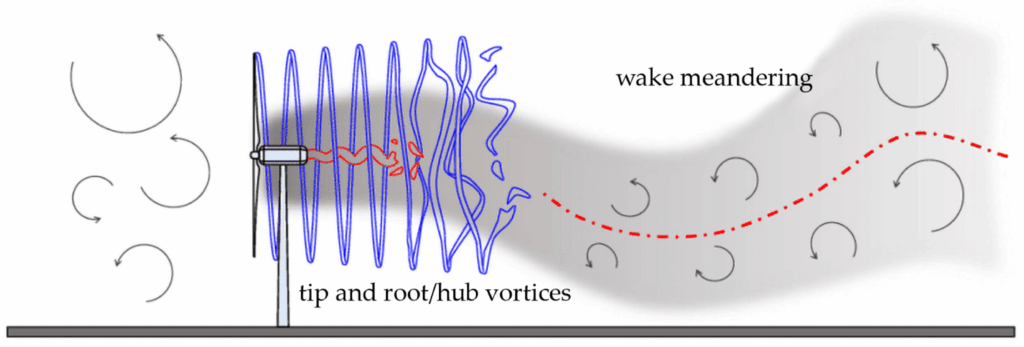
- Atmospheric Turbulence: One of the most important things for any observatory is the local seeing–essentially how sharp we can make our images. The VLT and ELT are at uniquely good spots; the high altitude of the telescopes, along with the dry air of the Atacama desert, and a stable, laminar flow over the observatories all make the seeing one of the best on the planet. Here the wind farms planned in the INNA project could also have a large impact on the seeing at ESO’s nearby sites. For observations, swirling air (turbulence) will affect how light travels through the atmosphere, worsening the seeing. Wind turbines are known to have these ‘wake effects’ (see Fig. 3), where a long tail of turbulence can drag on for ~50-100 km. INNA’s wind farms would be about 10 km away from the observatories: in the case of wind coming from the south, which tends to lead to the best seeing conditions at Paranal, the effects of this should not be underestimated and have, up until now, not been considered at all by AES Andes.
- Dust: As the observatories are in a desert, finding dust everywhere is no surprise. This would be annoying enough to clean your windows, but for ESO’s telescopes this is on a whole new level and all of the telescopes would be affected. Regular specialised mirror cleaning and recoating is a large part of the observatories maintenance, and even has a dedicated facility for this at Paranal. Now, estimates show that the construction of the INNA site would increase the local dust content in the air by ~75% for years. This will then lead to two scenarios; 1) a much more frequent mirror recoating, where the costs would skyrocket immensely, or 2) more dusty mirrors, leading to a large drop in the telescope’s performance. While this would already impact the VLTs and the ELT, the CTAO-S site would be impacted the heaviest as these telescopes will not have a dome to protect them.
The communication with AES Andes
The first talks between ESO and AES Andes date back to when the company planned to build a small renewable energy plant in the vicinity in 2020. Any early warnings to the company from the ESO side on the effects of this smaller project on the observatories were ignored. This project was approved by the Chilean environmental office without notice to ESO. For the INNA project itself, ESO was not contacted in advance by the company. The existence of the megaproject was only found out via a public event, organised by AES, where some ESO staff was present by random chance. Despite expressing serious concerns for the environmental qualities at the observing sites, the company has made no modifications to the plan they eventually submitted for INNA to Chile’s governmental instances on December 24th, 2024.
A view on the worst case scenario
The plan submitted by AES Andes, without any modifications for mitigation of the estimated effects of any kind, would be extremely detrimental to the VLT, ELT and CTAO-S sites. This would mean heavily reduced quality of the instruments, and increased costs at the existing sites, while large projects like the ELT’s construction would lose a lot of the investments’ value. However, there are still a wide range of options for improvement from this worst-case scenario, with relocation of the megaproject to a distance where the observatories are hardly affected the best outcome. A number of diplomatic missions by ESO member states have been carried out to see what Chile’s government could do to improve the situation.
Incentives for the relocation of the industrial complex
First and foremost: ESO is a non-profit organisation devoted to scientific progress. There is no direct financial advantage for AES Andes to reconsider the current plans for their megaproject. The impact on the company’s reputation can be a contributing factor as well. Can the company hear scientific argumentation and is it willing to act on it?
Since 1963, there has been an agreement between Chile and ESO to operate facilities on Chilean soil. With over 60 years of fruitful collaboration, both parties have offered each other much in return. ESO can continue to use one of the best night skies on the planet, vastly boosting scientific discovery. Chile, on its turn, has benefited from the presence of the observatories, with a large impact on the Chilean scientific community (astrophysics, engineering, etc.). On top of that, astronomy has become a part of Chile’s identity as a country for a long time. Last but not least, ESO is supportive of projects related to sustainable energy, and has committed to environmental sustainability through various actions. However, the Chilean government shouldn’t have to choose between the best observational sky in the world and improving its green energy capacity: both can be done at the same time without damaging the other.
Edited by Megan Masterson
Featured image credit: G. Hüdepohl (atacamaphoto.com)
