
Authors: Ramambason, L., Chevance, M., Kim, J. et al.
First Author’s Institution: entrum für Astronomie der Universität Heidelberg, Institut für Theoretische Astrophysik, Albert-Ueberle-Str. 2, 69120 Heidelberg, Germany.
Status: Submitted to A&A [open access]
Stars are formed from giant clouds of molecular hydrogen (GMCs) that collapse under the force of their own gravity. As a result, young stars can be born embedded within dense, dust-rich material. Over time, the intense radiation from the star, stellar winds, and supernovae explosions can destroy dust, break apart hydrogen molecules, and lower the density of the gas surrounding the star.
Understanding how a star goes from being deeply embedded within a GMC to being exposed and surrounded by ionised hydrogen gives astronomers a crucial insight into star formation. Many different processes, known as feedback mechanisms, can impact the lifetime of a GMC. If stellar radiation and winds are strong enough to disperse a GMC, then the GMC will have a short lifetime since these effects are strongest in young stars. However, if supernovae explosions are the dominant mechanism dispersing GMCs, then the embedded phase lasts longer, prolonging the GMC’s lifetime and allowing it to form more stars.
The authors of today’s paper aim to measure the typical timescale of the embedded phase of a star’s lifetime and illuminate the dominant mechanisms responsible for GMC dispersion. The measurements are made for 37 galaxies (See Figure 1) from the Physics at High Angular resolution in Nearby Galaxies (PHANGS) survey, which have been observed in three different regions of the electromagnetic spectrum.
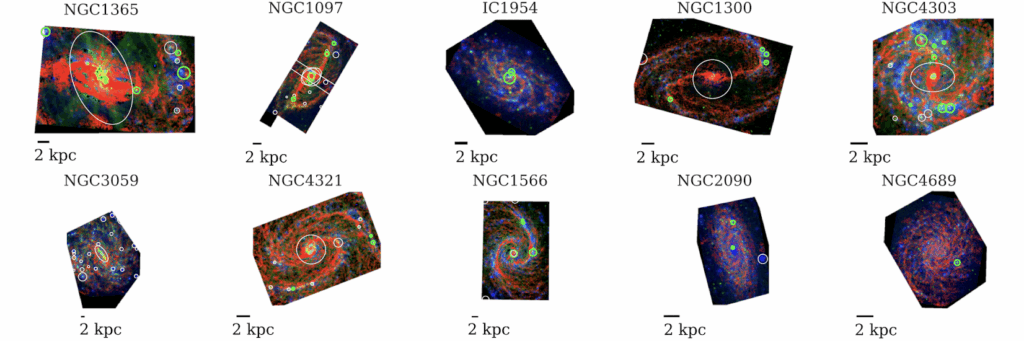
Each observation traces a different phase of gas surrounding young stars. The authors use the Atacama Large Millimetre Array (ALMA), to observe emission from carbon monoxide (red in Figure 1). Carbon monoxide is generally only found in clouds of molecular gas, making it a good proxy measurement for molecular hydrogen. The James Webb Space Telescope’s (JWST) Mid-Infrared Instrument (MIRI) is used to observe emission from dust that’s being heated up by a nearby star, causing it to emit light at a wavelength of 21μm (green in Figure 1). Since stars are born in dusty environments, dust emission can be used as a tracer of recent star formation. The Multi-Unit Spectroscopic Explorer (MUSE) on the Very Large Telescope (VLT) is used to observe recent star formation in the Hα wavelength (blue in Figure 1). The quality of the observations means that the authors can explore scales as small as 50 parsecs (for reference, a spiral galaxy like the Milky Way can have a radius around 10 kiloparsecs), which is comparable to the typical size of a GMC.
To measure the timescale of the embedded phase, today’s authors first identify the locations of peaks in CO (white circles in Figure 1) and 21μm emission (green circles in Figure 1). Then, for each peak, they measure the ratio of CO emission to 21μm emission, relative to the average value of this ratio (y-axis of Figure 2) at different distances from the peak (x-axis of Figure 2). The ratio of CO to 21μm will be higher than average near the peak of CO emission (positive deviations in Figure 2) and lower than average near the peak of 21μm emission (negative deviations in Figure 2). In Figure 2, you can see that the data shows a “tuning fork” shape, which is actually sensitive to the timescale on which GMCs are dispersed.
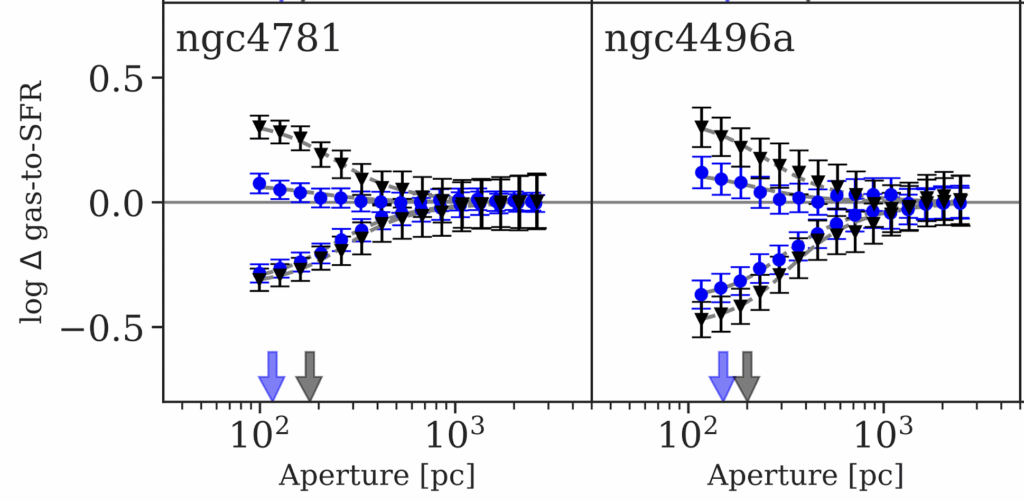
After fitting the tuning fork diagrams for all of the PHANGS galaxies in their sample, the authors can estimate the timescale of the embedded phase. They find a relatively short median timescale for stellar feedback effects (such as radiation pressure and winds) to disperse the GMC, around 3.4 million years. They also measure the timescale of dust-obscured star formation to be even shorter, with a median value around 800,000 years. While this may seem like a long time to us, it’s really quite short in comparison to a star’s lifetime. Crucially, a short timescale shows us that supernova explosions cannot be the dominant feedback mechanism causing clouds to disperse. Instead, GMCs are more likely to be dispersed by a star’s radiation and winds, which are strong at the beginning of a star’s lifetime.
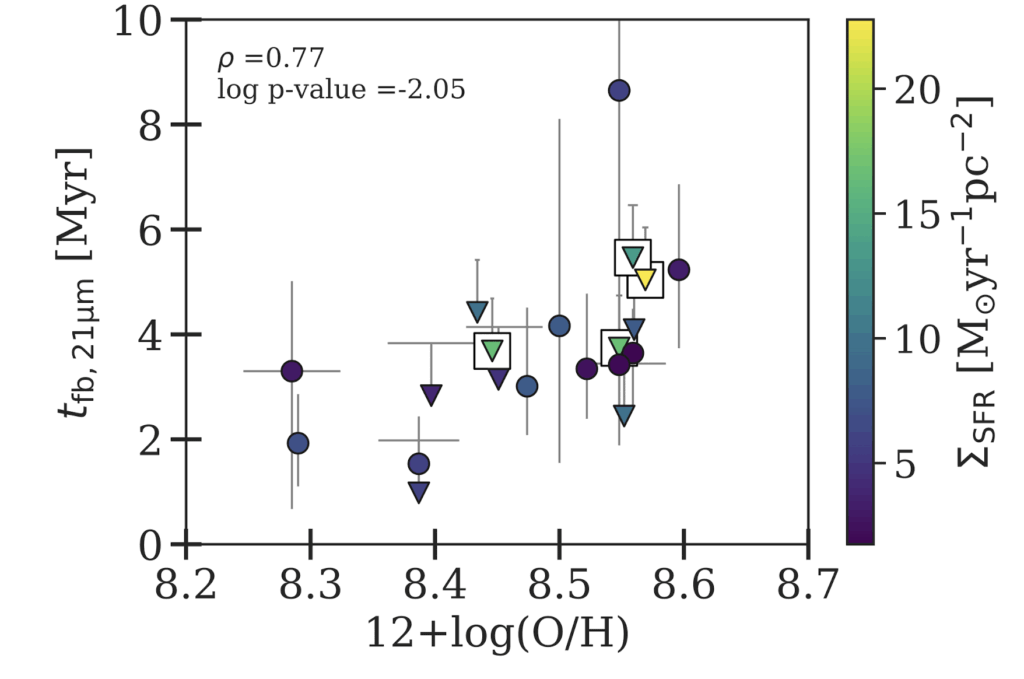
In addition to measuring the timescales of different phases, the authors look for correlations between the lifetime of each phase and different galactic properties. They find that the timescale of the embedded phase and obscured phase are both positively correlated with the amount of elements heavier than helium (colloquially referred to as ‘metals’ in astronomy) in the gas. You can see this correlation in Figure 3. More metal-rich gas also tends to be more dust-rich, suggesting that the correlation between dispersal timescale and metallicity may be due to an underlying correlation between dispersal timescale and the amount of dust in the GMC. If this is the case, then it suggests that a GMC is primarily dispersed through ionisation and destruction of dust by stellar radiation, rather than by stellar winds, which tend to keep dust intact.
The authors also find a correlation between dispersal timescale and the mass of a GMC. On a galaxy-wide scale, the mass of a GMC is correlated with the pressure in the GMC, meaning that higher-pressure GMCs take longer to be dispersed. This finding has important implications for the study of star formation and galaxy growth earlier in the universe’s history. Early universe galaxies tend to have higher gas pressures than galaxies do today, meaning that GMCs would have taken longer to disperse, and therefore a single GMC could form more stars during its lifetime.
The results of today’s paper confirm previous results which pointed towards short GMC lifetimes as a result of the dominant role of stellar radiation in cloud dispersal. Detailed studies of local galaxies also give astronomers insight into the conditions in more distant galaxies, which are more challenging to study in such detail. More work, especially in lower-metallicity galaxies, will allow astronomers to further develop the conclusions of today’s paper, so stay tuned to learn more about star formation!
Astrobite edited by Maria Vincent
Featured image credit: ALMA (ESO/NAOJ/NRAO)/PHANGS, S. Dagnello (NRAO)
