
Paper Title: Signatures of BH seeding on the M• − σ relation: Predictions from the BRAHMA simulations
Authors: Jonathan Kho, Aklant Kumar Bhowmick, Paul Torrey, Alex M. Garcia, Niusha Ahvazi, Laura Blecha, Mark Vogelsberger
First Author’s Institution: University of Virgina, Charlottesville, VA, USA
Status: published on arXiv [open access]
The Birth of Black Holes
Astronomers believe that nearly every known galaxy contains a supermassive black hole (SMBH) at its center. A SMBH is a black hole – an object so dense that even light cannot escape its gravitational pull – that is at least 1 million times more massive than the sun. As astronomers are using state-of-the-art telescopes like the James Webb Space Telescope (JWST) to peer back into the first billion years of the universe’s history, we observe that SMBHs already exist even at these early times. This is quite surprising since it’s not clear how black holes that massive appear that early. This depends heavily on how the black hole was formed, or “seeded”.
There are two main ways in which we believe the seeds of SMBHs may have formed. First are the “light” seeds, which are thought to form from the deaths of the first generation of stars. Second are the “heavy” seeds, which are thought to form from the collapse of very massive stars in the early universe that could form under special conditions. In short, a galaxy normally forms when gas in a dark matter halo collapses and forms stars in a process called fragmentation. However, under certain conditions, it may be possible to prevent the gas from fragmenting, which instead leads to a buildup of gas in the center that will eventually result in a heavy seed black hole.
So why is all this important? The mass of a SMBH (M•) is known to be correlated to properties of its host galaxy, like the stellar mass and the stellar velocity dispersion (σ), which quantifies how varied the speeds of stars tend to be relative to the mean orbital velocity around the SMBH. By looking at how seed black holes and their host galaxies compare to the M• − σ relation, today’s authors can study how different models of black hole seeding hold up to observational constraints and how this depends on redshift.
Seeding Black Holes
Today’s authors use the BRAHMA simulations, a set of magnetohydrodynamic (MHD) simulations focusing on the formation and evolution of SMBH seeds, to study how seed black holes and their host galaxies evolve onto the M• − σ relation. They consider heavy seeds, which form under the following conditions:
- The host halo must be of a sufficient mass.
- The gas in the host halo must be dense (to create a central object that will become a heavy seed) and metal-poor (to prevent fragmentation).
- The host halo must be exposed to a sufficient flux of Lyman-Werner radiation, a particular type of ultraviolet (UV) radiation that helps prevent fragmentation.
- The host halo must be slowly-spinning, making collapse easier.
- The host halo must have a neighboring halo of similar or greater size, which also helps justify the Lyman-Werner condition.
The authors consider four models (denoted BI through BIV). All models use condition 1, and then each models add the next condition; that is, BI considers conditions 1 and 2, BII considers conditions 1-3, and so on. Tests of these different restrictions to the seeding model can determine how they impact the formation of heavy seeds and their placement along the M• − σ relation.
Sigma and Seeding Restrictions
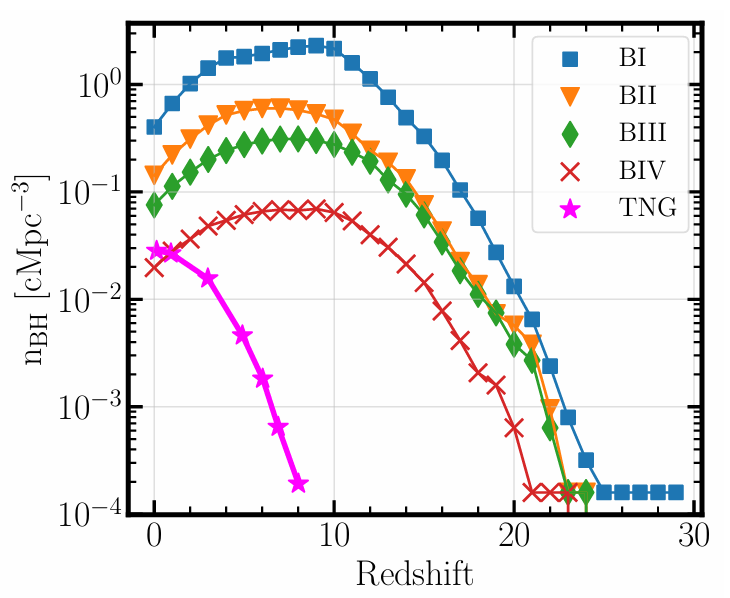
First, they look at the overall population of black holes produced by each seeding model as a function of redshift, shown in Figure 1. The colored curves show the number density of black holes for the different models, with a comparison to the black hole number density from the IllustrisTNG simulation, another galaxy formation simulation. As expected, the black hole number densities are lower with more restrictive seeding models since it becomes more difficult for a halo to meet the seeding criteria. Additionally, the BRAHMA simulations allow for seeding significantly earlier than TNG, which will allow for comparisons with high-redshift observations to constrain seeding models in future work.
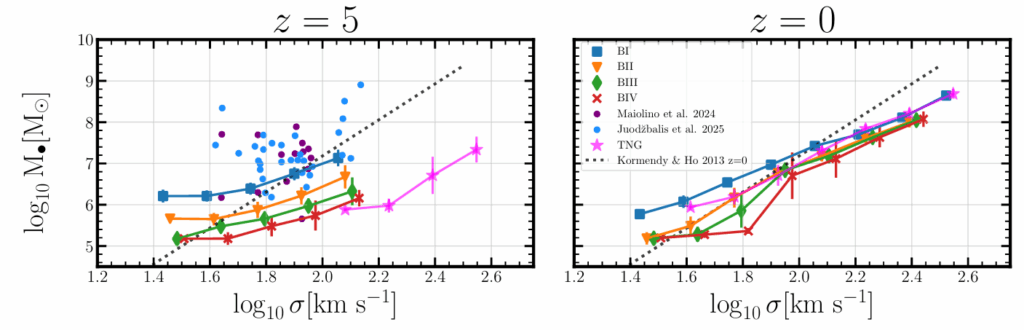
Then, they look at the M• − σ relation and its evolution in time for the different models, shown in Figure 2. In general, the less restrictive seeding models tend to produce larger black holes for a given velocity dispersion (that is, the curves are flatter and higher). This is in better agreement with the high-redshift observations shown in the left panel. The slopes of the M• − σ relations predicted by all of the models also tend to be flatter than the observed local relation. Another important feature is in the evolution – the less restrictive models tend to evolve less with redshift, particularly at lower masses and velocity dispersions. This is because the growth of the black holes in these cases is dominated by mergers with other black holes, whereas the growth of more massive black holes in more restrictive seeding models is dominated by gas accretion, which pushes the curves upwards towards the local relation.
In summary, the way the seeds of SMBHs are formed, which determines both their masses and number densities, can have significant implications for where massive black holes and their host galaxies lie in the M• − σ plane. This is mainly due to how black holes evolve over different mass scales – black holes that are less massive tend to grow primarily via mergers, even at low redshifts, while more massive black holes tend to grow via accretion, particularly at low redshifts. Additional observations and improved measurements of high-redshift SMBHs will continue to shed light on the population of young SMBHs. Further simulation studies, especially those that are able to more accurately model the growth of massive black holes in the early universe, will allow future observations to better constrain seeding scenarios for SMBHs.
Astrobite edited by Cesiley King
Featured image credit: Wikipedia
