
Authors: Natalia Lahén, Thorsten Naab, Antti Rantala, Christian Partmann
First Author’s Institution: Max Planck Institute for Astrophysics, Garching, Germany
Status: Submitted to MNRAS, available on arXiv
When asked to picture outer space, most people correctly grasp the concept that it is mostly, vastly empty. However, they may be shocked to learn that, for astronomers, a region of space where stars are as close to one another as three times the distance from Earth is to Pluto is considered outrageously crowded. While on human scales that may still sound roomy, these regions are actually among the densest in the universe. These are young massive clusters (YMCs): gravitationally bound clusters of hundreds of thousands of stars that are formed from the collapse of giant clouds of molecular gas. How these star clusters form and evolve over time is a big interest for astronomers, and star-by-star simulations like the one done in today’s paper can help us begin to understand.
The Set-Up
To properly simulate the formation of a star cluster you don’t just need stars you need the environment that forms those stars too — you need a whole galaxy. In this case, the authors even decided that two galaxies might just be better than one. Observationally, we know that the biggest sites of YMC production in the universe are gas-rich, merging galaxies. When these large reservoirs of gas are quickly compressed by shock waves as their host galaxies merge with one another, the gas collapses and creates a burst of star formation, also known as a “starburst”.
This simulation begins with two dwarf galaxies at the beginning stages of merging. By simulating dwarf galaxies, they don’t need to simulate more material than necessary (two merging Milky Way-like galaxies would be computationally expensive) and by simulating a merger the simulation can form their YMCs quickly (only 7.5 million years), meaning it doesn’t need to run for longer than necessary. The simulation is part of the Galaxy Realizations Including Feedback From INdividual massive stars (GRIFFIN) project, and uses a hydrodynamics code called SPHGAL.
The Results
Their simulated merger produced 850 star clusters, with the most massive cluster formed in the simulation ending with 2 x 10⁵ solar masses within only a 0.7 pc half-mass radius — the radius which encloses half of its total mass . The extreme densities in the simulated YMCs mean that very massive stars can form and die quickly, with 78 stars in the simulation collapsing as black holes and 20 exploding as supernovae. They also track star-star collisions, identifying 90 and noting that 16 of these collisions were between stars with masses greater than 40 times that of the Sun!
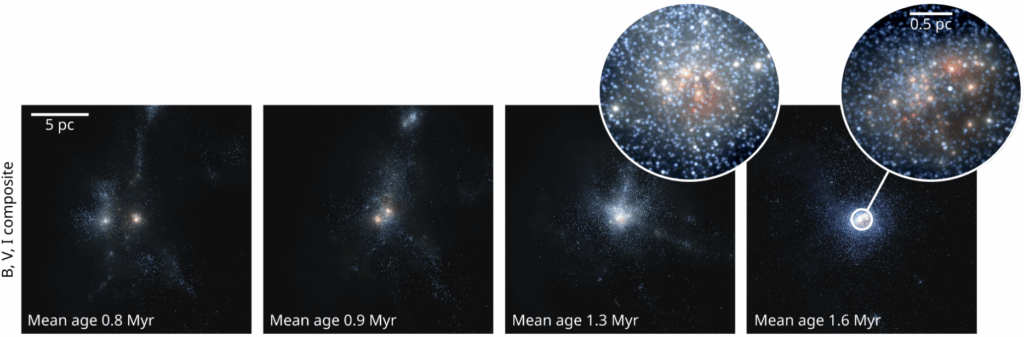
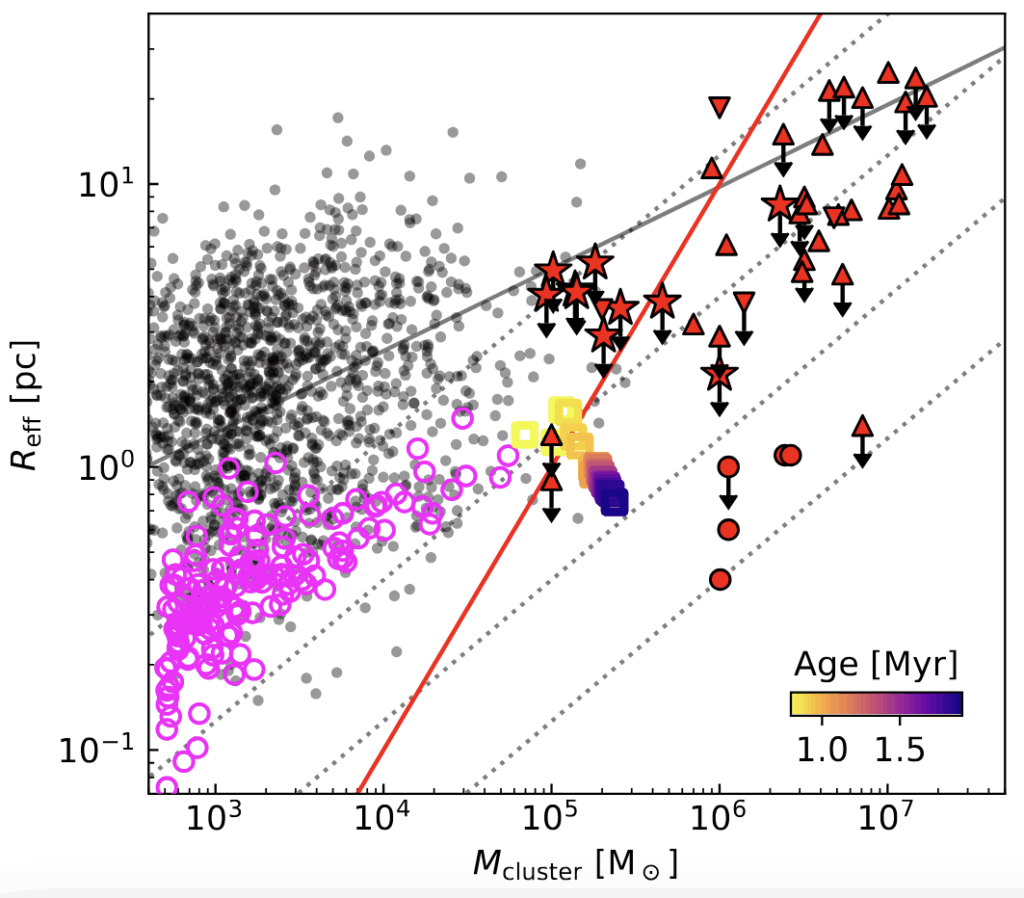
They compare the properties of their simulated YMCs to those in the LEGUS Survey, which looked at YMCs hosted by galaxies < 12 Mpc away, and to a few extremely high-redshift star clusters that have recently been observed with The James Webb Space Telescope. These high-redshift clusters were formed billions of years ago, but due to their distance we are observing them as they were at just 10 million years old. So, although they have similar ages, the environment they were formed in was radically different.
Compared to the LEGUS clusters, their simulated YMCs are smaller while still having similar masses, making them more dense. This difference is likely because the simulated YMCs are still young and haven’t fully dynamically evolved. Over a few more million years they are expected to “relax” and expand. They also tracked the mass and size properties of their most massive cluster as a function of time and found that it was actually shrinking in half-mass radius. This is because, unlike the other simulated YMCs, it was still forming stars and growing mass in its core, thus shifting the half-mass radius smaller.
Multiple Stellar Populations
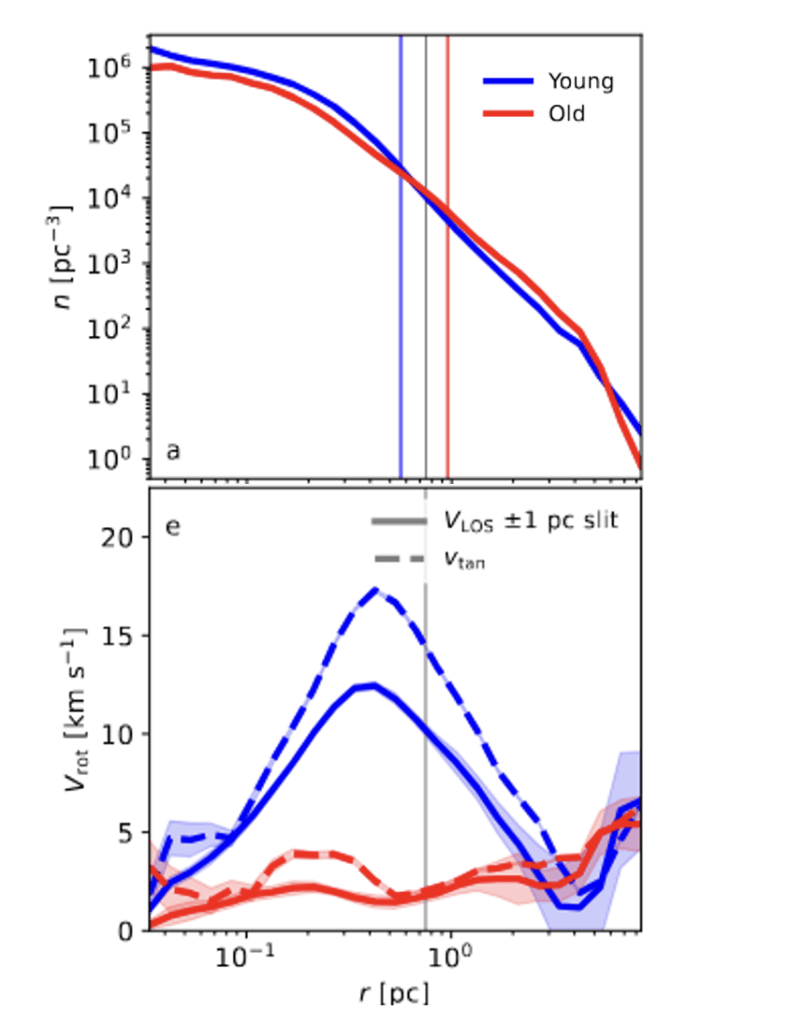
YMCs are often referred to as the “progenitors” of globular star clusters (GCs), the idea being that if you give them 12 billion years to evolve you will likely end up with a GC. One big question in GC studies is why we observe two different sub-populations of stars in many Milky Way GCs. One population (P1) are “chemically normal” with chemical makeups similar to field stars, while the other population (P2) are “light element enhanced”, meaning they have comparatively more Helium, Nitrogen, Sodium, and Aluminum. One theory, which the authors try to examine here, is that these two populations may have formed at different times.
The authors divide the stars in their most massive cluster into the older half and the younger half of the age distribution and compare their kinematic and spatial properties. They found that their younger stars were more centrally concentrated and were driving the vast majority of the rotation of the cluster, while the older stars had very little rotation. They compared this to the Milky Way GC 47 Tuc and found that its P2 stars had very similar properties to the young stars in their simulation.
So, this result could mean that this difference in chemical composition of stars in GCs would be due to an age difference, but it isn’t definitive. For starters, not all GCs with multiple populations have the same differences in kinematics for their P1 and P2 stars, with some having their P1 stars being more centrally concentrated and others seeing no statistically significant difference in kinematics.
Outlook
The authors emphasize that this work is a big step in galactic-scale star cluster formation studies, but that there are still a few ways it can be expanded and improved. First, it would be useful to continue the simulation to allow the simulated YMCs to dynamically evolve. This would allow them to be better compared to the LEGUS star clusters and to see how the kinematic differences in the young and old stellar populations change over time. Second, more detailed prescriptions for chemical enrichment in the code are needed in order to better study the origin of multiple populations in GC progenitors. Regardless, things are really coming together in the field of star cluster formation.
Astrobite edited by Kaz Gary
Featured image credit: Edited from an image of NGC 3169 and NGC 3166 (ESO/Igor Chekalin) and an artist’s impression of young star formation in the Large Magellanic Cloud (NSF/AUI/NSF NRAO/S.Dagnello).
