
Title: A fast radio burst from the first 3 billion years of the Universe
Authors: Manisha Caleb, Themiya Nanayakkara, Benjamin Stappers, Inés Pastor-Marazuela, Ilya S. Khrykin, Karl Glazebrook, Nicolas Tejos, J . Xavier Prochaska, Kaustubh Rajwade, Lluis Mas-Ribas, Laura N. Driessen, Wen-fai Fong, Alexa C. Gordon, Jordan Hoffmann, Clancy W. James, Fabian Jankowski, Lordrick Kahinga, Michael Kramer, Sunil Simha, Ewan D. Barr, Mechiel Christiaan Bezuidenhout, Xihan Deng, Zeren Lin, Lachlan Marnoch, Christopher D. Martin, Anya Nugent, Kavya Shaji, Jun Tian
First Author’s Institution: Sydney Institute for Astronomy, School of Physics, The University of Sydney, Sydney, Australia
Status: Submitted to Nature, available on arXiv
What are Fast Radio Bursts?
Fast Radio Bursts (FRBs) are a relatively new and enigmatic class of astrophysical phenomena. Characterized by short (~millisecond), coherent burst(s) of radio emission, the first FRB was discovered in 2007. Most are single, isolated events, but a small subset of FRBs have been found to emit repeatedly on a variety of timescales. As for their origin, the short answer is that astronomers have no idea!
Astronomers think that FRBs are produced by some of the most energetic processes/systems in the universe, such as gamma ray bursts, neutron star mergers, or magnetars. While FRBs are interesting enough themselves (who doesn’t love a space mystery?), astronomers also use them to measure the distribution of matter across a variety of environments in the universe, probe physical processes in galaxies, map magnetic fields, and even independently measure the Hubble constant!
Pinpointing where a FRB occurs requires a detection of its host galaxy, typically through a spectroscopic measure of the galaxy’s redshift. The majority of FRBs with known host galaxies originate at relatively low redshifts (\(z \leq 0.5\)), corresponding to events occurring within the last ~5 billion years. However today’s authors push the earliest known FRB back a substantial amount. In their paper, they report the detection of FRB 20240304B at a whopping redshift of \(z = 2.148\pm 0.001\), or about 3 billion years after the Big Bang.
A FRB at Cosmic Noon
FRB 20240304B was detected on March 4th, 2024 by the MeerKAT radio telescope. The dynamic spectrum and polarization profile of FRB 20240304B are shown in Figure (1). One of the key features of FRBs is a frequency-dependent delay in the arrival time at the telescope (see panel of Figure). This parameter, called dispersion measure (DM) arises due to the emission propagating through cold, ionized matter in the universe. The DM of FRB 20240304B was estimated to be approximately 2330 \(\mathrm{pc\;cm^{-3}}\), implying a high redshift origin.
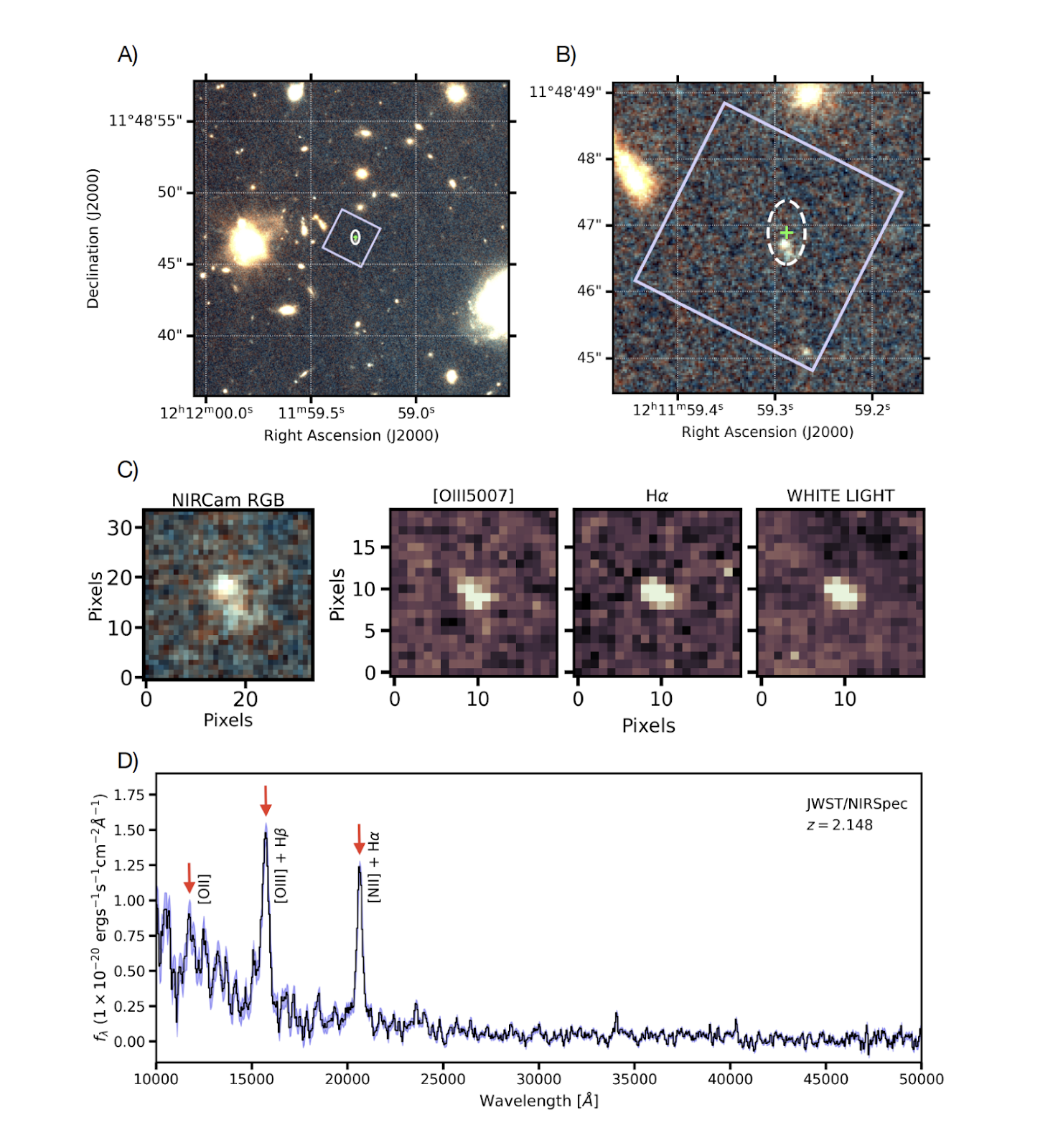
The authors attempt to locate FRB 20240304B’s host galaxy using ground based observatories and archival data came up short. However, follow ups with JWST’s NIRCam and NIRSpec instruments succeeded in revealing the FRB’s host galaxy and obtaining a spectroscopic redshift of \(z = 2.148\pm 0.001\). Imaging and spectroscopic data of the host galaxy is shown in Figure (2).
The host galaxy is found to have an optical luminosity of the order \(2 \times 10^9 \; L_{\odot}\), making it one of the lowest luminosity galaxies ever found to host a FRB. Its stellar mass and star formation rate were found to be \(\sim 10^7 \; M_{\odot}\) and \(\sim 0.2 \; M_{\odot}\;\mathrm{yr^{-1}}\), implying that the host galaxy is forming stars at a pretty high rate given its small stellar mass.

Insights into the Origin of FRB 20240304B
The nature of the host galaxy provides some interesting insights into the origin of FRB 2020304B. Since its host galaxy is relatively young, not very massive, and still forming stars, the presence of a FRB implies an origin which can occur over relatively short timescales, such as young magnetars. Some proposed FRB origins, such as neutron star-neutron star mergers, are very rare, and typically occur in galaxies with older stellar populations, making them unlikely in this case.
A New Era of FRB Science
The detection of FRB 2020304B marks a new step forward in the study of FRBs, and their use as cosmological probes. With further high redshift FRB detections in the future, we can continue to constrain the mysterious nature of their progenitor systems and extend their use as cosmological probes. While FRB 2020304B is the first FRB to extend our insight into the high redshift universe, it certainly won’t be the last!
Astrobite edited by Sparrow Roch
Featured image credit: South African Radio Astronomy Observatory (SARAO)
