
Today’s coverage is focused on the DESI DR2 results, which have been published today in the Physical Review Journal (see the published papers on their Astro website, go.aps.org/astro). For more information about Astrobites’ partnership with APS, see this Astrobite.
This is Part 3 of our coverage of the DESI DR2 results. See Part 1 for discussion of the main results and Part 2 for more coverage of results!
Paper title: Extended Dark Energy analysis using DESI DR2 BAO measurements
Paper first author: K. Lodha, Korea Astronomy and Space Science Institute and University of Science and Technology
Paper status: Published in PRJ [open access]
So the DESI DR2 results indicate that dark energy may be evolving over time. But do they tell us more about what dark energy actually is?
Although we don’t have a lot of information about dark energy, and we’ve never observed it in a lab, we can use the tools of particle physics to write down models of substances that have w near -1 and evolve during cosmic expansion. In fact, we can write a lot of them. The hard part is narrowing it down!
The best w0waCDM fit to the DESI DR2 data indicates that w is greater than -1 today and was less than -1 in the past, crossing -1 somewhere around z = 0.5. That’s surprising! The simplest and best-studied class of evolving dark energy models (if you want a long name, those are the single minimally-coupled scalar fields) can’t allow for w < -1 at all. Also, although we can’t rule it out, anything with w < -1 is really weird. A w > -1 describes a substance that dilutes as the universe expands, and w = -1 is a special edge case where the amount of the substance is proportional to the amount of spacetime, but a w < -1 implies the amount of your substance increases faster than volume does as the universe expands. This raises additional physics complications, unsettles theorists, and should unsettle you. This hypothetical kind of dark energy is called phantom dark energy (there of course papers about it with Phantom Menace in the title).
Since a transition of w across -1, called a phantom crossing, would be a strange feature, the authors perform some extra checks. By default, DESI fits its expansion data to w(z) = w0 + wa*z/(1+z), where w0 is the value of the equation of state of dark energy today, and wa is a coefficient that allows it to vary with redshift. This equation isn’t a physical model itself, just a function that can approximate many physical models for the right choice of w0 and wa. The key word is approximate, so maybe it’s a bad choice of function and the apparent phantom crossing will go away if we fit the data to a different function?
The authors try four other functions of w0 and wa (shown in Fig. 1 below), and they also try adding more parameters or doing the fitting to expressions for energy density rather than equation of state. None of these alternatives get rid of the apparent phantom crossing or improve the goodness-of-fit.
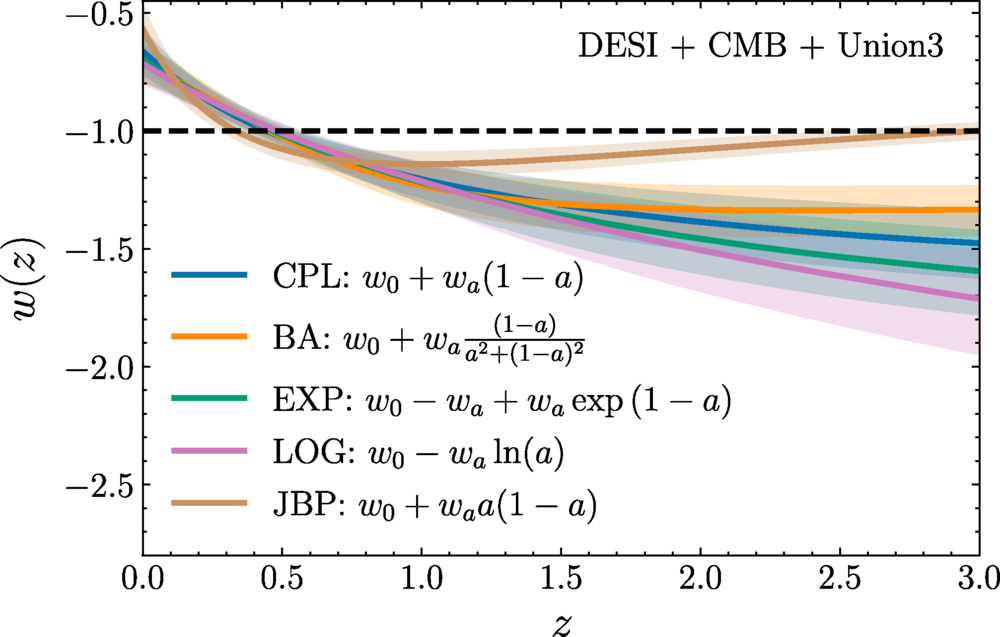
Fig. 1 (Fig. 4 from the paper) w vs redshift when the DESI DR2 data, combined with the Union3 supernova dataset and CMB data from the Planck spacecraft, are fit to the original parameterization of w (the Chevallier-Polarski-Linder parameterization, CPL for short, the blue line) or four alternate parameterizations. All the parameterizations fit approximately as well as each other and have a phantom crossing in roughly the same place except the Jassal-Bagla-Padmanabhan (JBP) parameterization, the brown line, which does not fit the data as well.
Next, the authors try not making any assumptions at all about the functional form of w. They bin the data by redshift in several different ways and see where the results fall relative to w = -1 (see Fig. 2). It’s hard to pin down a potential phantom crossing with this method due to the dependence on where you divide up your bins and large uncertainties, but the binning approach generally agrees with the parameterized result.
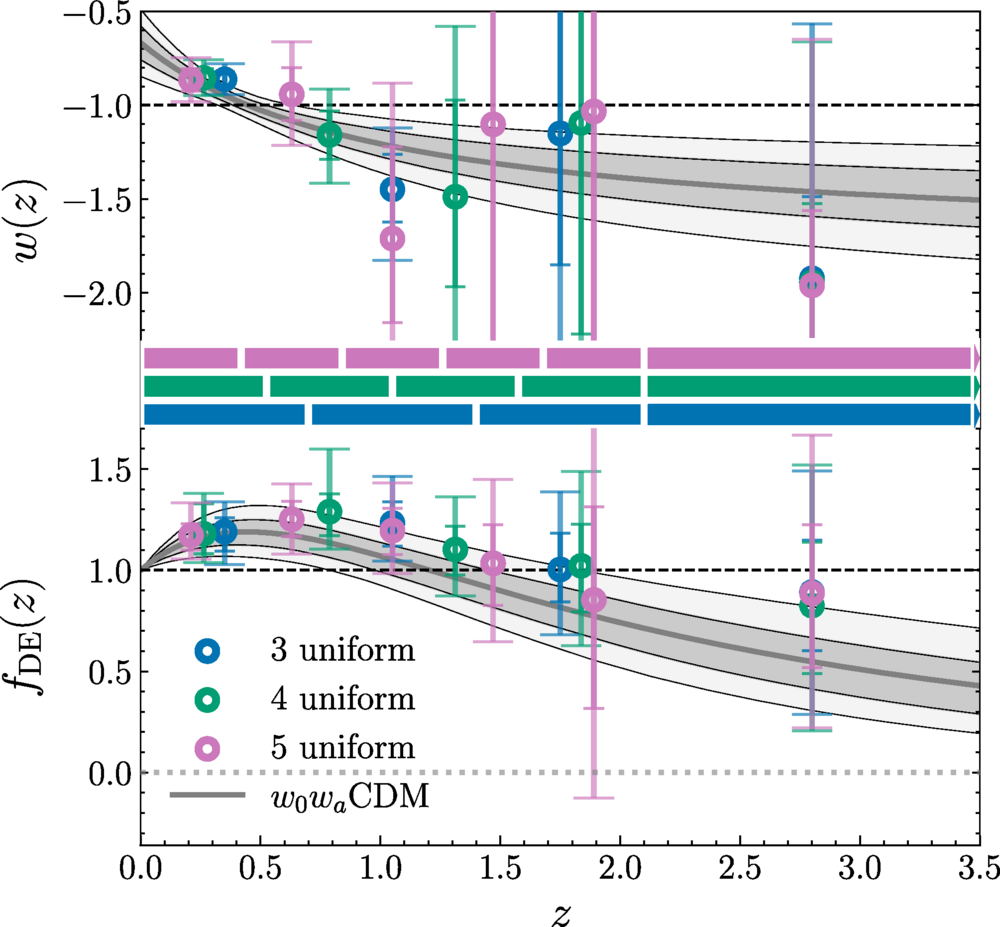
Fig. 2 (Fig. 7 from the paper) w vs. redshift (top panel), and normalized energy density vs. redshift (bottom panel), for the binned data. The three colors are for three different divisions of the redshift range into bins; the bars between the panels show where the bins extend in redshift for each color. The shaded gray area in the background is the best w0waCDM fit and its 68% and 95% confidence intervals, and the dotted black line is at w = -1, that is, ΛCDM.
Finally, the authors try fitting the data to some specific, physically-motivated types of dark energy models which do not have a real phantom crossing but might look like it in an inexact fit. They pick one called thawing quintessence (what a cool name), where dark energy acted like a cosmological constant for a while before w increased later in time, and another called emergent dark energy, where dark energy had little effect until recently. It turns out both of these fit the DESI data worse than the generic w0wa fit.
So, are we stuck? Not at all! There are still plenty of more complicated dark energy models that do allow for phantom crossing: for example, models with multiple components to dark energy, interactions between dark energy and dark matter, or modifications to how gravity works in some situations.
And, it’s still too soon to say that the phantom crossing is definitely real. For one, the evidence for evolving dark energy hasn’t hit 5σ yet – the key threshold necessary to claim a discovery. For another, it’s suspicious that, out of all the many, many evolving dark energy models, our observations apparently fall in the subset that look like a cosmological constant if you fit a static w – so maybe we’re missing a systematic effect.
Dark energy is still mysterious, but that doesn’t make it any less interesting.
Paper title: Constraints on Neutrino Physics from DESI DR2 BAO and DR1 Full Shape
Paper first author: W. Elbers, Institute for Computational Cosmology, Department of Physics, Durham University
Paper status: Published in PRJ [open access]
The implications of this result also extend beyond cosmology and into the realm of neutrino physics. Neutrinos are very tiny neutral particles which belong to a family of particles called leptons (the same family as the electron). In the Standard Model of particle physics, there are three charged leptons (electron, muon, and tau) and three corresponding flavors of neutrino (electron neutrino, muon neutrino, and tau neutrino). Unlike the charged leptons, neutrinos have been seen to oscillate flavors. This means that if you start with one neutrino flavor (for example, an electron neutrino) after it travels some distance, it might oscillate in flavor and be detected as a muon neutrino instead! This phenomenon happens because the neutrino flavor states (electron, muon, and tau) are made up of a combination of neutrino mass states (called 1, 2, and 3).
So, what do tiny neutrinos have to do with the large-scale structure of our Universe?
Neutrinos are important for helping us understand how our Universe expands. Shortly after the Big Bang, neutrinos were among the particles in the hot fluid of the Universe, and these neutrinos helped to determine how the Universe expanded. Early in the Universe, neutrinos behave like radiation, while later they behave like dark matter. This behaviour means that neutrinos make an imprint on the expansion history of the Universe. Today’s authors use the BAO in combination with other cosmological measurements to answer two main outstanding questions in neutrino physics using the BAO: (1) what is the sum of the masses of the three neutrinos? and (2) how many neutrinos are there?
The mass of individual neutrinos is not known. From studying neutrino oscillations, we can calculate the difference between the mass states, but not their individual masses. But this gives us a lower limit on the sum of the masses – if we just sum the differences in mass, the sum of individual neutrino masses must be larger! However, the sum of the neutrino masses impacts the large scale structure of our Universe, so today’s authors can place the strongest limits on the sum of neutrino masses using cosmological measurements.
However, these constraints cannot be placed with the BAO measurement alone. The authors use constraints from different models of cosmology or from measurements of the cosmic microwave background (CMB) which provide critical information to make this measurement.
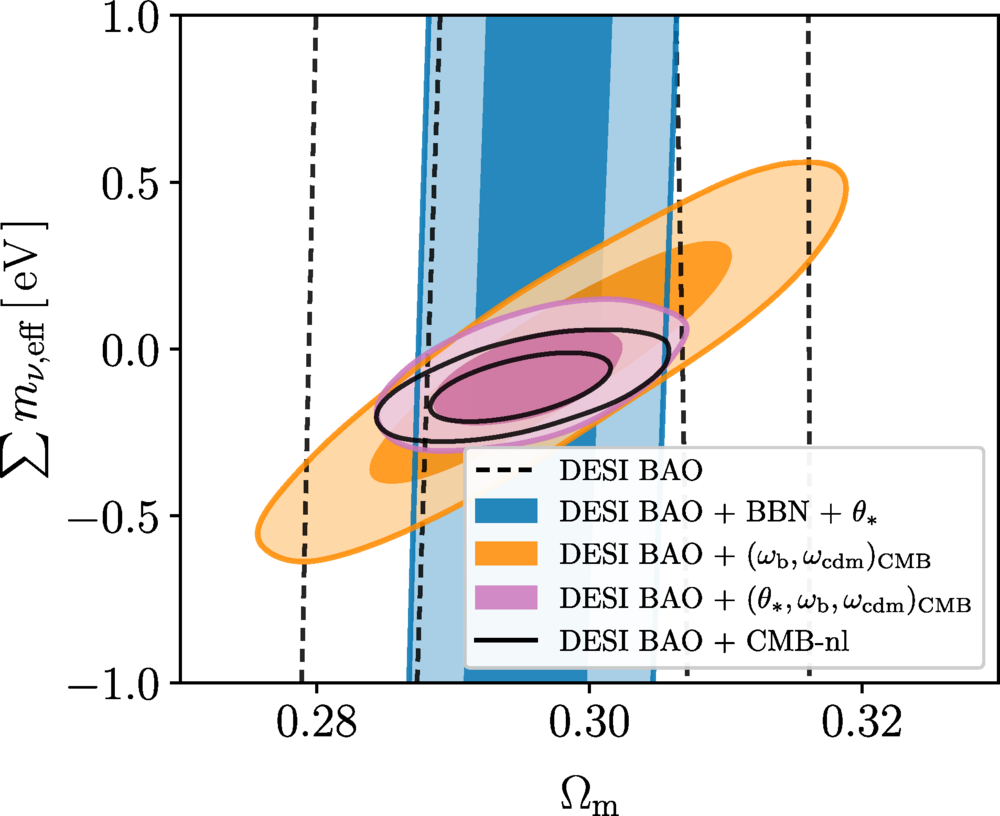
Fig. 3: Constraints on the sum of neutrino masses (y-axis) as a function of the total matter density in the Universe (Ωm). The colored regions show the allowable range of values, depending on the model used. Figure 2 in the paper.
The authors explore many different combinations of their data with different cosmological models and CMB measurements to provide comprehensive limits under multiple cosmological scenarios. They find an upper limit on the sum of the masses very close to the lower limit from neutrino oscillations, assuming the standard ΛCDM cosmology. Indeed, using the BAO measurement and data from CMB experiments and assuming ΛCDM, they find a 2.7-4.0σ tension with current neutrino oscillation results. This constraint relaxes if they instead consider w0waCDM, which is another possible hint that DESI and CMB data might challenge ΛCDM (although it’s not statistically significant yet). But it is also important to note that all of their measurements still agree with massless neutrinos (sum of the masses is 0), which is actually what the Standard Model predicts, although we know that at least two neutrinos still have mass from oscillation experiments.
In fact, they find that their measurements prefer very low neutrino masses, especially for the case of ΛCDM–another piece of evidence that may challenge ΛCDM. They explore several reasons for this preference. One of them is the discrepancy in the value of H0 times rd (the sound horizon when the photons decoupled from baryons in the early Universe). The authors note that a small value of H0*rd from CMB measurements pushes the mass towards lower values. They find that using an evolving dark energy model like w0waCDM relaxes this constraint and is more compatible with results from neutrino oscillation experiments.
They also place a limit on the effective number of neutrino species that existed in this early cosmological period. From our current understanding of the Standard Model, we expect to have 3 neutrino species. But it is possible that there are more than 3, and an additional neutrino species (often called a sterile neutrino) has been proposed as a possible candidate for particle dark matter. Using data from the CMB and constraints on cosmological parameters from the BAO, the authors get a result consistent with the Standard Model and 3 neutrino species.
This analysis shows that understanding the Universe at cosmological scales has yielded constraints on the very tiny scale of the mass of the neutrino. There are many open questions remaining about the fundamental nature of neutrinos, including how they get mass, and the mass of each neutrino mass state. It is especially interesting that there is some tension remaining between particle physics measurements and those described here from cosmological measurements, especially when considering ΛCDM as the cosmological model. With more data from DESI and particle physics experiments we hope to better understand the fundamental nature of the neutrino.
Edited by: Brandon Pries and Abbé Whitford
Featured Image Credit: DESI Collaboration/KPNO/NOIRLab/NSF/AURA/P. Horálek/R. Proctor (CC BY 4.0)

