
Title: “Near the Runaway: The Climate and Habitability of Teegarden’s Star b”
Authors: Ryan Boukrouche, Rodrigo Caballero, and Neil T. Lewis
First Author’s Institution: Department of Meteorology & Department of Astronomy, Stockholm University, Sweden
Status: Published in The Astrophysical Journal Letters [open access]
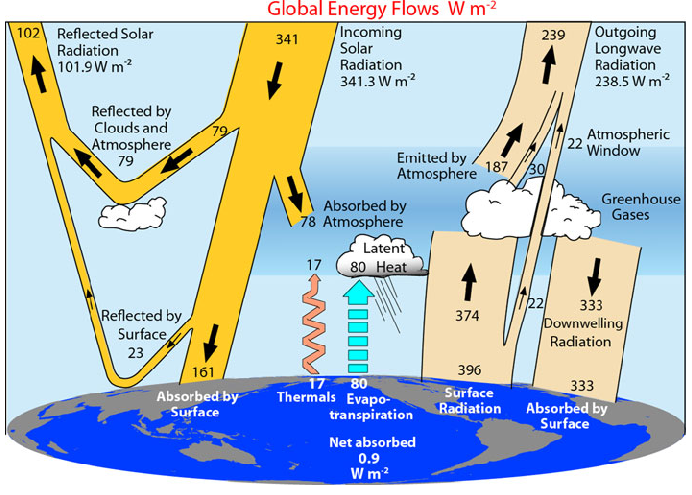
To find life on other planets, we start our search for planets like Earth. (It’s the best example of a habitable planet that we know of!) Earth’s distance from the Sun allows for liquid water to exist on the surface, which is vital for life as we know it. This region, called the “habitable zone”, describes the right atmospheric conditions and proximity to its host star that a planet can have to support liquid water. Earth is also special because of its atmosphere, which contains greenhouse gases such as water vapor and carbon dioxide (CO2); these help keep the average global temperature moderate enough for life to exist.
A few factors govern the habitable zone for a given solar system: for example, the strength of a star’s radiation, the composition of the planet’s atmosphere, and a planet’s orbital period around its star. This is because a planet’s “energy budget” is dictated by these factors. For a planet to have a “stable” climate, the energy it receives from its star must balance the energy it re-emits. For instance, in a given solar system, the closer a planet’s orbit is to its host star, the more sunlight it receives and therefore the more energy it must radiate away. This balance is between outgoing longwave radiation (OLR), which is heat emitted by the planet, and absorbed/incoming shortwave radiation (ASR or ISR), which is the sunlight the planet receives from its host star. (You can see Earth’s energy balance in Figure 1. Along the top of the figure, if you take the value of the down arrow and subtract the two up arrows, you should get a value of 0 W/m².)
Some Earth-like analog planets have piqued the interest of astronomers because observations suggest that they lie within the habitable zone for their respective solar systems. One system, named after its discoverer, Bonnard Teegarden, features an M-dwarf star with three orbiting Earth-mass planets. It exists about 12.5 light-years away, making it one of the closest solar systems to us. One of the planets, Planet b, is believed to have very similar characteristics to Earth: a radius of 1.02 REarth and a mass of 1.16 MEarth. Because the planet orbits an M-dwarf star, which is much cooler (temperature-wise) and less massive than our Sun, the planet’s orbit is much, much smaller than Earth’s, with a semimajor axis of 0.0259 AU (compared to 1 AU for Earth) and an orbital period of 4.9 days (compared to 365 days for Earth).
The authors of today’s paper explore how close Planet b is to its habitable zone based on current observations, and how future observations could lead to vastly different interpretations of its habitability.
Exoplanets are small and faint, making it difficult for current technology to study their atmospheres accurately. Modern simulations, known as general circulation models (GCMs), can model how a planet’s atmosphere might behave under various assumptions. Isca, the climate and atmospheric dynamics model used in this paper, has been used to model exoplanetary atmospheres in previous studies. Modelling a planet around an M-dwarf, the authors tried matching the planet’s properties as closely as possible to Earth, using a simple cloud model (which is challenging to model), moist physics (since our atmosphere contains water vapor), and a radiative transfer scheme. In their simulation, the authors also assumed that Teegarden b is tidally locked, meaning its dayside always faces its sun. For example, our Moon always shows the same side to us on Earth and is considered tidally locked.

One way to change a planet’s energy balance is to reduce the amount of absorbed shortwave radiation (ASR or ISR) by reflecting a percentage of it as it reaches the planet’s surface. For example, Earth is covered in ice and clouds, which help reflect some sunlight away from the surface. (You can see this value for Earth in Figure 1.) This property, known as albedo, is a crucial factor to consider when discussing the habitable zone of a planet. To explore the effect of albedo, the authors investigated two different values: 0.07 for an ocean-dominated planet (7% of radiation deflected) and 0.3 for a land-dominated planet (30% of radiation deflected, which roughly matches Earth’s albedo).
They also assigned Planet b a similar atmospheric composition to Earth: 78% nitrogen (N2), 28% oxygen (O2), and a CO2 concentration of 400 ppmv. Unlike Earth, they did not include an ozone layer; however, they state that including one did not significantly change the results. Combinations of these different factors were run for 8 to 41 Earth years, until the Planet b model either reached a stable state (where the energy balance equals 0 W/m²), or it exceeded the runaway greenhouse gas threshold–the point at which the energy balance exceeds zero, and the planet’s surface temperature increases uncontrollably (see Fig. 2).
The average amount of radiation that a planet receives is called its instellation, or sometimes “insolation” when talking about our Sun. For reference, Earth has an insolation value of around 1365 W/m². Different studies of Planet b suggest an instellation of 1481 W/m² or 1565 W/m², so the authors explore both.
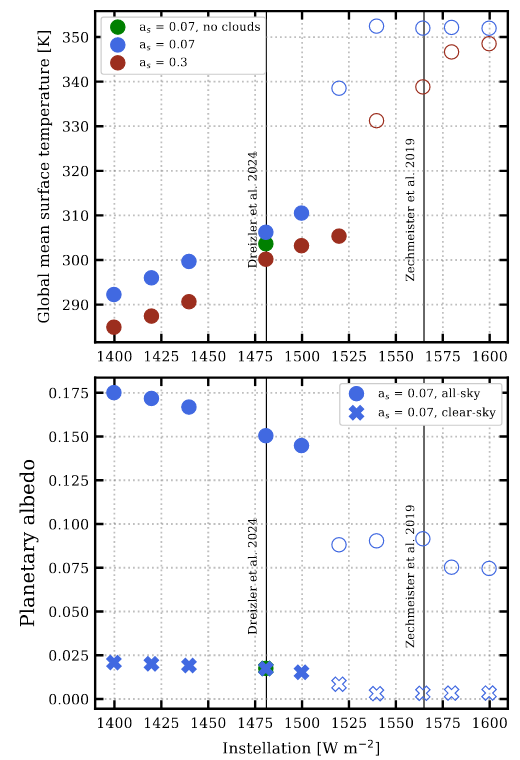
The biggest difference in results comes from the two different instellation values of 1480 and 1565 W/m² (see Fig. 3). For 1480 W/m², Teegarden b lies just within the habitable zone, but admittedly not by much. It’s only about 20 to 40 W/m² away from becoming uninhabitable. This would give Planet b a mean surface temperature about 18 K higher than that of present-day Earth. Since a Kelvin is equivalent to a degree Celsius, a temperature of 18 degrees Celsius above your average day on Earth is pretty hot and unlikely to be comfortable for lifeforms similar to ours. The precipitation would also be similar to the wettest regions of the Sahara Desert, so overall, Planet b would be a relatively dry planet. For 1565 W/m², Planet b crosses the runaway greenhouse threshold and cannot be considered habitable for life similar to ours.
Our best guess of the habitability of Planet b is highly dependent on future observations and measurements. A slight change in the estimate of the planet’s instellation could have drastic consequences for its habitability. The assumptions of the authors’ model—its atmospheric composition and how heat and moisture are transported through the atmosphere—might also affect this habitability. We don’t quite know why Earth has its particular atmospheric composition, especially 78% N2, so why might Planet b have the same? A CO2 concentration of 400 ppmv also aligns with present-day Earth values, but pre-industrial CO2 levels on Earth were approximately 280 ppmv. As for future observations, it might be possible to measure the potential presence of N2 through indirect ways using the Large Interferometer For Exoplanets (LIFE). Teegarden’s Star b is still a promising Earth analog, but we’ll need better information in the future to constrain some of these assumptions.
Astrobite edited by Joe Williams
Featured image credit: Mckenzie Ferrari (made in Canva)
