
Title A carbon-rich atmosphere on a windy pulsar planet
Authors: Michael Zhang, Maya Beleznay, Timothy D. Brandt, Roger W. Romani, Peter Gao, Hayley Beltz,
Matthew Bailes, Matthew C. Nixon, Jacob L. Bean, Thaddeus D. Komacek, Brandon P. Coy,
Guangwei Fu, Rafael Luque, Daniel J. Reardon, Emma Carli, Ryan M. Shannon,
Jonathan J. Fortney, Anjali A.A. Piette, M. Coleman Miller, and Jean-Michel Desert.
First Author’s Institution: Department of Astronomy & Astrophysics,University of Chicago, Illinois, USA
Status: Submitted to The Astrophysical Journal Letters [open access]
When we hunt for exoplanets, we typically picture worlds orbiting main-sequence stars like our Sun. But the universe is rarely so accommodating. In the time that we have been searching for other worlds, we have found some truly bizarre and extreme places.
Some of the most extreme planetary environments exist around pulsars: rapidly rotating, highly magnetized neutron stars that blast the cosmos with beams of radiation. It’s such an unlikely place to look for planets that when astronomers discovered the first two “pulsar planets” in 1992, they could hardly believe it. Surely no planets should exist there at all! Fast forward to today, and pulsar planets remain some of the most enigmatic worlds out there.
Among these rare systems is a number of special cases known as “black widows.” In these violent partnerships, a millisecond pulsar is orbited closely (often in less than a day) by a low-mass companion. The system gets its arachnid nickname from its evolutionary history: the pulsar was “spun up” to incredible speeds by accreting mass from its companion in a previous life as a low-mass X-ray binary. Then, the energetic pulsar blasts its companion with high-energy radiation, slowly evaporating it away until the companion gets closer and closer to something we would call a planet instead of a star.
While roughly 50 black widow systems are known, most companions have been stripped down to tiny, dense and very hot remnants. However, the object at the center of today’s paper, PSR J2322-2650b, is a distinct outlier. It is a black widow companion that uniquely resembles a traditional “hot Jupiter” exoplanet, boasting a mass of roughly 0.8 times the mass of Jupiter and a density of only 1.8 grams per cubic centimeters. Because the pulsar itself is invisible at infrared wavelengths, this system offers a rare opportunity for the authors to study the atmosphere of this object with the James Webb Space Telescope (JWST).
To understand the atmosphere, the team employed two distinct strategies using different modes of the NIRSpec instrument:
First, the team used the low-resolution PRISM mode to stare at the system for a full 7.8-hour orbit. This allowed them to measure the planet’s emission from both the scorching “day” side facing the pulsar and onto the cooler “night” side. The resulting spectrum was bizarre. Instead of the smooth curves typical of cloudy worlds or the familiar bumps of water vapor, the spectrum showed a “sawtooth” pattern and a dramatic “cliff” where the flux suddenly dropped off (see Figure 1).

Figure 1: This figure shows the light collected from the planet at three different orbital phases: the “Dayside” (top/orange), “Quadrature” (middle/purple), and “Nightside” (bottom/dark purple). While the nightside spectrum is mostly flat and featureless, suggesting thick clouds or uniform temperatures, the dayside reveals sharp, distinct shapes. In the bottom panel, the authors try different model fits to identify the patterns in the spectrum as diatomic and triatomic carbon. Figure 1 in the paper.
While the nightside spectrum is featureless and consistent with a nearly even temperature profile or a thick grey dust/cloud deck, the dayside spectrum has clear absorption features and a temperature above 2000 kelvin.
By comparing these features against opacity databases, i.e. catalogs of how different molecules absorb light, the authors identified the “cliff” as a massive absorption feature caused by triatomic carbon C3. The sawtooth pattern at shorter wavelengths strongly hinted at diatomic carbon C2.
To confirm the presence of C2 and search for other molecules, the team followed up with the G235H grating, which offers much higher spectral resolution. They used a technique called cross-correlation spectroscopy, where you, in essence, use a template of a specific molecule that you then slide across your noisy data to see if it “clicks” into place. The authors did exactly this, cross-correlating the expected opacity of C2 with their observations. The match was definitive (21 sigma detection), confirming the presence of C2. Interestingly, when they searched for common hot Jupiter molecules like water (H2O), methane (CH4), and carbon monoxide (CO), they found nothing. They did note, however, that the spectrum cannot be explained by C3 and C2 alone, and they speculated that some of the features may come from the bonding between carbon and hydrogen in the atmosphere.
But the chemical makeup of PSR J2322-2650b gets even stranger. The team’s models indicate that for diatomic carbon to be this visible while carbon monoxide is absent, the atmosphere must have a Carbon-to-Oxygen ratio (C/O) greater than 100 and a Carbon-to-Nitrogen ratio (C/N) greater than 10,000. For context, the Sun has more oxygen than carbon, and even “carbon stars” (stars with carbon-rich atmospheres), where a C/O ratio of more than one is a defining characteristic, don’t get anywhere near that high.
To add to the strangeness, the atmosphere seems to be very dynamically active. In a simple system, the hottest part of the planet is the point directly facing the star. However, the authors found that the brightest thermal emission occurred about 12 degrees after that point passed into view. This “westward offset” may indicate that powerful winds are blowing against the direction of rotation, dragging the heat around the planet (see Figure 2).
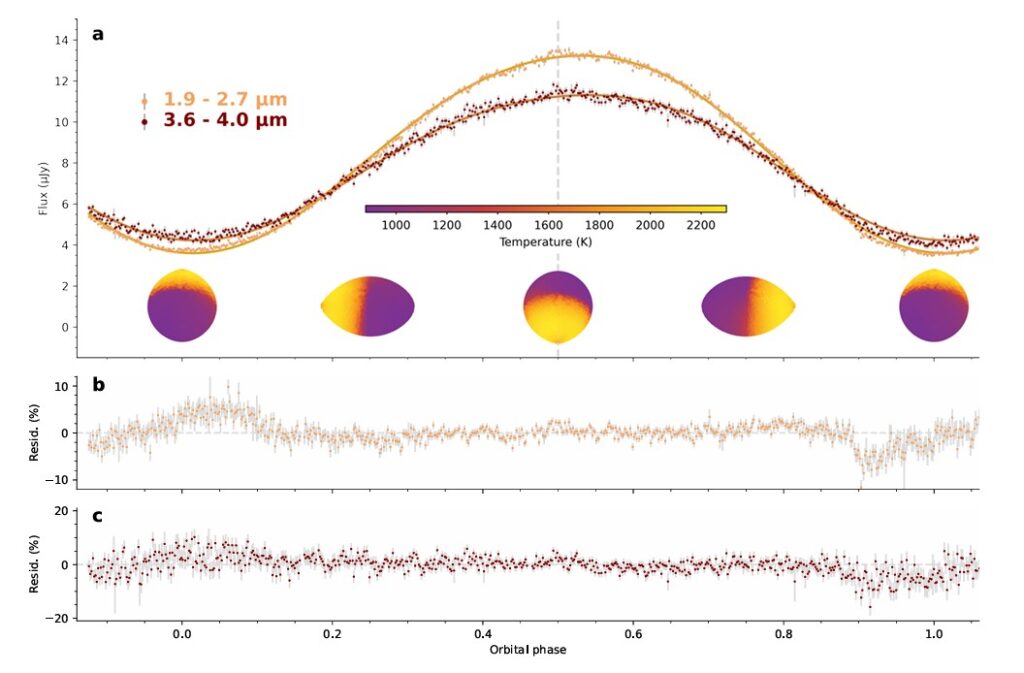
Figure 2:This figure tracks the planet’s brightness over a full orbit. The peak brightness does not happen exactly at phase 0.5 (when the dayside faces us directly). Instead, it occurs about 12 degrees later. This “westward offset” suggests powerful winds are blowing opposite to the planet’s rotation, dragging the hottest part of the atmosphere away from the sub-stellar point. Figure 4 in the paper.
The leading theory for black widow formation involves a pulsar stripping away the outer hydrogen envelope of a normal companion star, leaving behind a dense core. However, stripping a normal main-sequence star or even a red giant simply doesn’t produce the extreme C/O or C/N ratios seen here. The atmosphere is just too rich in carbon. The authors go on to speculate on how such a companion star-turned-wannabe planet could have come to be. Several exotic options exist, such as the companion having been a R Coronae Borealis star, a product of a merger between a He- and CO-rich white dwarf that then paired up with the pulsar. However, such a scenario is unlikely and still doesn’t guarantee a high enough C/O ratio to explain the one obtained from the atmospheric spectrum.
In the end, the authors conclude that we need to look for more of these bizarre worlds to figure out if PSR J2322-2650b is a cosmic freak or a common end-state for stars eaten by their neighbors.
Astrobite edited by Lucie Rowland
Featured image credit: NASA / JPL-Caltech
