
Title: Testing general relativity with amplitudes of subdominant gravitational-wave modes
Authors: Ish Gupta, Purnima Narayan, Lionel London, Shubhanshu Tiwari, Bangalore Sathyaprakash
First Author’s Institution: Department of Physics, University of California, Berkeley, CA 94720, USA
Status: Available on arXiv.
What are gravitational-wave modes?
Imagine sitting across from your friend in a crowded restaurant as they tell you a story. If you turn your head, you can overhear the conversation at the table next to you, and if you have sharp hearing, you may even catch a few words from the family a few tables down. Nevertheless, you direct your focus to the conversation in front of you.
Similarly, gravitational waves can be broken down into components, called modes. Some dominate the signal, like the story your friend tells you from across the table, while others are subdominant, like the conversations happening at the other end of the restaurant. Together, these modes add up to the full gravitational wave signal that detectors observe.
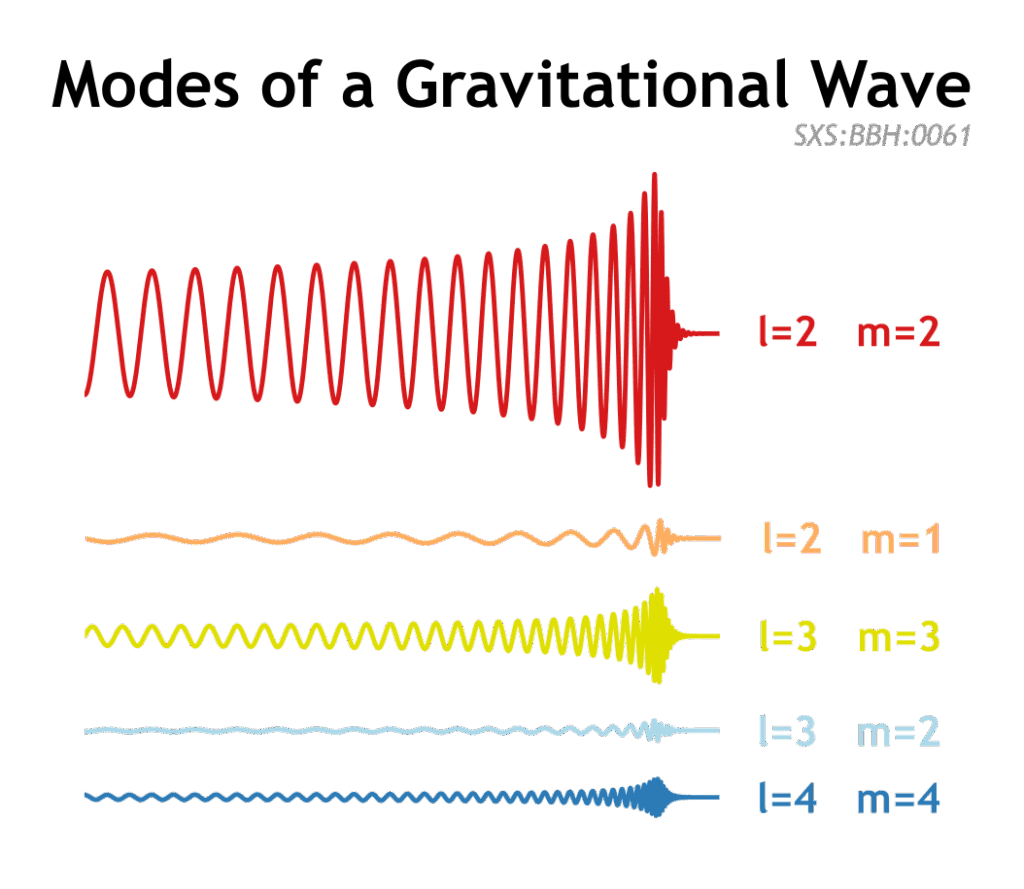
Physicists label each mode using two numbers (l, m), which come from solving Einstein’s equations (if you’ve taken a quantum mechanics course, these numbers are similar to the orbital and magnetic quantum numbers!). For a gravitational wave coming from two black holes merging, the loudest mode is generally the (2, 2) mode, and all other modes are subdominant. Figure 1 shows an example of how different modes that make up a gravitational wave from a binary black hole merger differ in loudness and shape.
Testing general relativity
The simulation shown in Figure 1, as well as other simulations and models for gravitational waves from binary mergers, rely on Einstein’s theory of general relativity (GR). But what if GR isn’t completely correct? It must be at least mostly correct, since it has been incredibly successful in predicting the outcome of countless experiments. Nevertheless, observations of gravitational waves by the LIGO and Virgo detectors allow physicists to scrutinize the theory in a variety of new ways.
In today’s paper, the authors implement the subdominant-mode amplitude (SMA) test for binary black hole mergers. This test explores the possibility that the dominant mode is just as predicted by GR, but the amplitudes of subdominant modes depart from predictions. In particular, the test estimates how large these deviations might be, so a deviation of 0 means the amplitudes are fully consistent with GR. They consider the dominant (2, 2) mode and the subdominant (2, 1), (3, 3), (3, 2), and (4, 4) modes.
Does the test work?
Before claiming to have found a violation of GR, you’d better be sure that it is not due to random noise fluctuations in the data or errors in your model. To this end, the authors examine in what cases the SMA test may find nonzero deviations in the mode amplitudes in signals that are fully consistent with GR.
The authors find that, if the model used to analyze the data accurately captures the properties of the system, 0 generally falls within the 99% credible interval computed by the test, even with noisy data. However, gravitational wave models often make approximations or lack physical effects like precession or eccentricity that may, although rarely, be present. The authors find that these errors can result in the SMA test finding false violations of GR, and extra care must be taken to rule these out when analyzing real data.
Then, they check if the SMA test can capture deviations from GR by performing the test on a signal with altered subdominant mode amplitudes. They successfully find the correct deviation values, ensuring that the test serves its purpose.
What can we say with current observations?
Unfortunately, in real gravitational-wave data, subdominant modes are usually drowned in noise. However, if the signal is particularly loud or if one of the black holes is much more massive than the other one, some modes beyond the (2, 2) mode may be distinguishable.
Two LIGO-Virgo observations make ideal candidates for the SMA test: GW241011 and GW230814. GW241011 came from a system with very unequal masses, producing an observable (3, 3) mode. Meanwhile, GW230814 was a very loud signal with a clear (4, 4) mode. The authors performed the SMA test on both.
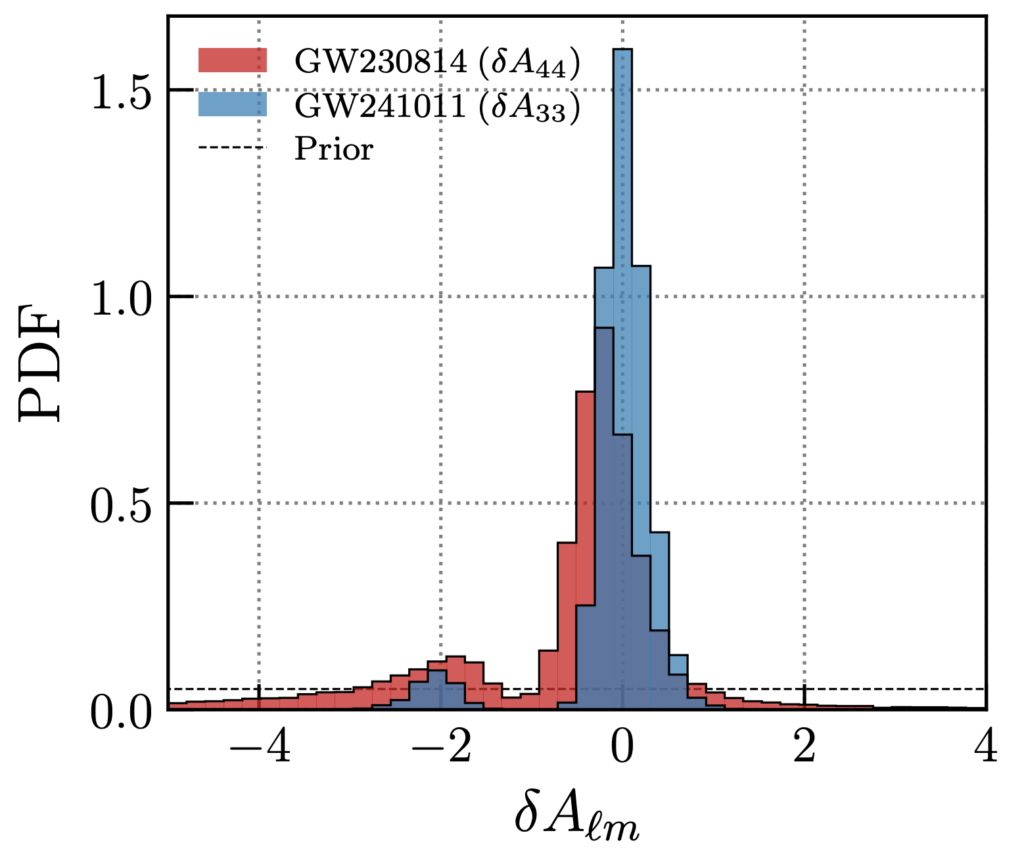
Figure 2 shows the probability distributions of how large the deviations are likely to be. As seen in the figure, these distributions peak around 0, meaning that the mode amplitudes of these signals are consistent with GR.
As the gravitational-wave catalog expands and detections get better, tests like this one will place stronger and stronger constraints on GR, or perhaps someday, reveal its flaws. For today, however, GR stands its ground as the best description we have of strong gravity and lives on another day!
Astrobite edited by Katherine Lee.
Featured image credit: Viviana Cáceres.
