
Title: Could a Primordial Black Hole Explosion Explain the KM3NeT Event?
Authors: Lua F. T. Airoldi, Gustavo F. S. Alves, Yuber F. Perez-Gonzalez, Gabriel M. Salla, Renata Zukanovich Funchal
First Author’s Institution: Instituto de Fisica, Universidade de Sao Paulo, C.P. 66.318, 05315-970 Sao Paulo, Brazil
Status: Published in the Physical Review Letters [closed access]
On February 13 2023, a detector at the bottom of the Mediterranean Sea observed the highest-energy neutrino ever recorded. This was the Cubic Kilometre Neutrino Telescope (KM3NeT), and the neutrino it detected had an energy of 220 peta-electron volts — the world’s most powerful particle accelerators can’t even make a particle that has one-ten-thousandth of this energy. In today’s paper, the authors investigate whether this high-energy particle could have come from the death of a primordial black hole (a black hole that formed less than a second after the Big Bang).
Wait, what are neutrinos and why are we using an underwater telescope to look for them?
Neutrinos are the most abundant subatomic particles in the universe that have nonzero mass. But even though they’re so common, they’re annoyingly and notoriously difficult to detect because they rarely interact with other matter. At this moment, there are about a hundred trillion neutrinos passing through your body without you even noticing.
At the bottom of the sea, the KM3NeT telescope is shielded from other particles — such as photons, electrons, and protons — which all get absorbed by water before they can reach the detector. The only thing that can make it down that far is a neutrino. On the rare occasion that a neutrino interacts with a water molecule down there, it’ll produce a faint blue flash that the telescope can detect.
All of KM3NeT’s detectors haven’t been placed in the sea yet, but once complete, the telescope will span roughly a cubic kilometer of water. This gigantic size will improve KM3NeT’s chances of detecting neutrino interactions.
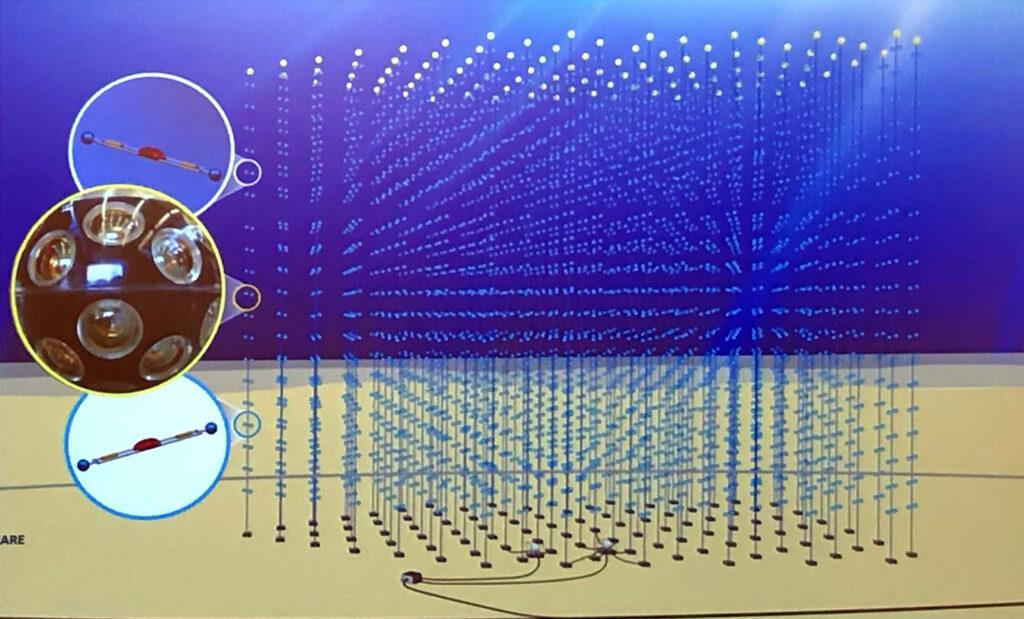
Primordial black holes might die in explosions that release high-energy neutrinos
Typical black holes are created from the deaths of massive stars, but primordial black holes are a theoretical type of black hole that formed soon after the Big Bang. We’ve never observed one of these before, but we’ve calculated that they could range from very tiny (a hundred thousand times less massive than a paper clip) to very large (a hundred thousand times more massive than our Sun) depending on the exact time that they formed.
These primordial black holes might not hang around forever, though — Stephen Hawking predicted that black holes will eventually evaporate away through Hawking radiation (see this Astrobite for a good explanation of this complicated process). This evaporation would be slow at first, but as the black hole gets smaller the process would speed up, ending in an explosion of particles that would have energies similar to the neutrino that KM3NeT detected.
Was the neutrino from a primordial black hole?
For a dying primordial black hole to have created the neutrino that KM3NeT observed, it would’ve had to be a tiny black hole (with roughly the same mass as a small mountain) located about 1.2 billion kilometers away from us (which is about how far away Saturn is).
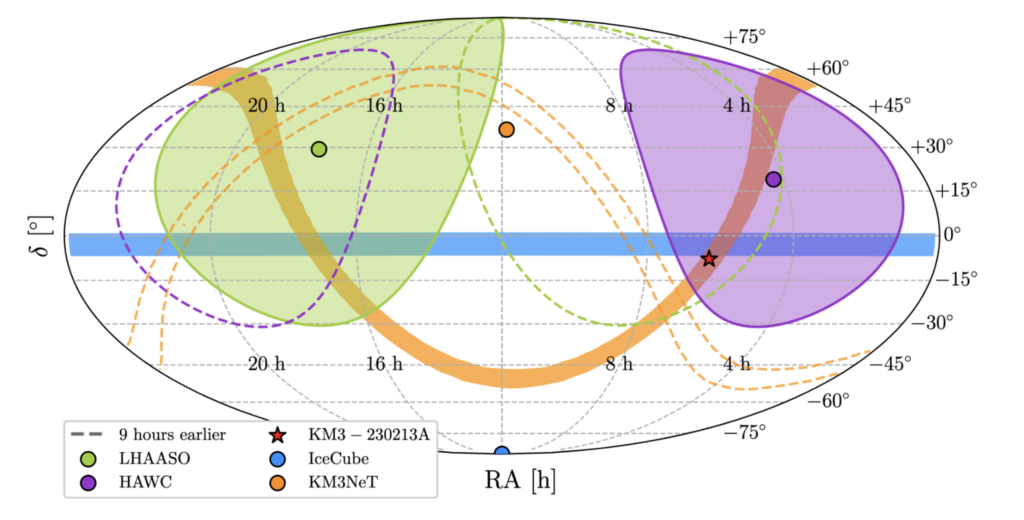
However, the death of a primordial black hole wouldn’t just create neutrinos — we’d expect to see other high-energy particles like gamma rays from it as well. Also, these particles should have been detected in the hours leading up to the death of the primordial black hole, not just at the final explosion. The authors of today’s paper looked at detections from two gamma-ray observatories — the Large High Altitude Air Shower Observatory (LHAASO) and the High Altitude Water Cherenkov observatory (HAWC) — and another neutrino observatory called IceCube in order to investigate this. The sky coverage for these observatories is shown in Figure 2.
LHAASO should have detected hundreds of millions of gamma-ray photons between fourteen and seven hours before the black hole’s death, and IceCube should have observed ~100 neutrino events in the black hole’s final moments. However, neither of these observatories detected anything like that. (HAWC could have detected gamma rays as well, but it wasn’t operational at the time.)
It’s pretty unlikely that these observatories would just miss these signals, so today’s authors conclude that the high-energy neutrino that KM3NeT detected most likely did not come from a dying primordial black hole.
Discovering the death of a primordial black hole would make history, but it hasn’t happened quite yet
When a primordial black hole evaporates, we’d expect it to release a whole range of different particles that we could detect with many different instruments. In the future, multi-messenger astronomy (observations of many different types of signals from space) could eventually allow us to observe these explosive events for real.
For now, researchers aren’t sure what created the high-energy neutrino that KM3NeT detected. It could have come from other high-energy sources like supernovae or active supermassive black holes, but there aren’t any obvious candidates in the area of sky it came from. The authors of today’s paper don’t provide any further speculation on the neutrino’s source.
Astrobite edited by Catherine Slaughter
Featured image credit: 1973-2018 CERN / Gargamelle: First Neutral Current


As an alternative model I’m exploring a scenario in which some non‑repeating FRBs and isolated UHE neutrinos originate from the delayed collapse of supramassive magnetars into black holes, a process I refer to as the Delayed Magnetar Black Hole Collapse (DMBHC) engine. In this picture, the terminal collapse both disrupts the magnetosphere, producing a one‑off FRB, and launches a short, baryon‑loaded outflow capable of generating PeV–EeV neutrinos through hadronic interactions without requiring a GRB. The rates, energetics, and multi‑messenger signatures predicted by this channel appear broadly consistent with current observations.
If anyone is aware of prior work that explicitly treats delayed supramassive magnetar collapse as a joint FRB–UHE neutrino pathway, I’d be grateful for pointers. I’m mainly interested in presenting the concept and seeing whether this collapse channel has already been explored or constrained in the literature.