
In this series of posts, we sit down with a few of the keynote speakers of the 247th AAS meeting to learn more about them and their research. You can see a full schedule of their talks here, and read our other interviews here!
Look closely at the heart of any galaxy, and more often than not, you will encounter a monstrous supermassive black hole (SMBH), often weighing a whopping million to billions of solar masses. How did these gigantic black holes form? How are their lives intertwined with their host galaxies? How can we learn about the nature of dark matter? These are just some of the questions that Dr. Natarajan has been at the forefront of deciphering for over three decades.
Priyamvada Natarajan is the Joseph S. and Sophia S. Fruton Professor of Astronomy and Physics as well as the Chair of the Astronomy Department at Yale, and the winner of the 2025 Dannie Heineman Prize for Astrophysics for groundbreaking contributions to our understanding of dark matter substructure in galaxy clusters, the formation and fueling of black holes, and their feedback into the surrounding environment.
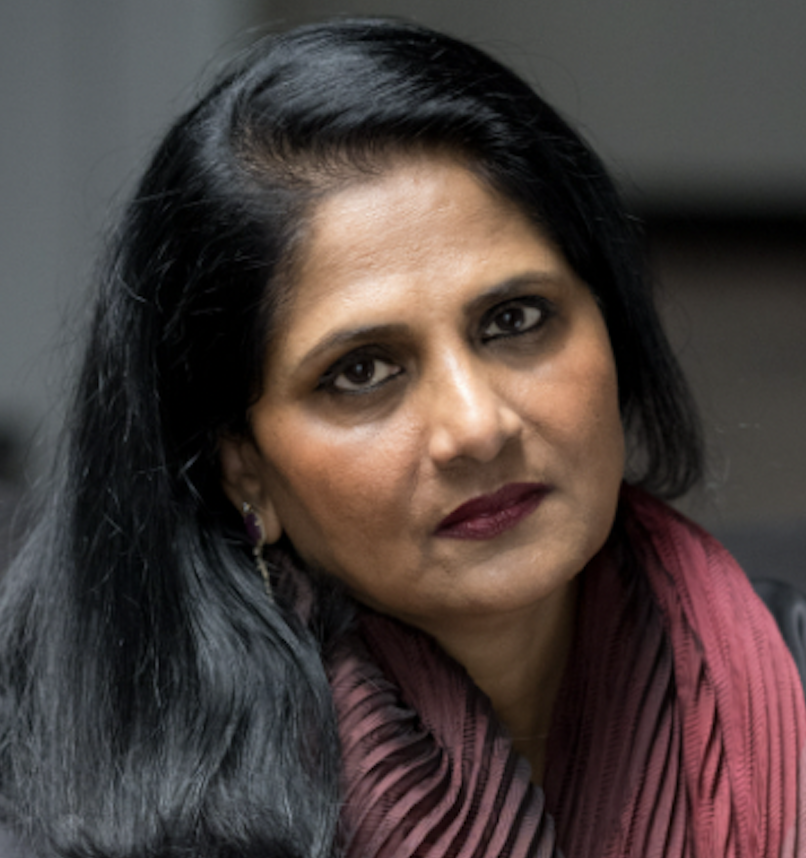
Growing up in an academic family in Delhi, India, Dr Natarajan had always been interested in a plethora of different topics ranging from history to math and physics. She was also an avid amateur astronomer, and in her high school years in the mid-1980s, not only did she write a computer program for generating sky maps, but she also worked on tracking and mapping sunspots. She moved to the US for her undergrad at MIT where she explored topics ranging from the architecture of Venice in the 1400s to early universe cosmology in research projects.
Continuing on a circuitous route into astrophysics, she initially started a PhD in the History and Philosophy of Science at MIT. During this time, she recalls an interaction with Martin Schwarzschild that motivated her to get back to astrophysics research. This led her to once again cross continents and pursue a PhD at Cambridge University, where she worked with Martin Rees. This was in the 1990s, which was an exciting time with the launch and operation of two flagship space observatories Hubble and Chandra. This was also when an empirical relation between the mass of supermassive massive black holes (SMBHs) and their host galaxies was first uncovered. For her thesis one of the projects she tackled was to make sense of this correlation, and understand the various factors that went into it, such as the black holes, the galaxies, and the dark matter within them. She attempted to integrate that into our account of structure formation, and build a model where one could look at the co-evolution of SMBHs and galaxies over time, and make predictions, such as the number of quasars as a function of redshift. During her PhD, she also made significant contributions to mapping the underlying distribution of dark matter using galaxy clusters. She recalls, “Hubble Space Telescope was starting to provide brand new images of cluster lenses, these very dramatic gravitational lensing events that you could see by eye (…) So I delved into that, because that was the super exciting new data set. So, in a way, a lot of my work (…) and the questions that drive me have been shaped very much by the data, (…) by what we are seeing, and what kinds of new explanations we need.”
After completing her PhD and a short detour at the Canadian Institute for Theoretical Astrophysics (CITA), she started as a junior faculty at Yale, and she has been there ever since. That is where she started thinking about the first black holes, and how they formed, a question that has been gaining a lot of traction recently thanks to breakthrough observations with JWST. With her postdoc, Dr Natarajan developed some of the first models of how the first black holes could have formed early on through the direct collapse of pristine (free of metals) primordial gas, and continued working with her group and collaborators making concrete predictions about the properties of these black holes and correlations with the galaxies in which they live. Recently, several of these predictions have been found to spectacularly match the data through joint observations by JWST and Chandra of UHZ1. She highlights that we are currently in a golden age of astronomy and astrophysics and mentions, “I just think it’s super, super exciting time to be alive and working in research right now, and I’m just thrilled (…) what inspires me every day is that there’s some unusual object that’s detected, (…) and I want to see, okay, how can I explain this? How can I explain all the spectral features? Can I explain everything that’s seen? Can I make an additional prediction, that can be detected in the future, which can validate or invalidate it? (…) This process (of prediction and validation) has gotten amplified, it’s been sped up with the JWST. So within the span of a career the entire cycle of prediction and validation can be completed.”
Advice for undergraduate and graduate students
Dr Natarajan emphasizes the importance of developing a mastery in foundational material such as physics, math, and computing. She also encourages everyone to “not lose the childlike sense of joy that you get out of figuring something out. (…) it doesn’t have to be a discovery. Even if you redo a derivation, (…) think through it, do it your own way, and understand it. That is joy. That is to be celebrated. You have to savor that feeling.” She emphasizes that during research, there will always be many ups and downs, frustrations, and dead ends , but that it is important to develop a mindset to deal with them, and to always seek out the little joys that keep one going. She is also very excited about the rapid advances occurring in AI and Machine Learning. She mentions that these technologies are going to transform lives and scientific research, and advises younger people in the field to “understand AI and machine learning tools, and to just always have an expanded toolkit.”
Dr Natarajan’s plenary talk at AAS247 will delve deeper into the compelling evidence that has emerged recently for forming black holes through direct collapse. Looking towards the future, she will also talk about some of the exciting open questions in the distribution of black holes in the universe. She will also highlight recent work on techniques to test some of the fundamental questions in the nature of dark matter, dark energy, and highlight the exciting era of time–domain astronomy that is coming up with LSST, and LISA in the near future.
To hear more about Unveiling the First Black Holes in the Universe, tune into Priyamvada Natarajan’s Dannie Heinemann Prize Lecture at 3:40pm MT on Wednesday, January 7 at #AAS247!
Edited by: Katherine Lee
Featured Image Credit: AAS
