
Title: Direct high-resolution imaging of Earth-like exoplanets
Authors: Slava G. Turyshev
First Author’s Institution: Jet Propulsion Laboratory, California Institute of Technology, Pasadena, CA, USA
Status: Published in Physical Review D 113 [closed access]
This bite was written and published as part of Astrobites’s partnership with the American Physical Society (APS). As part of this partnership, we cover selected articles from the Physical Review Journals, APS’s premier publications covering all aspects of physics. For more coverage as part of this partnership, see our other PRJ posts.
While we have discovered thousands of exoplanets, we usually only “see” them as tiny dips in starlight or as a slight wobble in the movement of a star. In fact, direct observation of an exoplanet is the exception rather than the norm. And when we finally do catch a glimpse of one, it is usually as a faint blurry dot of light. But why can’t we just take an image of one? A nice high-resolution image with surface details that we can study and debate? Unsurprisingly, trying to image something so small and distant provides a whole range of challenges that we have yet to overcome.
One key issue is the sharpness. Every telescope has a physical limit on how much detail it can see based on the size of its mirror. Light behaves like a wave, so when it passes through a finite opening such as a telescope mirror or a microscope lens, it spreads out and forms a diffraction pattern instead of a perfect point; this spreading makes two very close objects blur together, setting a fundamental limit on how small a detail we can distinguish. This limit depends mainly on the wavelength of light and the size of the opening. The absolute, theoretical maximum angular resolution of a telescope, dictated by this wave nature of light, is known as the diffraction limit. To take even a basic “10×10 pixel” photo (think of a very blurry, low-resolution thumbnail) of a planet 10 parsec away, you would need a gigantic mirror with a diameter in the hundreds of kilometers. While we do have telescopes with impressive sounding names, like the European Extremely Large Telescope (EELT) on the way, the “extremely” part means a mirror of about 40 meters in diameter. Its angular resolution is still orders of magnitude bigger than the angular resolution we would need. Without a mirror large enough, the planet remains a single, unidentifiable point of light.
Even if we could build a telescope that big, we will still have to deal with the photon budget, i.e. the amount of light that we can actually collect. Distant planets are incredibly faint so the amount of photons that we collect from them would be very small. To create a resolved image of an exoplanet, we will need to divide that tiny amount of light into 100 different pixels, so each pixel becomes “starved” for light. To get a clear enough image, we would have to keep the telescope’s shutter open for decades or even over a century just to collect enough light for one single photo. At the same time, we would collect a lot of light from other sources with our giant telescope, like starlight from the host star, local- and exozodiacal light from dust in and around the Solar System and light from galaxies, including our own. This decreases the signal-to-noise ratio (SNR) and would make the image more noise than anything else.
But saying it is impossible is the boring answer. Actually calculating how impossible, even with all the clever tricks that we can come up with to help mitigate some of the issues, is the interesting answer. And that is what today’s author set out to do. Generating a 10×10 pixel resolved map of an Earth sized planet within 10 parsec requires about 0.85 microarcseconds of angular resolution and photon collection sufficient for a SNR above 5 per pixel. So what would that take? How far are we at the moment?
Can a space telescope help?
Several flagship missions are designed for direct detection and spectral characterisation of exoplanets. How far can we get with the next generation of space telescopes like Roman Space Telescope, Habitable Exoplanet Observatory or the Large UV/Optical/IR Surveyor (LUVOIR)? With primary mirrors of 2.4 meters and 4 meters, respectively, Roman and HabEx have an angular resolution between 60.000 and 40.000 times larger than what would be required for a 10×10 pixel image. Even LUVOIR, with a 15 meters primary mirror is still four orders of magnitude above the angular resolution needed. And with this best case scenario, collecting enough photons with LUVOIR is calculated to take about 19 years per pixel. Even without time for telescope operations, the full 100 pixel image would take millennia.
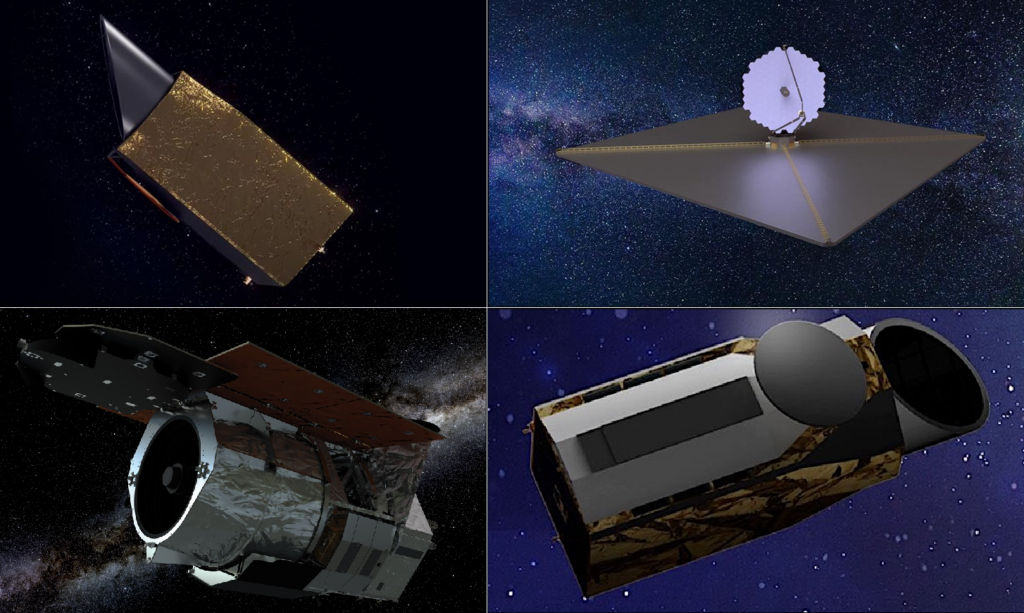
Figure 1: Different proposals for the next generation of flagship space telescopes. From the top-left is the Habitable Exoplanets Observatory (HabEx), the Large UV/Optical/IR Surveyor (LUVOIR), the Habitable Worlds Observatory (HWO) and finally in the lower left, the Roman Space Telescope. Image Credit: NASA/JPL.
What about using a starshade?
An external starshade is a separate, petal-shaped spacecraft designed to fly tens of thousands of miles in front of a telescope. A starshade is incredible at suppressing starlight, easily reaching a contrast level where the star is billions of times dimmer. But it has a major catch: it does not make the image any sharper. So a telescope would still be limited by the mirror size. It does make getting a better SNR easier as it can block out a lot of unwanted starlight. Under ideal conditions, a starshade would reduce the integration time to around 2 years per pixel and the complete image would be done in about 230 years. Still too long, especially when you consider how difficult formation flying with a starshade is.
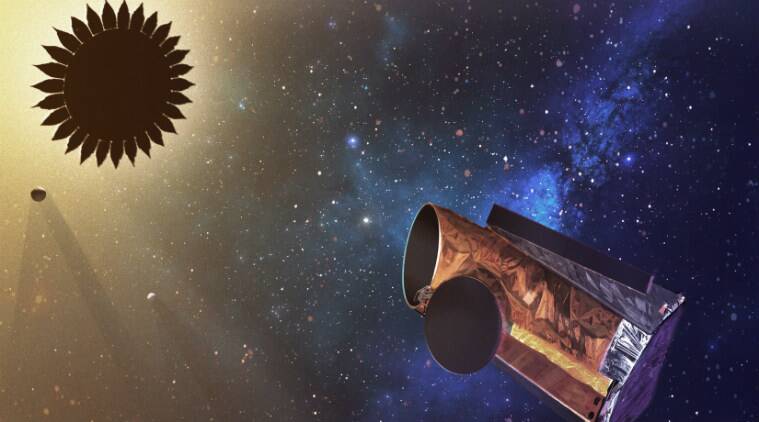
Figure 2: Using a starshade can help block unwanted light from the host star, making it far easier to spot a planet in orbit. While it will help with the collection of photons, it won’t change the size of the primary mirror. Image credit: NASA/JPL.
Optical interferometry maybe?
Nope. The baseline required for interferometry would be around 130 kilometers and you would need to do it in space. While there is certainly enough space… in space, it would be impossible to get the picometer precision needed with any formation flying concept we can imagine at the moment. We might get down to two orders of magnitude off on the resolution with a more realistic baseline but the low amount of photons for each pixel, the overwhelming astrophysical and instrumental backgrounds and the number of reconfigurations would still lead to centuries of required observation.
Back to telescopes then. Big ones, on the ground.
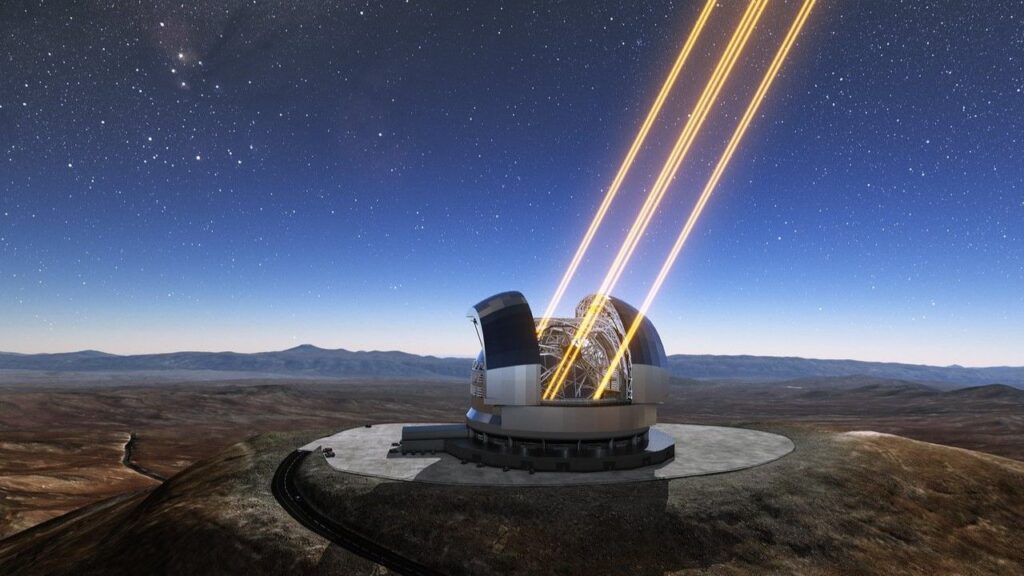
With the 39 meter EELT mirror, the angular resolution is down to 2000 times too coarse in order to resolve our 10×10 pixel image. And even with adaptive optics, there is a limit to how much noise we can suppress. Getting enough photons for a SNR ration above 5 would take about 285 years. That is a lot of clear nights to wish for.
Can we cheat physics? Indirect mapping.
What about indirect reconstruction techniques? These are clever mathematical tricks that attempt to create a map without actually having a telescope big enough to see the planet’s surface. While these methods have worked for giant, “Hot Jupiter” planets, the paper finds they are almost entirely impossible for an Earth-like world.
Rotational mapping doesn’t work well. This technique is like watching a distant, spinning disco ball. As different colored tiles rotate into view, the total brightness changes slightly. By tracking these flickers over time, you can try to guess what the “tiles” (continents or oceans) look like. But this technique only gives you a “slice” of the planet across its middle (longitude). It provides no information about the top or bottom (latitude) of the planet. Additionally to get even a basic 1D map of an Earth-twin, you would need to watch it rotate for about 10 to 20 days straight. During this time you would want the skies to be completely clear. Earth’s clouds change every day. These shifting patterns act like “noise,” making it very hard to tell if a bright spot is a permanent continent or just a passing storm.
Eclipse mapping fares no better. This method involves watching a planet as it passes behind its star (an eclipse) or in front of it (a transit). By measuring how the light disappears and reappears pixel-by-pixel as the star’s edge “scans” the planet, we could theoretically build a map. But here that math really turns against us. For an Earth-sized planet, the signal is so faint that you would need to watch thousands of eclipses to get a clear picture. Since these planets only eclipse their stars once a year (like Earth), a full map would require tens or even hundreds of thousands of years worth of observation. Not very practical.
So it looks like we won’t get our exoplanet image anytime soon. But we knew that going in and who knows – perhaps in the future we will be able to just send a probe with a camera to take that damned picture and be done with it. But for now, we are demonstratively a long way off getting an actual image of an exoplanet. But luckily, there is still a wealth of information in the data that we can get. Current and next generation telescopes show great promise for detecting biosignatures that will help us answer the question about whether we are alone in the Universe. Just don’t expect any pictures of aliens waving back at us.
Astrobite edited by Sandy Chiu
Featured image credit: Pablo Carlos Budassi @ Wikimedia Commons. Original image pixelated using Resizepixel.com
