
Title: How Mergers and Flybys Shape Azimuthal Age Patterns in Spiral Galaxies
Authors: Qian-Hui Chen, Alex M. Garcia, Zefeng Li, Kathryn Grasha, Emily Wisnioski, Paul Torrey, Rhea-Silvia Remus, Lucas C. Kimmig, Andrew J. Battisti, Sven Buder
First Author’s Institution: Research School of Astronomy and Astrophysics, Australian National University, Canberra, Australia
Status: Published in MNRAS [open access]
Astronomers are blessed to be able to do research on a universe of breathtaking objects and structures. Depending on who you ask (and their subfield), you will get different answers to what the most beautiful astronomical objects are, but you can bet safe money on a grand design spiral galaxy making the list. Their gorgeous, twisting spiral arms are where the majority of star formation in the Local Universe takes place, however the question of exactly how these arms form is not a closed case. The authors of this paper use cosmological simulations of five spiral galaxies to study the stellar populations in their arms and how they evolve over time to try to answer this question.
A Tale of Two Competing Spiral Arm Theories
The two main theories as to what causes spiral arms to form are density wave theory and dynamic spiral theory. The density wave theory is often described similar to traffic on the highway: cars are all moving at varying speeds but a slow moving semi-truck can cause one section of the highway to slow down and bunch up behind it. The cars will still eventually be able to go around the truck, make it through the section of traffic and carry on, but the area of the slow down will remain behind the truck with new cars entering the area of the traffic jam. In this case the cars act as the individual stars in the galaxy and the traffic jam is the density wave that creates the spiral arm.
On the other hand, dynamic spiral theory suggests that spiral arms are physical, co-moving groups of stars in a galaxy that wind up more and more due to differential rotation. Because of this, the spiral arms will constantly be broken apart and then re-form over and over again, making them transient structures in galaxies. Take a look at the two animations below to compare the movement of stars in these two theories.
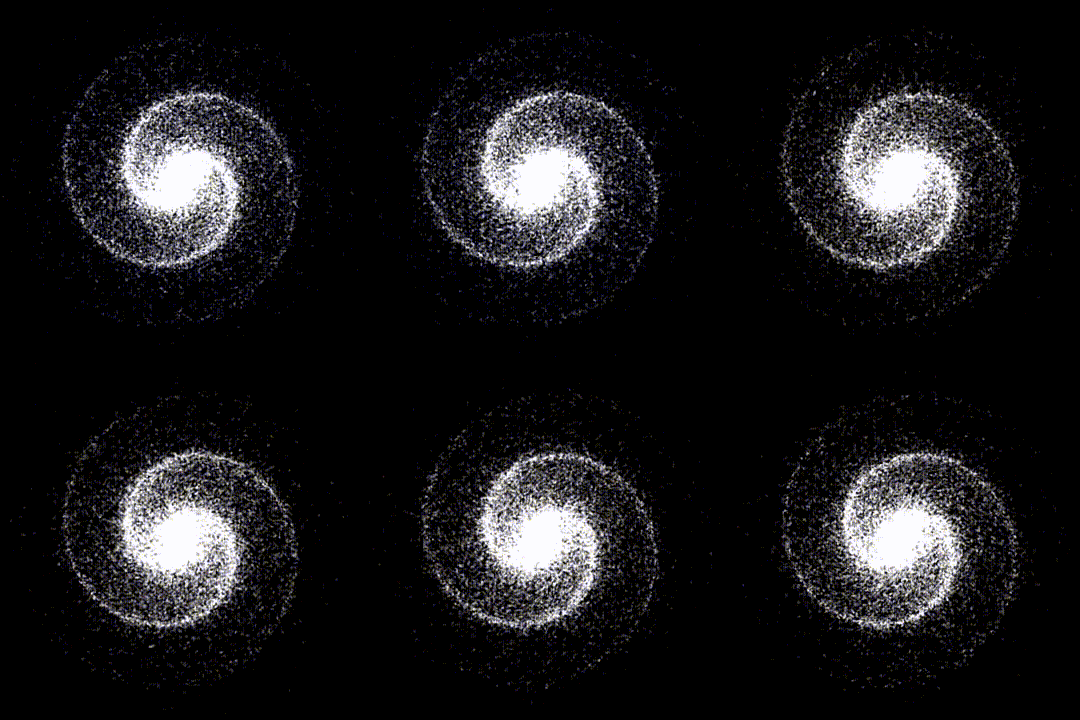
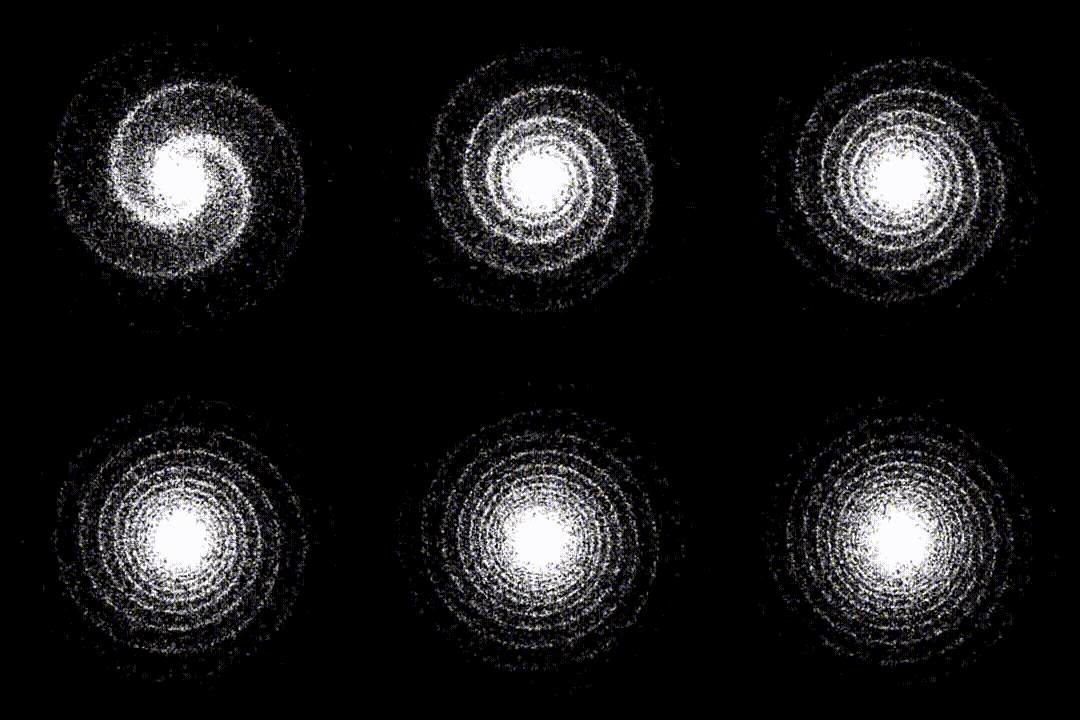
So, if you’re observing a galaxy at a snapshot in time, how can you tell which of these mechanisms formed the arms? One option is looking at the average age of the stars on either side of the arms. Since density wave theory is based on stars and gas bunching up on the leading side of the arm, this would cause an increase in star formation compared to the trailing side, meaning you should see an age gradient across the arms. However, since dynamic spiral theory has all the stars and gas moving together, you would expect no compression of gas on either side, so the average ages of the stars on the leading and trailing sides of the arms would be identical. Simple right?
Unfortunately, observations of spiral galaxies in the Local Universe show that there is a mix, with some galaxies exhibiting this age gradient and others not. So, the authors of this paper turn to simulations to try to determine if these age gradients can evolve over time, and if so what can influence their evolution.
Build-a-Spiral-Galaxy
The authors look at five Milky Way-mass spiral galaxies in the Auriga cosmological zoom-in simulations over the course of 5 billion years. They check in on the age gradients of the stars at 300 million year snapshots to see how they change. They define three possible cases the age gradients can take on (also illustrated in Figure 2):
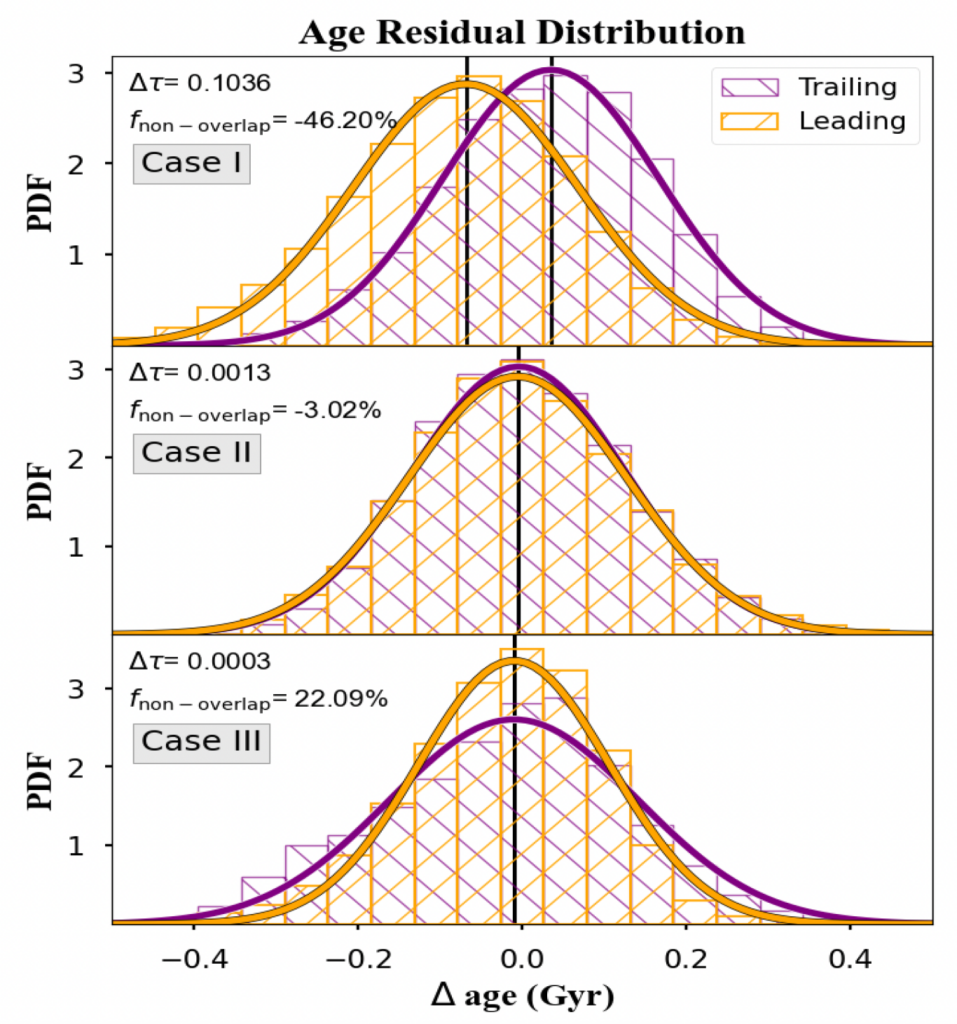
- Case 1: There is a noticeable difference in the average ages of the stars on the leading and trailing sides of the spiral arm, as you would expect for density wave theory.
- Case 2: The age distributions of the stars on the leading and trailing sides are virtually identical, with the same average ages and spreads, as you would expect for dynamic spiral theory.
- Case 3: The average ages of the stars on either side of the arm are the same, but their spreads are different. This isn’t necessarily predicted by either theory.
They found that the age gradients in the spiral arms of all five of their galaxies followed case 1 for the majority of their 5 billion year simulation run time, suggesting the arms were formed via density waves. However, all of their galaxies also had brief periods of the age gradients taking on cases 2 or 3 as well.
Hey! You Messed Up My Spiral Arm, Man!
Since the Auriga simulations are cosmological zoom-ins, that means these simulated galaxies don’t exist all by themselves, they can also interact with smaller satellite galaxies. The authors tracked when satellite galaxies either merged with the main galaxy or made a very close orbit called a “flyby”.
They found a total of 17 snapshots across their 5 simulated galaxies in which the age gradients followed case 2 or 3. For 16 of these 17 snapshots they were able to identify a merger or flyby immediately before, during, or immediately after the case 2 or 3 snapshots. There was only one instance where no satellite could be identified as being associated with when an age gradient followed case 2, as can be seen in Figure 3.
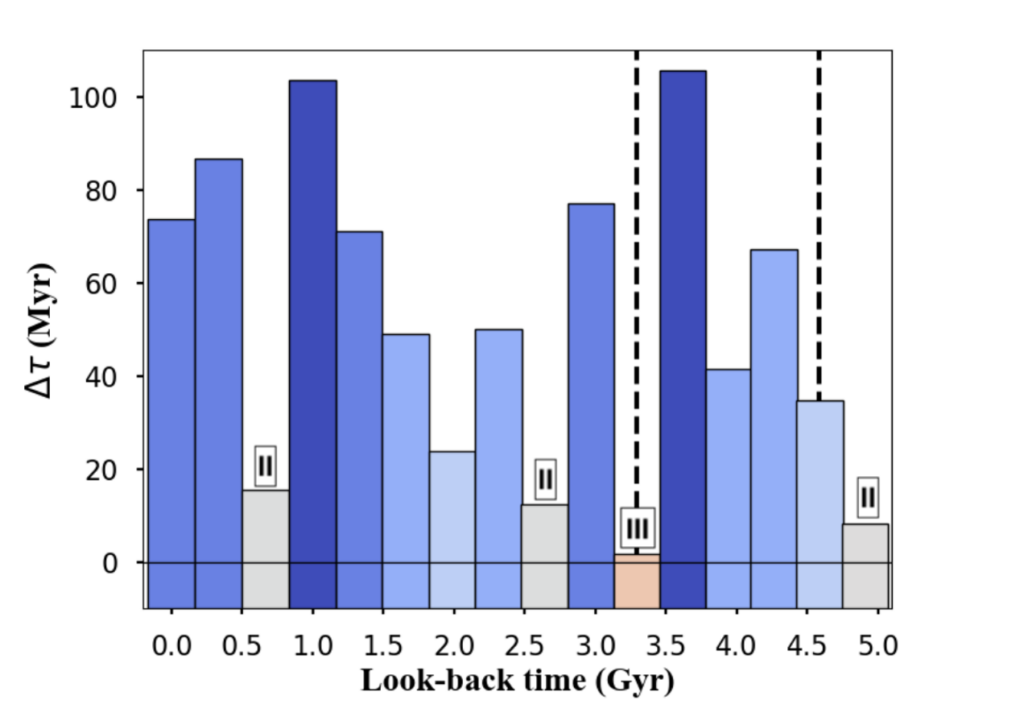
This could suggest that spiral galaxies that form their arms through density wave mechanisms can have their stellar age gradients erased by tidal interactions with other galaxies. But, once the interaction is over, the density wave can rebuild the age gradient in just 600 million years.
The authors offer some examples of spiral galaxies that have been observed to have stellar age gradients that have no current close companions (M74, NGC 1566, NGC 6946, and M101), and a couple that are known to be actively interacting with a satellite and have been observed to have no stellar age gradient (M51 and NGC 2442). These results could mean that if we wait 600 million years after M51 finishes interacting with its companion we could see its spiral arms rebuild their stellar age gradient … but who has that kind of time?
Astrobite edited by Ryan White
Featured image credit: NGC 1300, NASA
