
Title: The ALPINE-ALMA [CII] Survey: Unveiling the baryon evolution in the interstellar medium of z∼5 star-forming galaxies
Authors: P. Sawant, A. Nanni, M. Romano, D. Donevski, G. Bruzual, N. Ysard, B. C. Lemaux, H. Inami, F. Calura, F. Pozzi, K. Małek, Junais, M. Boquien, A. L. Faisst, M. Hamed, M. Ginolfi, G. Zamorani, G. Lorenzon, J. Molina, S. Bardelli, E. Ibar, D. Vergani, C. Di Cesare, M. Béthermin, D. Burgarella, P. Cassata, M. Dessauges-Zavadsky, E. D’Onghia, Y. Dubois, G. E. Magdis, H. Mendez-Hernandez
First Author’s Institution: National Centre for Nuclear Research, Warsaw, Poland
Status: Published in the Astronomy & and Astrophysics [open]
Exploring the cosmic baryon cycle in the early Universe
Galaxies are intricate engines of gas, dust, stars, and supermassive black holes. Stars emerge from collapsing clouds of cold, dense gas, and when they end their lives as supernovae, they return matter to the interstellar medium. All the while, supermassive black holes stir, heat, and swallow gas from the galaxy’s center, contributing to a process in which gas is consumed, expelled, replenished, and recycled. This cosmic baryon cycle is essential to our understanding of the origin and evolution of galaxies.
Even though it only constitutes 1% of the interstellar medium, dust is a key component that affects the light we see from galaxies (it is also part of what makes some of the most beautiful, dream-like pictures in astronomy). However, the mechanisms that lead to the formation and growth of dust is still debated in observations and simulations, especially as recent studies from the James Webb Space Telescope have revealed an abundance of dusty galaxies in the early Universe that challenge our current theories of galaxy evolution.
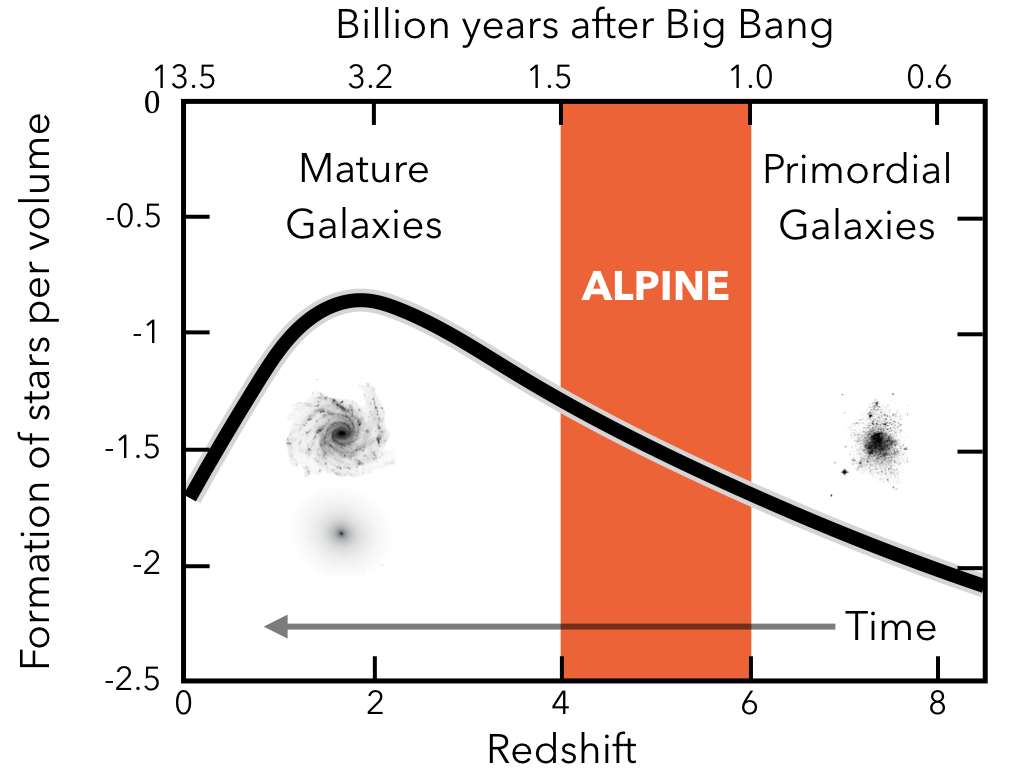
Figure 1: ALPINE measures the properties of gas and dust in galaxies that are transitioning from being primordial to mature, a phase that is crucial to understanding how galaxies formed and evolved. Image Credit: Caltech/IPAC.
The Atacama Large Millimeter/Submillimeter Array (ALMA) presents an opportunity to explore early galaxies by probing dust and gas in star-forming galaxies at redshifts z ~ 4 to 6: galaxies in this redshift range are still maturing, just one billion years after the Big Bang. In particular, ALMA has revealed that a significant amount of star formation occurred in dust-enshrouded galaxies such as those detected by James Webb. Specifically, the ALMA Large Program to investigate [CII] at Early Times (ALPINE) investigates the evolution of dust and gas in the interstellar medium of these “coming-of-age” galaxies (see Figure 1).
The past and fate of gas and dust in young galaxies
The prevalence of star formation in dusty galaxies from the early Universe prompts astrophysicists to rethink how stars form. For instance, the initial mass function (IMF) describes the distribution of stellar masses that arise from a cloud of gas: although the Chabrier IMF is canonical, discrepancies between theory and observations of young galaxies have led researchers to consider a “top-heavy” IMF, which predicts a higher proportion of massive stars than the Chabrier IMF. To explore each theory, today’s paper estimates the properties of galaxies from ALPINE based on the standard, Chabrier IMF and the alternative, top-heavy IMF. In particular, they check the stellar mass, star formation rate, dust mass, and ages of the galaxies as pictured in Figure 2 for each IMF assumption.

Figure 2: Properties of the interstellar medium of z ~ 5 star-forming galaxies (red circles) from the ALPINE program: stellar mass, star formation rate, and dust mass (top-to-bottom and left-to-right). The authors determined these properties using chemical evolution models based on a top-heavy (vertical axis, green histogram) and Chabrier (horizontal axis, blue histogram) initial mass function.
The authors then derive the evolution of the gas mass and star formation rate with varied outflow efficiencies—that is, how effectively gas is driven out of a galaxy relative to the rate at which new stars form—in Figure 3. Whereas the evolutionary tracks with high outflow efficiencies capture the distribution of older galaxies, galactic outflows appear to be less important for the younger galaxies with the Chabrier IMF (left). Assuming a top-heavy IMF, however, allows the models with high outflow efficiencies to reproduce the evolution of the the interstellar medium in almost all of the ALPINE galaxies (right).
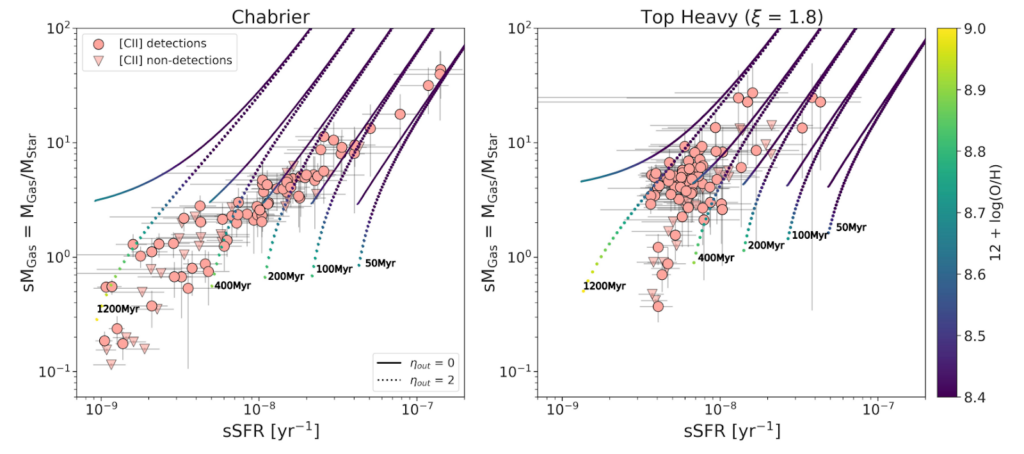
Figure 3: The gas-to-stellar mass ratio of the ALPINE galaxies (red circles) as a function of their specific star formation rate. The authors modeled the evolutionary tracks of the galaxies’ gas and stellar content over time assuming either a low (solid line) or high (dashed line) outflow efficiency in both cases of the Chabrier (left) and top-heavy (right) initial mass functions. Figure 3 in today’s paper.
Constraining the history of the interstellar gas and the properties of galactic outflows was a crucial first step in allowing the authors to trace the dust content of these galaxies. This is because dust is tightly coupled to the gas: it forms from metals produced by stars, grows within the interstellar medium, and is removed or redistributed by the same outflows that regulate the gas itself. Figure 4 shows the expected contributions of various sources of dust—supernovae, chemical enrichment from evolved stars, and dense regions of the interstellar medium—with the Chabrier and top-heavy IMF, once again. In both cases, Type II supernovae explosions and dust growth in the interstellar medium are significant sources for older and intermediate-aged stars (left). However, only the top-heavy IMF is able to account for most of the young, dusty galaxies in the ALPINE survey (right).
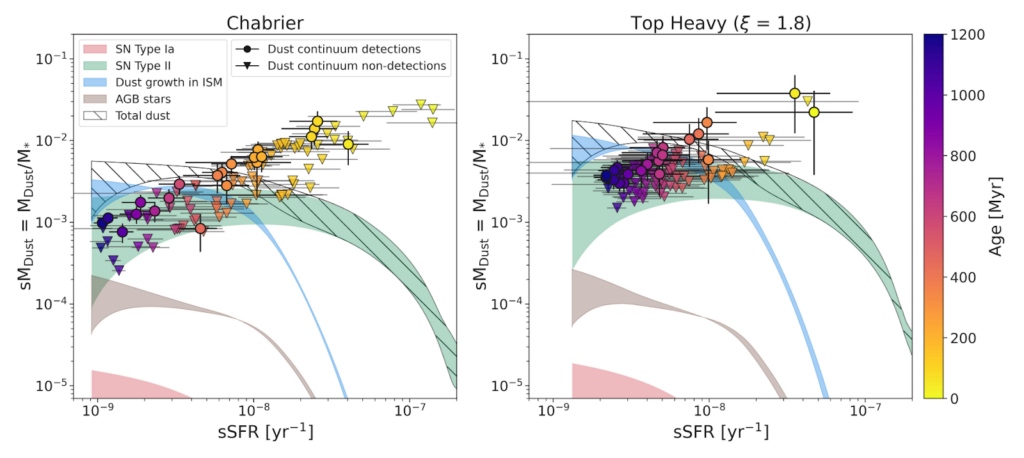
Figure 4: The contribution of various sources of dust to the specific dust mass of the ALPINE galaxies (circles and triangles): Type-1a supernovae (red), Type-II supernovae (green), the interstellar medium (blue), and AGB stars (brown). The overall dust evolution track includes all of the sources (dashed). Once again, the authors consider both the Chabrier (left) and Top Heavy (right) initial mass functions. Figure 5 in today’s paper.
The origins of young, dusty galaxies
In this way, a top-heavy IMF could help alleviate the tension between observations and theoretical models for galaxies at the first stages of the cosmic baryon cycle by better predicting the amount of dust in the interstellar mediums. This work underlines the importance of adjusting our stellar evolution models when studying the interstellar medium of primordial, still-forming galaxies. Future observations with ALMA and the James Webb Space Telescope will continue to improve measurements of dust and reveal how the youngest galaxies grew into the galaxies in our Universe today.
Astrobite edited by Joe Williams.
Featured image credit: Artist’s impression of a star-forming galaxy in the early Universe, with clouds of cosmic dust around newborn stars (from ALMA Observatory).

Studying the interstellar medium in coming-of-age galaxies should offer valuable insights into how star formation and galaxy evolution are connected during these critical stages.