
Title: Radio streaks in the Lighthouse Nebula discovered with MeerKAT — Particles escaping from the tail and illuminating the ambient magnetic field
Authors: Pierrick Martin, Mickael Coriat, Barbara Olmi, Elena Amato, Niccolò Bucciantini, Alexandre Marcowith, Sarah Recchia
First Author’s Institution: IRAP, Université de Toulouse, CNRS, CNES, F-31028 Toulouse, France
Status: Submitted to A&A (available on Arxiv)
Pulsars are rapidly spinning, highly magnetized neutron stars, the dense remnants left behind after massive stars explode. As they spin down, pulsars release their rotational energy into their surroundings, inflating bright structures called pulsar wind nebulae (PWNe). In these nebulae, powerful shocks heat the surrounding gas and accelerate particles like electrons and protons to extreme energies, turning them into cosmic rays.
These energetic particles do not keep their energy forever. As they travel, they lose energy through radiation processes such as synchrotron emission (when charged particles spiral around magnetic field lines) and inverse-Compton scattering (when particles transfer energy to low-energy photons). Fortunately for astronomers, these radiation processes make cosmic rays visible, allowing us to trace how energy from pulsars is transported into their environments.
A particularly interesting class of PWNe is known as bow-shock pulsar wind nebulae (BSPWNe). Most pulsars are born inside the expanding debris of their own supernova remnants. However, some pulsars move fast enough to escape these remnants and plow directly through the interstellar medium. As the pulsar speeds through space, the surrounding gas exerts a ram pressure, compressing the pulsar wind into a bow-shaped structure, much like the bow wave in front of a moving boat (see Figure 1). These systems therefore provide a unique bridge between the small-scale relativistic plasma physics near neutron stars and the large-scale injection and transport of energy and particles throughout the interstellar medium.
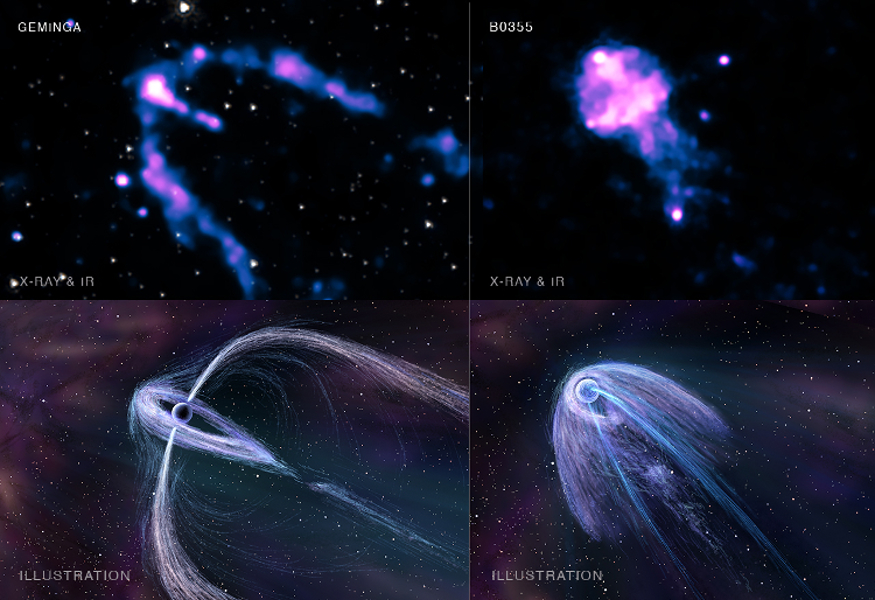
Figure 1. Two different types of bow-shock pulsar wind nebulae: Geminga (left panel) and B0355 (right panel). Because Geminga is viewed with its spin and magnetic axes nearly perpendicular to our line of sight, its jets are swept back into large arcs by the interstellar medium, whereas in B0355+54 we look almost along the jet direction, so the arcs are not visible and the nebula instead appears as a more compact tail behind the pulsar. (credit: NASA/CXC/PSU/B.Posselt et al; Infrared: NASA/JPL-Caltech; Illustration: Nahks Tr’Ehnl)
Unlike the roughly spherical shape of typical PWNe, BSPWNe often develop long tails that trail behind the moving pulsar. These tails form as material injected by the pulsar is swept downstream by the ram pressure of the interstellar medium. In addition, observations, especially in X-rays, have revealed tails that do not always align with the pulsar’s direction of motion. Instead, some tails appear tilted or even oblique, posing a puzzle for astronomers.
In this paper, the author investigates the physical mechanisms that can explain the origin of these puzzling misaligned tail signatures. Figure 2 shows the main observational result. The background color shows the radio intensity, while the green contours trace the X-ray emission. The pulsar sits near the bright blob in the lower-right corner of the X-ray contours. From there, a radio tail extends diagonally across the image toward the upper-left corner, while the X-ray contours extend to the upper-right corner, clearly misaligned with the pulsar’s motion.
One commonly proposed explanation for such a pulsar emission involves cosmic rays with different energies behaving in different ways. The highest-energy particles can cross magnetic field structures more easily and emit X-rays through synchrotron radiation. Lower-energy particles, in contrast, are more tightly tied to the flow of gas and magnetic fields. These particles are carried downstream by the ram pressure, forming the radio-emitting tail.
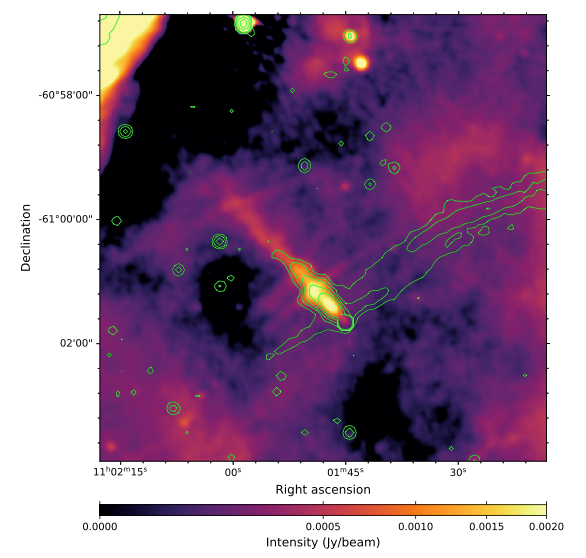
Figure 2. Radio emission from the Lighthouse Nebula, with the X-ray photon flux overlaid as green contours. The combined view highlights the spatial relationship between the radio-emitting tail and the higher-energy X-ray emission associated with the pulsar wind nebula. (Fig. 1 from the original paper)
The mystery deepens when we look more closely at the radio emission. As shown in Figure 3, the radio tail contains a series of narrow streaks, giving the entire structure a “fishbone-like” appearance. The contours mark radio detections at where the emission is 3, 5, 7, and 10 times more than the standard deviation of the whole dataset. If the tail is simply shaped by ram pressure, how do these thin filaments form, and why do they extend roughly perpendicular to the main flow?
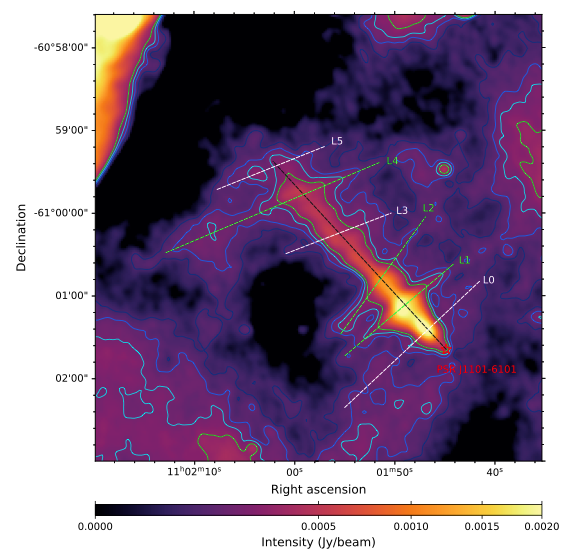
Figure 3. Radio intensity map of the Lighthouse Nebula. The pulsar’s position is marked by a red star. Contours indicate radio emission significance at 3, 5, 7, and 10 σ. Green dashed lines mark prominent transverse emission streaks, while white dashed lines highlight more tentative features. (Figure 2 from the original paper)
One possible explanation is that the radio streaks are the faded remnants of earlier X-ray jets. However, a simple timescale argument rules this out. For this scenario to work, particles would need to cool from extremely high energies (tens of tera–electron volts, which produce X-rays) down to a few giga–electron volts (which produce radio emission) within the time it takes the pulsar to move from the location of the streaks to its current position. Achieving such rapid cooling would require magnetic fields far stronger than those typically found in the interstellar medium.
The authors instead favor a different picture. In this scenario, the radio streaks form when instabilities in the flow occasionally allow electrons to escape from the main tail into the surrounding medium. Once free, these cosmic rays travel along nearby magnetic field lines and light them up in radio emission. Supporting this idea, the radio tail appears broader at the base of the streaks, consistent with particles leaking out rather than being injected as narrow jets.
If this interpretation is correct, these radio filaments offer a rare and valuable probe of magnetic field structures around fast-moving pulsars. Rather than being mere oddities, the streaks may act as natural tracers, revealing how cosmic rays and magnetic fields interact in some of the most extreme environments in our galaxy.
Astrobite edited by: Maria Vincent
Featured image credit: Martin et al. 2026
