
When Kimberly Burtnyk joined the LIGO Laboratory as Technical Writer and Editor in 2014, she had no idea that, a little over a year later, she would witness the Nobel-Prize-winning detection of gravitational waves. Naturally, her first reaction to the announcement was, “Oh my god, it worked.” Once the disbelief settled, a pressing question emerged: “How do we explain this to people?”
Kim is no stranger to this question. She found her calling as an Astrophysics student minoring in English at the University of Toronto. The first person in her family to earn a university degree and pursue science, she would come home eager to explain what she was learning. “I kind of started the science communication training that way, just driven by my own interest in what I was learning myself.” One day, her physics TA encouraged her to write a scientific article for The Varsity, the university’s student newspaper. “I had an epiphany,” she said. She found what she wanted to do for the rest of her life.
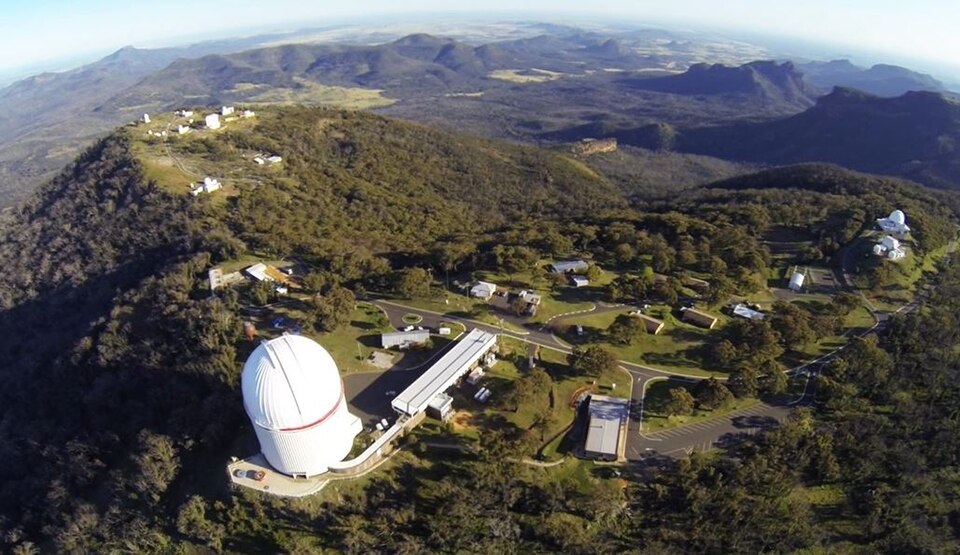
After years of writing for the newspaper and even publishing in science magazines like Sky & Telescope, Kim completed her undergraduate degree and went on to pursue a master’s degree in science communication at the Australian National University (ANU). For her thesis, Kim compared the visitor centers at two observatories: the Mount Stromlo Observatory and the Siding Spring Observatory. She observed how visitors interacted with the exhibits, then interviewed them as they exited. Six months later, she called them back with a simple question: “Tell me everything you remember from your visit.”
Kim found that, more than anything, visitors remember what their day was like. “People remember what it felt like to arrive there and drive up the mountain and then see this magnificent, white, beautiful dome. It was only after they got through that experience of reliving the journey to get there that they could dive into the exhibit.” This, she explained, is the affective impact of a visit to an observatory: our tendency to remember subjective experiences more readily than facts.
After earning her master’s degree, Kim worked as Manager of Research and Evaluation at the California Science Center until 2010. Looking for a new career path and surrounded by world-leading astronomy institutions like Caltech, JPL, and Carnegie Observatories, she took every opportunity to network with the astronomy community by volunteering at conferences and observatories.
She also obtained a business license to launch her own science communication consultancy. At one point, someone who had seen her website recruited her to edit the Giant Magellan Telescope Organization’s science case and later its design documents. Consolidating the work of over 30 contributors into a coherent voice was no easy task, but she relished the opportunity to see the project as a whole. “Everybody else, all the engineers have their piece. Somebody’s working on the bearings, somebody’s working on the drive… we (the editors) saw the whole big picture, and it was the coolest thing ever to me.”
As it happens, one of the engineers previously worked for the Laser Interferometer Gravitational-Wave Observatory (LIGO) and pointed Kim to an opening for a technical editor at their site in Hanford, Washington, where she has spent the past 12 years. There, Kim assembles annual reports, work plans, and quarterly reports that secure funding from the National Science Foundation. On top of that, she oversees content on the LIGO Laboratory website, edits grant proposals, and occasionally leads tours at the visitor center at Hanford, returning to her roots in the world of scientific exhibits.
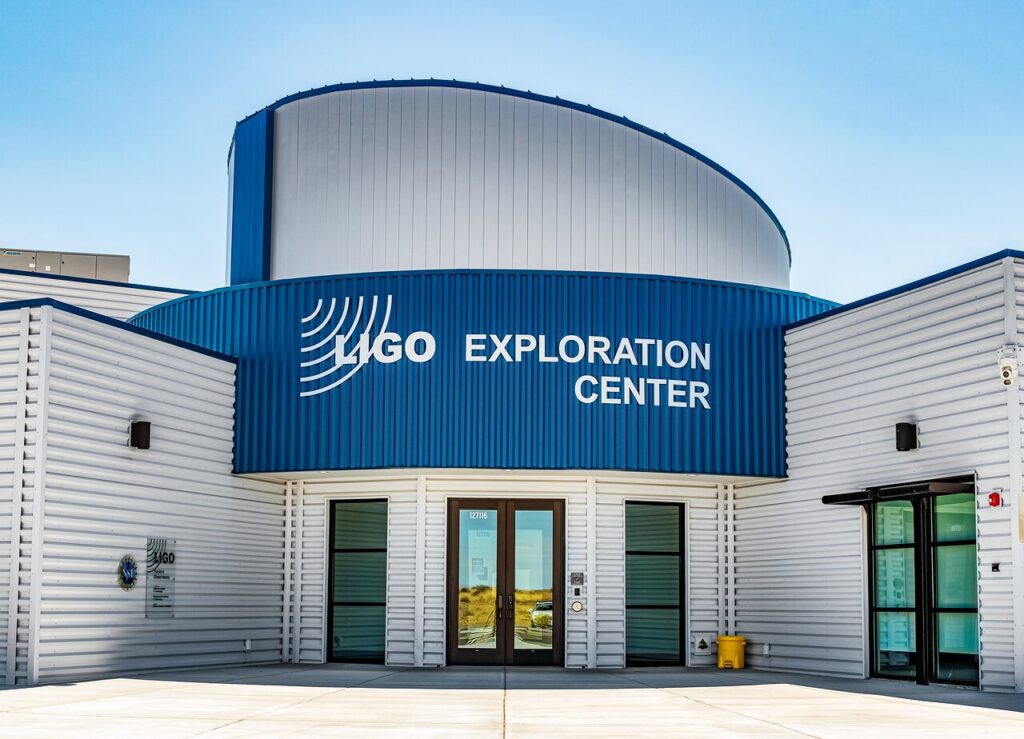
NOIRLab/LIGO/NSF/AURA/T. Matsopoulos.
I asked Kim for some advice because, like many Astrobites authors, I joined the site to improve my scientific communication skills. Avoiding jargon is a common recommendation, but how do you know what someone else doesn’t know? “Put yourself back in the situation where you’re learning something that you don’t know, so you can develop empathy for what that feels like,” Kim suggested. “When you look back on your own work, it’s easier to recognize, ‘Oh yeah, somebody may not know what this word means.’”
Kim also cautioned against cluttered slides. “Something inherent in human beings is that when we see something written, we’re reading it. If I’m reading, I’m not listening,” Kim says. In addition, be open and honest. “We’ll navigate between the subatomic distance scale and cosmological distances. None of these are comprehensible to a human being. I admit that to people.”
Finally, show your work to someone else. After staring at a document for so long, you stop reading the words. A proofreader encountering the words for the first time catches the mistakes you miss. “Being edited is scary. But ultimately, my name still went on it, and it was a better product,” Kim says. On the other side, an editor encourages the writer to think a little differently and helps them understand their audience. “I approach editing with a lot of empathy because I’ve been a writer who has been edited,” she adds.
Scientists rely on professionals like Kim to make complex ideas understandable, both to funding agencies that make discoveries possible and audiences eager to understand them. Her journey shows that science communication is far more than outreach. It’s about curiosity, empathy, and forming genuine connections.
Astrobite edited by: Lucie Rowland.
Featured image: Kim Burtnyk.
