
by Grace Piroscia
I am a second-year PhD student at the University of Sydney, working on the development of optical instrumentation for high-resolution astronomical imaging. When I am not working on my research, you may find me reading, baking pastries (danishes are my fave), or yapping around at Sydney Observatory.
Title: Exoplanets in reflected starlight with dual-field interferometry
Authors: S. Lacour, Ó. Carrión-González , and M. Nowak
First author’s institution: LIRA, Observatoire de Paris, Université PSL, Sorbonne Université, Université Paris Cité, CY Cergy Paris Université, CNRS, 92190 Meudon, France
Status: Published in Astronomy & Astrophysics [open access]
Civilisation has long searched for the answer to the question: are we alone in our universe? Setting aside tales of crop circles and Area 51, humanity has never been closer to answering this question. Today, the Habitable Exoplanets Catalog (HEC) contains a list of 29 potentially habitable exoplanets considered capable of hosting liquid water. While this is promising, how do we actually confirm the habitability of these planets or infer the existence of life on them from so far away? Having not yet reached the capability of interstellar travel, we must instead rely on the distant observations of these exoplanets and their atmospheres to find out. This study outlines a clever instrument suite, along with an expensive proposal to expand the Very Large Telescope Interferometer (VLTI) in order to further our search for signs of life on distant worlds.
Chemical “biosignatures” like oxygen and methane are hard to maintain without life, so detecting them in an exoplanet’s atmosphere would be a strong hint of life. By observing these planets directly, we can probe their atmospheres with a level of sensitivity unmatched by any other current technique. However, directly imaging exoplanets is extremely challenging because the signal we measure is from the starlight reflected off of exoplanets. This signal is much dimmer than that from the host star, which is usually more than ten million times brighter than the planet! With such a big brightness difference, the planet signal is almost completely drowned in starlight. We call this brightness ratio the contrast. Adding to the difficulty, these Earth-like planets lie so close to their host stars that spatially separating, or resolving, the two is extremely challenging. Imagine trying to see the light emitted from a glowworm that is held 10 centimeters away from a stadium floodlight, while observing from a distance of 10 kilometers away.
One technique to gain a boost in resolution capability involves combining, or interfering, light from multiple telescopes to effectively create one larger telescope. Combining their signals creates an interference pattern of bright and dark fringes, which can be decoded to spatially resolve the observed objects. This technique, known as interferometry, is employed by this study as a part of the solution to the extremely difficult task of directly imaging exoplanets. This study considers the VLTI observatory in the Atacama Desert of northern Chile to gain an insight into how difficult this task would be, and how many planets they could expect to observe. At the VLTI, with its current configuration, the largest distance between two unit telescopes is 130 meters, effectively creating a telescope that is 130 meters wide! This study proposes the addition of a new, fifth unit telescope, which would increase this number to over 200 meters therefore increasing the number of exoplanets we can resolve. However, increasing the resolution capability is only one of the workarounds this study proposes.
What about that tricky contrast problem? Well, this is the real creative technique that this study proposes, neatly coined ‘Dual-Field Interferometry’ (DFI). Instead of combining all of the light from both telescopes, DFI combines light from a specific region on each telescope, as is demonstrated in Figure 1. This is effectively like zooming into a specific area of the image as seen by each telescope. This is extremely handy because we can now almost completely separate the planet signal from the star signal just by picking the planet and the star light separately, creating two separate images, or, in the case of interferometry, interference patterns.

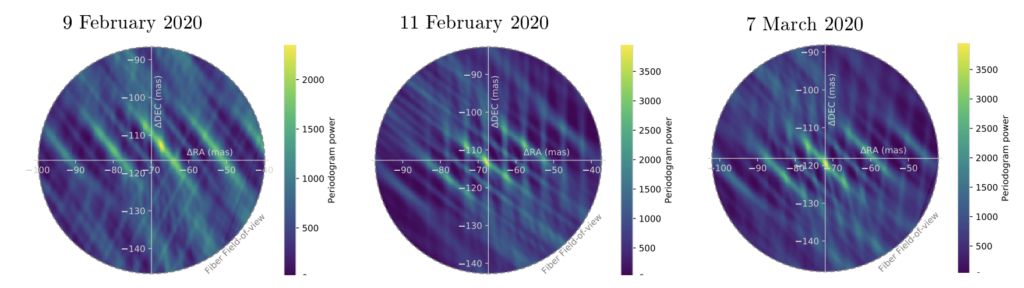
The technology that allows us to perform this ‘pick-off’ is the same technology that provides us with the internet: optical fibers. By using the known orbit of an exoplanet, we can position one fiber where we expect the planet to be, and another on its host star. Now you may be wondering, why don’t we just pick off the planet light and look at that only? It turns out that funneling only the planet light into your fiber is extremely difficult, and starlight contamination is unavoidable. However, if you can measure the signal from the star at the same time, you can find and remove its signal in the planet channels! This technique, with its unique combination of interferometry and spatial separation, and treatment of the planetary and stellar signals, has proven to be extremely effective. DFI at the VLTI has already been used to directly observe two exoplanets, beta Pictoris c and HD 206893 c, which have not been directly imaged by any other instrument at any other observatory to date. Figure 2 shows the interference signal we expect to see if our planet fibers are locked onto the location of an exoplanet, like beta Pictoris c.
By employing DFI at the VLTI, this study predicts that 37 exoplanets could already be directly imaged. To bump this number up to 60 exoplanets, along with the suggestion of a fifth unit telescope, the authors of this paper suggest observing at shorter wavelengths to increase resolution capabilities as well as the signal strength, because there is more reflected light at these shorter wavelengths. While the addition of a new telescope is a nine-figure investment, in the era of multi-million dollar space-based missions, this is a relatively small cost for a large stride toward spotting our Earth-twin(s) and finally meeting the neighbours.
Astrobite edited by Annelia Anderson
Featured image credit: Grace Piroscia
