

This guest post was written by Tatevik Mkrtchyan. Tatevik is a PhD candidate in Astrophysics at the Instituto de Estudios Astrofísicos, Universidad Diego Portales, Chile. She studies high-redshift quasars, from their identification to their circumgalactic medium, using photometry and integral field spectroscopy, with broader interests in active galactic nuclei, galaxy evolution, and observational astronomy. Outside of research, she enjoys reading philosophy, playing ukulele, hiking, and board games.
Paper title: Where Galaxies Go to Die: The Environments of Massive Quiescent Galaxies at 3 < z < 5
Authors: Ian McConachie, Anna de Graaff, Michael V. Maseda, Joel Leja, Yunchong Zhang, David J. Setton, Rachel Bezanson, Leindert A. Boogaard, Gabriel Brammer, Nikko J. Cleri, Olivia R. Cooper, Karl Glazebrook, Rashmi Gottumukkala, Jenny E. Greene, Andy D. Goulding, Michaela Hirschmann, Ivo Labbe, Zach Lewis, Jorryt Matthee, Tim B. Miller, Rohan P. Naidu, Themiya Nanayakkara, Pascal A. Oesch, Sedona H. Price, Katherine A. Suess, Bingjie Wang, Katherine E. Whitaker, Christina C. Williams
First Author’s Institution: Physics and Astronomy Department, University of Western Ontario, London, ON, Canada
Status: Submitted to ApJ [open access]
In today’s Universe, cosmic graveyards are packed with red galaxies that stopped forming stars billions of years ago. But if we travel back to when the Universe was less than 2 billion years old, finding these ‘dead’ galaxies becomes increasingly puzzling, and the question of where they die becomes even more mysterious.
Massive quiescent galaxies (MQGs), or galaxies that have stopped forming new stars despite their enormous size, represent extremes at early cosmic times. When the Universe was only a few billion years old, most galaxies were still actively building stars from abundant gas reservoirs. Yet MQGs had already gained substantial weight, making them among the most massive galaxies in existence at that epoch, and somehow managed to shut down their star formation far earlier than expected.
Now, the James Webb Space Telescope (JWST) has helped answer a crucial piece of this puzzle. This work shows that massive quiescent galaxies cluster in unusually dense regions, areas with far more galaxies packed together than average, even when the Universe was only 1.2 to 2.2 billion years old. More surprisingly, they cluster far more strongly than their star-forming cousins, revealing that environmental factors already played a decisive role in both galactic death and mass growth in the infant Universe.
The challenge? Theoretical models struggle to reproduce the observed numbers of these systems. Their very existence tests our understanding of galaxy formation.
But here’s the key insight: galaxies are extroverts. Their environments shape their destinies. In the present-day Universe, a clear pattern emerges: elliptical, red, quiescent galaxies concentrate in dense clusters, while blue, star-forming spirals populate lower-density regions.
At early cosmic times, however, this picture blurs. Instead of being sites of galactic death, these dense regions should be vibrant star-forming hubs, fed by fresh gas streaming in from the cosmic web. So why would dead galaxies be there?
James Webb will hunt the Zombies.
The authors studied 25 massive quiescent galaxies from when the Universe was less than 15% of its current age, using detailed observations from JWST’s NIRSpec instrument, which splits their light into spectra to reveal their physical properties. These galaxies, each containing over 3 billion times the Sun’s mass in stars, were found in two survey fields covering different regions of sky. This dataset enables us to study how these galaxies stopped star formation so early in cosmic history, a remarkable achievement that requires both explosive early star formation and efficient quenching (the processes that shut down star formation).
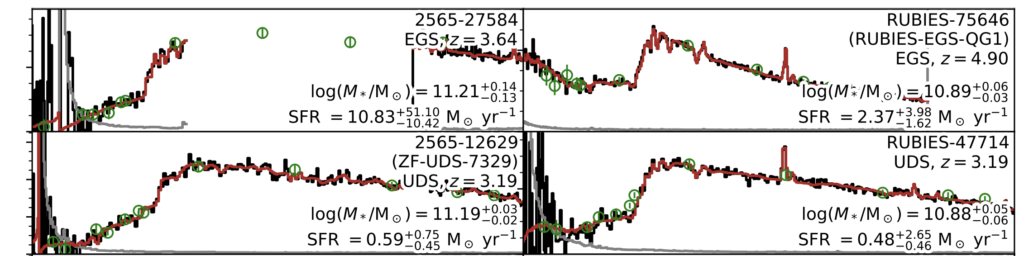
To identify these galactic “corpses,” the authors used Prospector, a publicly available analysis tool that simultaneously models the NIRSpec spectra and broadband photometry (measurements of brightness across different wavelength filters) from the Hubble Space Telescope and JWST. This technique is crucial because it identifies truly quiescent galaxies rather than impostors: heavily dust-obscured star-forming galaxies can masquerade as quiescent ones in photometry alone, and only their spectra (like the ones shown in Figure 1) can reveal the truth by showing whether stars are actually still forming behind the dust.
Mapping the Cosmic Graveyard
Finding dead galaxies is one challenge; determining where they reside is another. This is where the innovation known as Monte Carlo Voronoi Tessellation (MCVT) comes in. It creates 3D maps of galaxy density by combining distance measurements from over 6,000 galaxies. These measurements come from two sources: precise distances from spectroscopy and broader estimates from photometry. By mapping galaxy positions in three dimensions, MCVT reveals which regions are densely packed with galaxies and which are relatively empty.
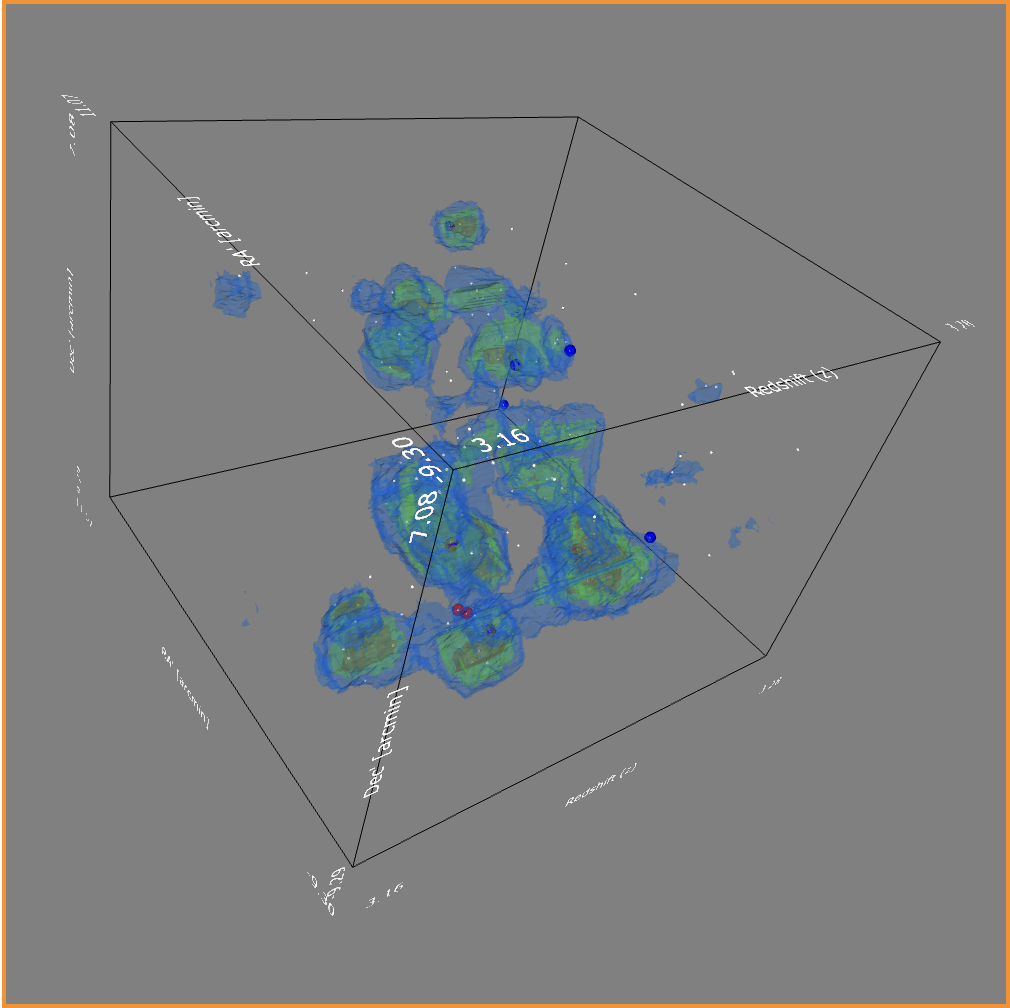
The process begins by taking a thin slice through cosmic time to identify which galaxies fall within that slice. Since distance estimates from photometry can be highly uncertain, the method generates 100 different possible distances for each galaxy that fall within those error limits. For each of these possibilities, the authors divide the field into cells and calculate the density of galaxies in each cell. Stacking all 100 iterations together reveals robust dense regions, allowing significant structures to emerge from the noise while others fade away.
This approach uncovered 12 massive dense peaks and 6 extended protoclusters (large cosmic structures in the process of collapsing to form the massive galaxy clusters we see in today’s Universe; see Figure 2). Several previously known structures were recovered, including a dense region at cosmic time corresponding to 1.8 billion years after the Big Bang surrounding the ancient quiescent galaxy ZF-UDS-7329, another dense region from when the Universe was 1.3 billion years old featuring two massive quiescent galaxies, and the striking “Cosmic Vine” that stretches across the EGS field from 2.1 billion years after the Big Bang.
Dead Galaxies Prefer Dense Neighborhoods
The massive quiescent galaxies in the authors’ sample strongly cluster in dense environments. After matching each galaxy to the nearest massive overdensity and calculating what fraction lived inside these peaks, the results were shocking: ~50% of massive quiescent galaxies reside in massive peaks, ~20% of massive star-forming galaxies live in similar peaks, and ~15% of the overall spectroscopically-confirmed population is found there.
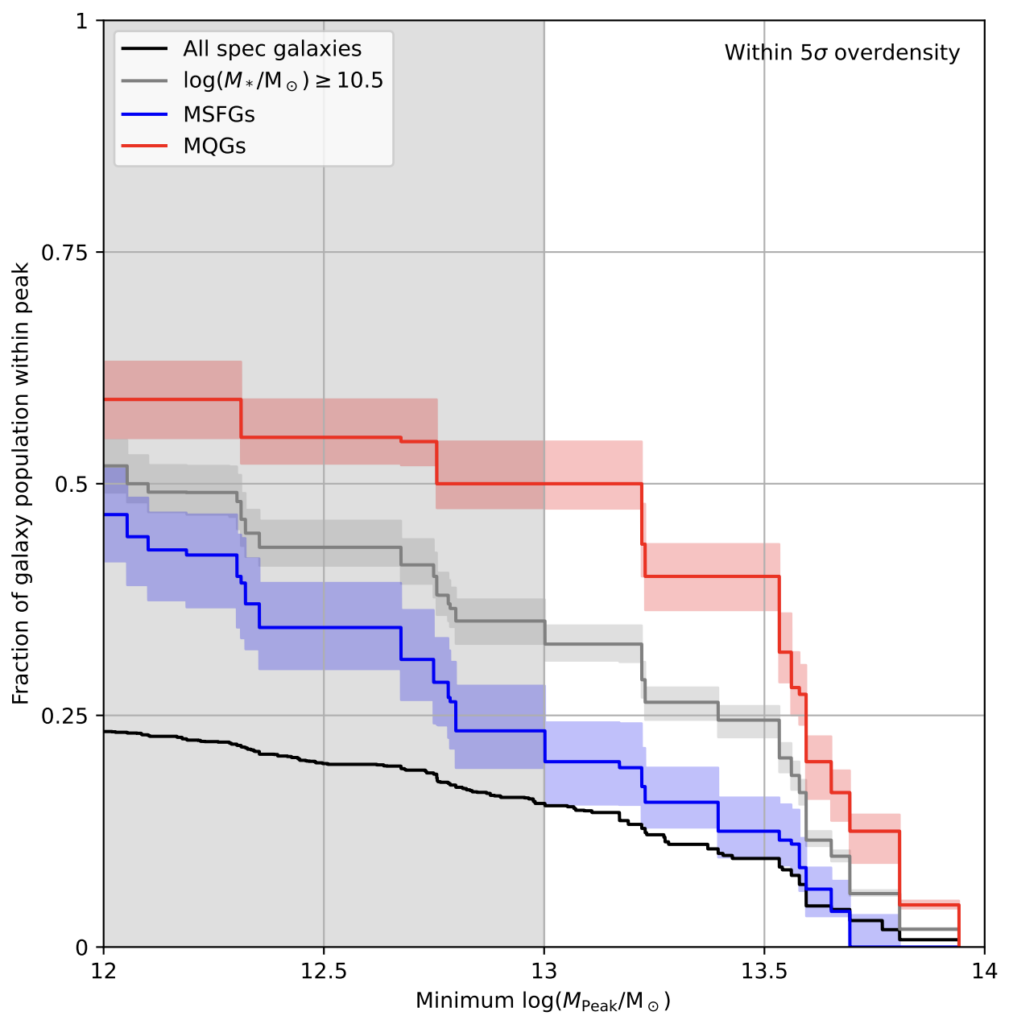
This is only the beginning. This environmental preference strengthens with stellar mass.
While massive galaxies tend to cluster together, what’s surprising here is the dramatic difference between dead and star-forming galaxies of similar mass. Dead galaxies strongly prefer the Universe’s most crowded neighborhoods, even at these early times. This environmental preference becomes even stronger for the most massive quiescent galaxies, 75% of them live inside overdense peaks (see Figure 3). This trend suggests that whatever mechanism shuts down star formation in massive galaxies works more efficiently in crowded cosmic environments.
This suggests that whatever is quenching star formation in massive galaxies works more efficiently in overdense environments.
This is the first systematic spectroscopic evidence that environment matters for massive galaxy quenching even at early cosmic time, when the Universe was barely 2 billion years old. Massive quiescent galaxies preferentially reside in crowded environments, the cosmic graveyards where galaxies go to die.
These walking dead galaxies, quiet in their star formation but loud in their environmental preferences, are showing us that the relationship between galaxies and their cosmic neighborhoods was already well established in the universe’s infancy. The graveyard shift began very early in the universe’s history, and JWST lets us watch it happen.
Astrobite edited by Katherine Lee
Featured image credit: JWST/Tatevik Mkrtchyan
