
Title: Cosmology with dropout selection: Straw-man surveys & CMB lensing
Authors: M.J. Wilson and Martin White
First Author’s Institution: Lawrence Berkeley National Laboratory, Berkeley Center for Cosmological Physics
Status: Published in Journal of Cosmology and Astroparticle Physics [open access]
Introduction
About 380,000 years after the Big Bang, the Universe expanded and cooled enough for electrons and protons to combine into neutral atoms. This event left behind a nearly uniform blackbody that we detect today, known as the Cosmic Microwave Background (CMB).
The CMB is like the Universe’s baby photo, offering a glimpse into its earliest moments. On the other hand, galaxy surveys, which map the Universe at the age when large-scale structure had already formed, are more like adult portraits. What happened between these two frontiers is less understood. In this paper, the authors seek to fill the gap by adding another image to the cosmic photo album: the Universe’s angsty high school yearbook photo.
Dropout Rebellion
Since the Universe is expanding, light gets stretched to redder wavelengths as it travels. Cosmological redshift, denoted by z, serves as a cosmic clock: higher redshifts mean earlier times (but the relationship is nonlinear). To study the Universe’s rambunctious teenage years, the authors peer back to high redshifts (z ~2–5 or ~10.5-12.5 billion years ago).
During this era, structure was still developing, and many galaxies were faint, making them hard to detect. The issue is compounded by the fact that most matter is dark, meaning that it only interacts gravitationally and cannot be seen directly. Nevertheless, we must use observable objects (“tracers”), like galaxies, to map the underlying cosmic web.
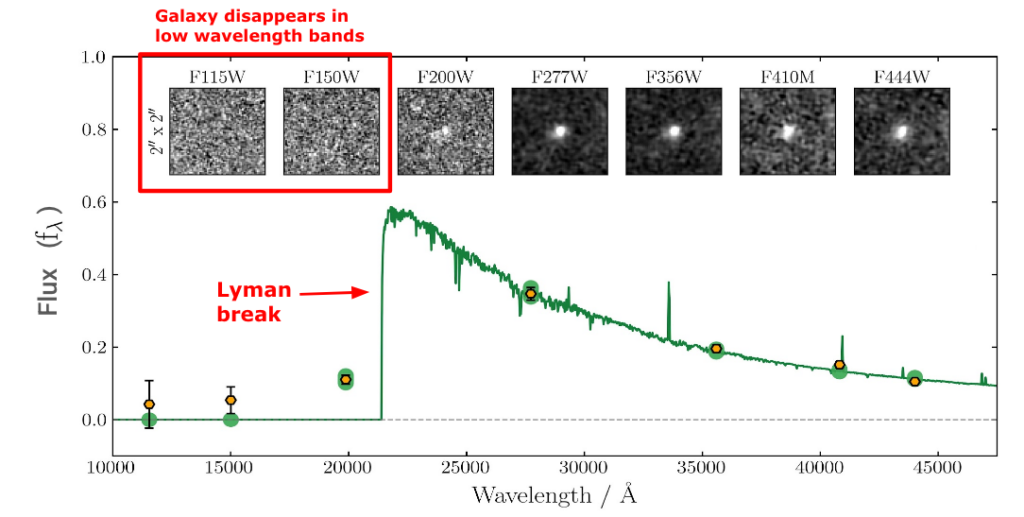
Fortunately, some young, bright galaxies have a unique property that makes them ideal tracers at high redshifts. The authors focus on these eccentric galaxies, which are called dropout galaxies or Lyman-break galaxies. Rather than dropping out of high school, these teenage galaxies “drop out” or disappear in certain filters when observed.
The dropout phenomenon occurs because early galaxies contain abundant neutral hydrogen, which is very efficient at absorbing light below a specific wavelength, called the Lyman limit. Only photons with wavelengths longer than the Lyman limit escape the galaxy. This creates a sharp drop in the galaxy’s spectrum, called the Lyman break.
In the galaxy’s rest frame, the Lyman limit occurs at 912Å (91.2 nm), which is an ultraviolet wavelength. But the wavelength at which the Lyman break occurs is dependent on redshift, moving to longer wavelengths at higher redshift. Conveniently, during the Universe’s teenage years, the Lyman break lands in optical and infrared wavelengths, exactly where many telescopes see. By looking for galaxies that exhibit this drop in their spectrum within the optical and infrared, we can easily pick out the galaxies that existed during the Universe’s adolescence.
Peer Pressure
In addition to using dropout galaxies to trace the underlying matter distribution, the authors also focus on a subtler direct measurement. General relativity predicts that mass bends spacetime, which distorts passing light—a phenomenon called gravitational lensing.
As CMB photons travel across the Universe, they pass by both dark and baryonic (“regular”) matter, getting gravitationally lensed, like a form of cosmic peer pressure. By measuring these changes in the CMB, we can reconstruct the total mass distribution that caused the bending, resulting in a mass map of all matter along our line of sight. Lensing is strongest when the lens sits halfway between the source and the observer. For the CMB and us, this sweet spot is at z ~ 2, right during the Universe’s teenage years!
A Yellow Brick Road
The major result of this paper is the idea of combining these two probes (the angsty dropout galaxies and gravitationally peer-pressured CMB photons) to study the adolescent cosmos. By statistically comparing (“cross-correlating”) where the dropout galaxies are against where the total mass is concentrated, we can measure structure formation.
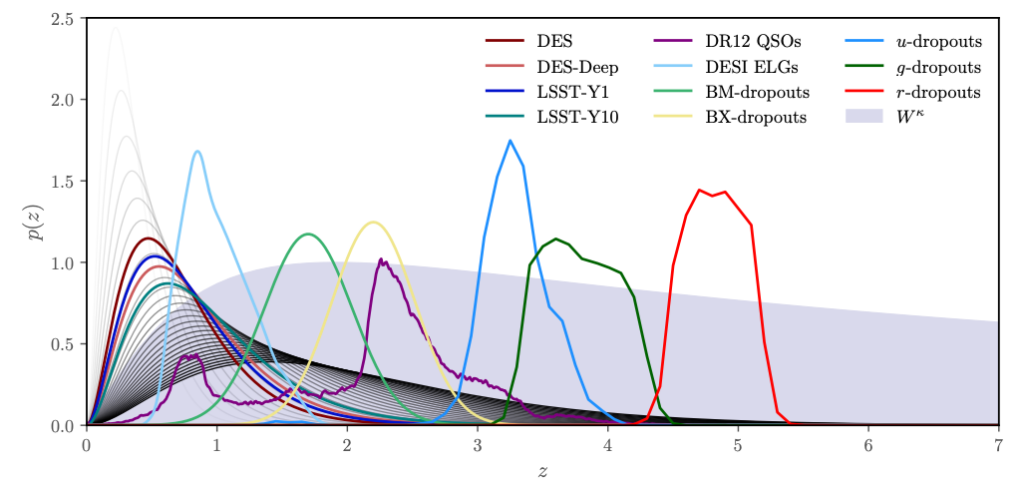
Wilson and White lay out a clear path, a yellow brick road perhaps, for measuring this cross-correlation. Since the Lyman break moves predictably with redshift, they propose using specific color filter selections to isolate 1D narrow, high-redshift layers. This method, called tomographic decomposition, allows them to break down the blended 2D CMB lensing mass map into individual signals to create a 3D stack of mass slices.
To determine if tomographic decomposition is possible with current and planned technology, they propose “straw-man” surveys. These are simplified observational plans, with a bit more brain than the Scarecrow. What they find is stunning: we can achieve an extremely confident (>100σ) measurement of the cross-correlation within the next decade.
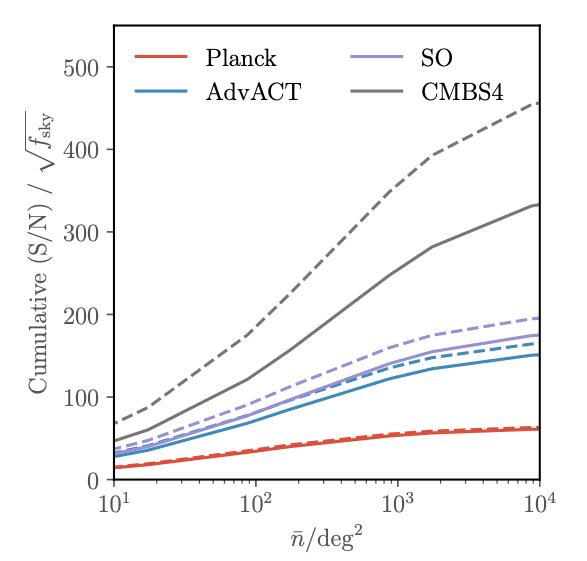
Finally, Wilson and White detail the cosmological implications of this measurement, which is a treasure trove. From constraining neutrino masses to understanding the evolution of dark energy, many compelling tests of physics can be studied.
Outlook
This paper establishes the use of dropout galaxies and CMB lensing as a powerful cosmological probe for the future. The authors provide a blueprint for creating an unprecedented window into the structure of the high-redshift Universe. Rubin Observatory will be able to detect ~150 million dropout galaxies, and Simons Observatory will provide incredibly detailed CMB lensing maps, both sufficient for a confident measurement. In short, we are poised to read the Universe’s teenage diary and reveal some of its well-kept secrets.
Astrobite edited by Jared Bull and Viviana Cáceres
Featured image credit: ESA and the Planck Collaboration
