
Title: I Zw 18 Revisited with HST ACS and Cepheids: New Distance and Age
Authors: A. Aloisi, G. Clementini, M. Tosi, F. Annibali, R. Contreras, G. Fiorentino, J. Mack, M. Marconi, I. Musella, A. Saha, M. Sirianni, and R. P. van der Marel
First Author’s Institution: European Space Agency/STScI
Status: Published in The Astrophysical Journal (2007 September 18) [open access]
A Newborn Galaxy? In Your Local Universe? It Might Be More Likely Than You’d Think
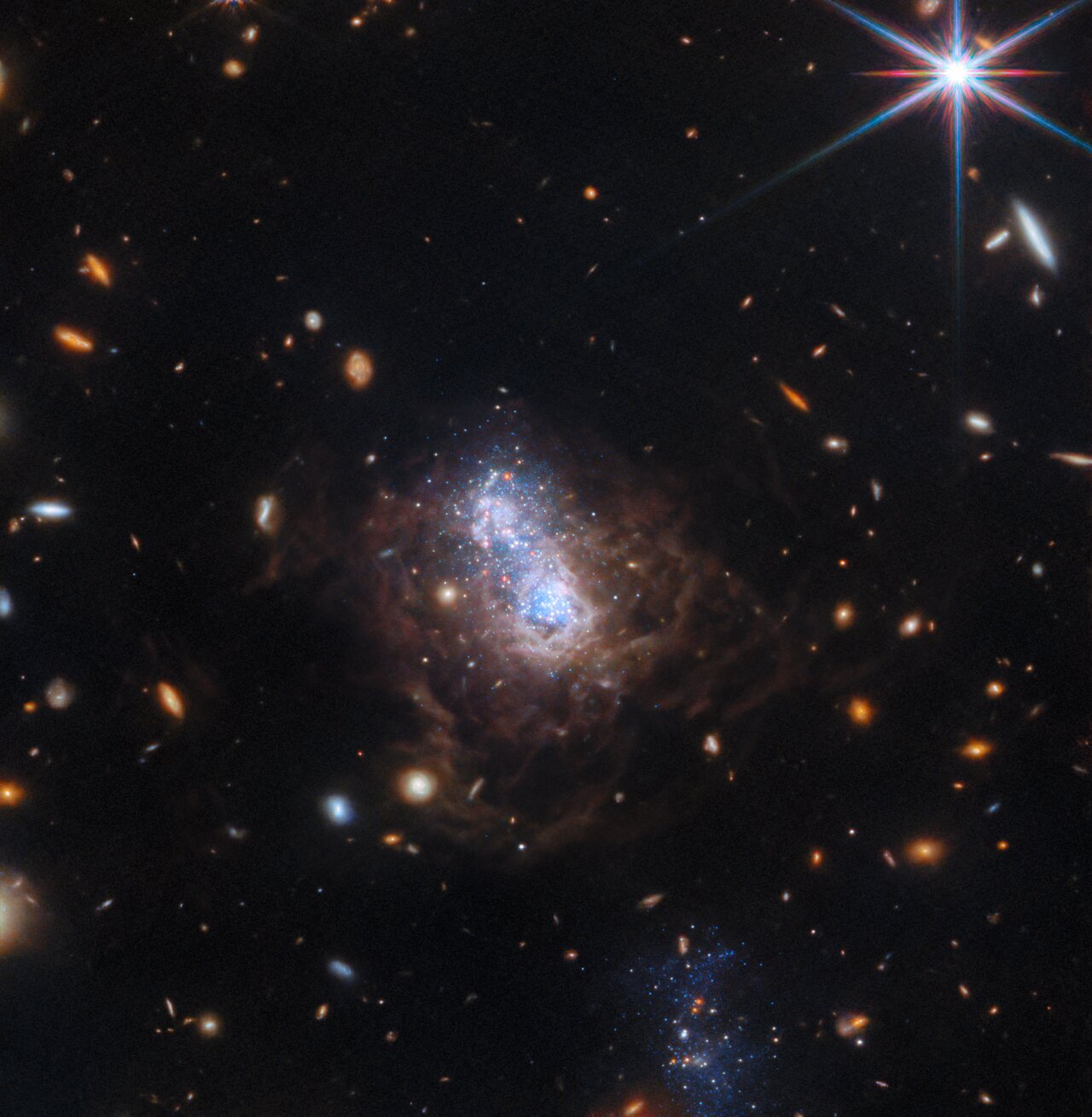
Credit: ESA/Webb, NASA, CSA, A. Hirschauer, M. Meixner et al.
The key to unlocking the secrets of the early cosmos might just be hiding in plain sight. Within spitting distance of the Milky Way lies I Zwicky 18, a dwarf galaxy with an unusual star formation history, seen in Figure 1. At first glance, it seemed to have only just started forming stars, with a stellar population made up entirely of young stars. If this were correct, and I Zwicky 18 had only begun forming stars recently, it would likely be inexplicably young, considering that most galaxies in the local universe have been forming stars for billions of years.In addition to being a newborn galaxy, there is no precise distance measurement for I Zwicky 18. Prior to this work, it was estimated to be roughly 10 megaparsecs away with significant margins of error. In order to accurately measure the distance to a galaxy, you need evidence of standard candles: types of objects that have brightnesses that are well-known regardless of distance. One type of standard candle that is especially useful in distance measurements is an older star with a well-understood brightness. Since light travels at a finite speed, more distant galaxies are seen at a younger age. If I Zwicky 18 were as close as astronomers predicted, it would be much younger compared to other galaxies near it. Today’s paper gets to the bottom of this issue, determining once and for all: How old is I Zwicky 18 and how far away is it?
Hydrogen, Helium, and Metals, Oh My!
The early universe was made up almost exclusively of hydrogen, helium, and very trace amounts of heavy elements often described generally as “metals.” Metals are formed in the cores of stars by way of fusion: the art of slamming atoms into each other to release energy and make more, slightly heavier elements, thus increasing the overall metallicity of the star. Over time, those stars die, circulating the metals they have spent their lives making, thus enriching the universe in a process known as cosmic recycling.
The galaxies we see now have had ample time to produce stars, thus having metallicities that reflect multiple rounds of cosmic recycling. I Zwicky 18, on the other hand, has a metallicity one fiftieth of that of the Sun, indicating that the galaxy has not been around for long enough to undergo this process and is composed of mostly young stars. This would be highly unlikely in the local universe.
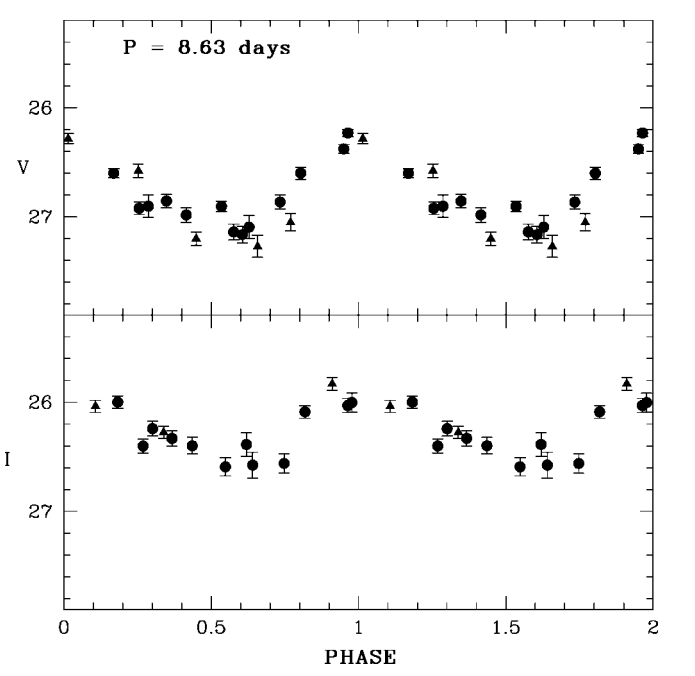
Credit: A. Aloisi et. al, 2007
Cepheids in Hubble’s Sight
The authors collected over seven hours of data from the Hubble Space Telescope to probe the dusty tendrils of I Zwicky 18 for older stellar populations. The galaxy’s proximity allows Hubble to resolve individual stars, giving today’s authors an unprecedented first look at I Zwicky 18’s stellar population. They detected, for the first time, older stars in the galaxy, shattering previous understanding of its age and star formation history. They detected several asymptotic giant branch stars (which indicate a burst of star formation several billions of years ago) and four Cepheid variable stars, a type of evolved star that fluctuates in brightness, as seen in Figure 2.
Once the Cepheids had been properly calibrated, the authors could then use them to calculate a distance to I Zwicky 18. If you know the true brightness of a star, and how bright it would appear from a fixed distance, you can find the overall distance to that star, and by proxy, its host galaxy. Using this method, today’s authors found a distance of 18.2 ± 1.5 megaparsecs, nearly double that of previous assumptions.
Primordial Galaxies in Our Backyard
A galaxy with low metallicity and minimal star formation in our local universe could provide a strong analog for some of the very first galaxies to have ever existed. These primordial galaxies often are too dim or too far to be accurately studied. Nearby analogs allow astronomers to probe the early secrets of the universe with greater accuracy, thus driving astronomical advancement, all from the comfort of our own backyard.
Astrobite edited by: Akshita Mittal and Drew Lapeer
Featured image credit: ESA/Webb, NASA, CSA, A. Hirschauer, M. Meixner et al.
