
Authors: James G.Rogers, Edward D. Young, Hilke E. Schlichting
First Author’s Institution: Institute of Astronomy, University of Cambridge, Cambridge, United Kingdom
Status: Published in Monthly Notices of the Royal Astronomical Society [open access]
In our daily lives, we step on the surface of the Earth as if it were a “floor”. But how often do we stop to consider the thousands of kilometres of dynamic, layered structure that lie beneath our feet?
We know that Earth’s interior is complex and differentiated (i.e., composed of distinct layers such as a core, mantle, and crust) because we have directly measured it through seismic and geophysical observations. Mars, too, has recently been probed by the InSight mission, providing similar measurements. Yet for the vast majority of exoplanets, we cannot drill, sample, or “listen” to their internal vibrations. Their interiors remain hidden, inferred only indirectly from measurable properties such as mass, radius, and atmospheric spectrum. With no possibility of direct probing, our only way to understand their internal structure is to construct models based on the limited observables that we do have.
What are sub-Neptunes made of?
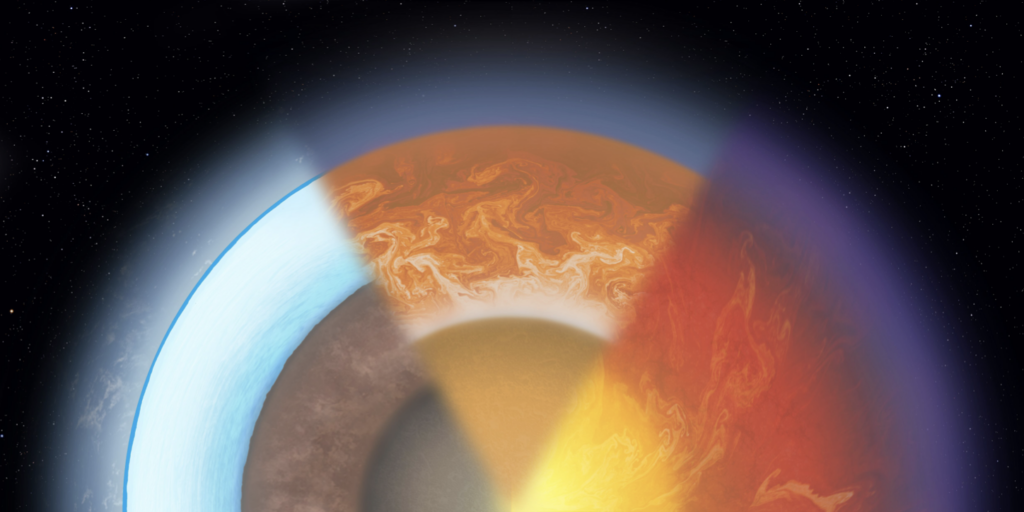
The short answer: we do not know precisely (yet). The long answer: “sub-Neptune” is an umbrella term used to define exoplanets whose bulk density is closer to Neptune than Earth. These planets likely possess substantial envelopes of volatile material (such as hydrogen, helium, or water) atop a rocky core, but their exact compositions and structures remain uncertain and heavily debated (see Figure 1 for some possible scenarios).
So, to move forward, planetary scientists must make assumptions. To approach the extremely complex problem of determining a sub-Neptune’s internal structure from limited observable data, researchers often model each layer independently with known equations of state — rules that describe how a material squishes or expands under pressure and heat. For example, a silicate-rich core and a hydrogen-rich envelope are treated separately, each following its own equation of state. But is such a simplification truly realistic? Today’s Astrobite discusses a novel, more physically grounded alternative.
A Sub-Neptune walks into a bar…
Forget a perfectly shaken cocktail — imagine the bartender just gives your Whiskey Sour a quick, sloppy stir. Some flavors mix, some stay put. That’s a good way to picture how the authors rethink sub-Neptune interiors: part blended, part layered. Indeed, under extreme pressures and temperatures in sub-Neptunes, materials such as hydrogen and silicates can mix with each other. This ability of two substances to mix into a single phase is known as miscibility. Thus, by investigating hydrogen-silicate miscibility under high-pressure conditions, the paper challenges the idea that sub-Neptunes are neatly layered worlds. If so, our current models for interpreting their structure, thermal evolution, and even observational signatures may need substantial revision.
Modeling hydrogen-silicate cocktails
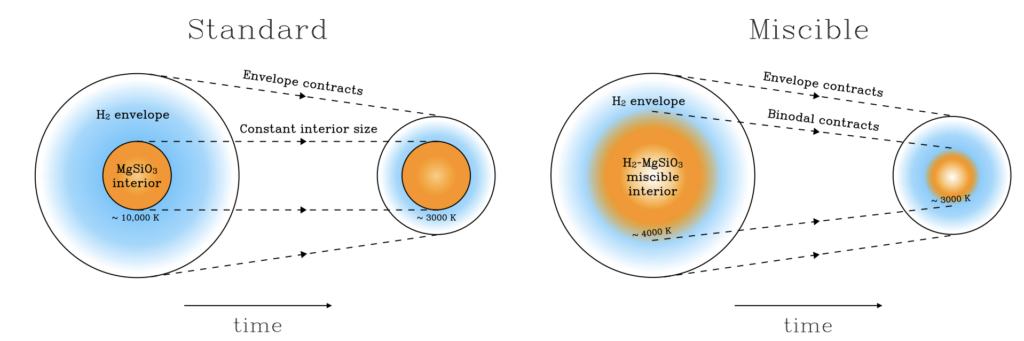
The authors developed a thermal and structural evolution model for sub-Neptunes that moves beyond the traditional picture of planets with cleanly separated, non-interacting layers. Instead of assuming a sharp boundary — often referred to as a “magma ocean surface” — they identify the “binodal surface” as the physically meaningful dividing line inside the planet. This surface marks where a phase change occurs: deep inside the planet, hydrogen and silicates exist as a fully miscible fluid (forming the planet’s “interior”), while above the binodal surface they separate into gas and silicate-melt phases (making up the planet’s “envelope”). Their evolution model tracks how this boundary moves over time, because as the planet cools, the pressures and temperatures at which hydrogen and silicates mix or separate also change, unlike standard layered models in which the boundary remains fixed and does not evolve (see Figure 2).
Sipping hydrogen
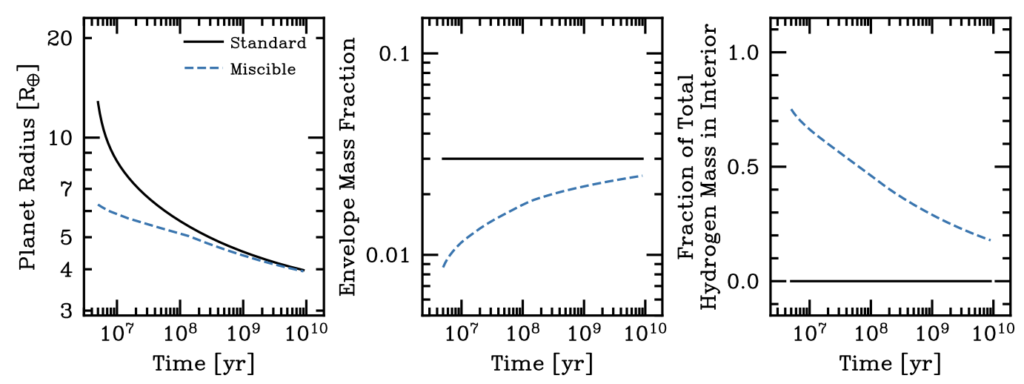
As shown in Figure 3, under the miscible model, the planet’s radius, envelope mass fraction (the fraction of the planet’s total mass contained in its envelope), and hydrogen distribution evolve in ways that differ significantly from the standard layered picture. Because hydrogen and silicates are fully mixed at high pressures and temperatures, a significant mass fraction of the planet’s hydrogen initially resides in the interior (about 75% at early times). As the planet cools, hydrogen becomes less soluble in the silicate melt. The melt can no longer hold as much hydrogen, so the excess gradually moves into the envelope, causing the fraction of hydrogen stored in the interior to drop to ~10% over time.
This continuous exsolution increases the envelope mass fraction, which in turn influences the planet’s radius. As cooling proceeds and the binodal surface contracts inward, the envelope composition becomes progressively more hydrogen-rich, and the planet’s radius decreases accordingly. Overall, the miscible model produces a dynamic, evolving envelope whose mass and radial extent grow over time — a behavior absent from the standard model, where the boundary is fixed and the interior cannot store or release hydrogen. In other words, the planet slowly sips its hydrogen from the inside out!
The aftertaste of hydrogen
Miscible sub-Neptunes also contract more slowly than planets in the standard scenario, suggesting that many sub-Neptunes may be larger for longer periods of their lifetimes than previously thought, potentially reshaping our interpretation of the observed radius distribution. After several gigayears, however, most of the interior hydrogen has exsolved, and sub-Neptune with or without miscibility converge to similar radii at a given mass. Their internal distribution of hydrogen and silicates remains different, with some hydrogen still stored in the interior.
So what does this mean for the aftertaste of our silicate-hydrogen cocktails? It means that miscibility leaves a long-term compositional signature, even after its effect on the observable radius has faded. Much, however, remains hidden beneath the observable surfaces of sub-Neptunes, and future work is needed to determine how competing processes like gas accretion and atmospheric escape compete with miscibility throughout their lifetimes.
All in all, who would have thought that studying planetary cocktails could help us link interior physics, atmospheric evolution, and future observations to make sense of the sub-Neptunes we see so many of in the Universe? Cheers to that!
Astrobite edited by Julie Kiel Holm and Joe Williams
Featured image credit: Artistic impression of metal vapor condensates producing liquid metal rain in the atmospheres of ultrahot exoplanets, credited to ESO/M. Kornmesser/L. Calçada, licensed under CC BY 4.0.

Thank you for the article, super interesting!
A wonderfully written article with inventive metaphors throughout! I must say I particularly enjoyed the (surprisingly apt) final analogy of the “aftertaste” of a silicate-hydrogen cocktail!