
Title: First observation of the cosmic ray shadow of the Moon and the Sun with KM3NeT/ORCA
Authors: The KM3NeT Collaboration
Status: Published in the European Physical Journal C [open access]
Today’s Forecast: Cloudy with a Chance of Cosmic Rays
No matter where you are in the world right now, I can guarantee that if you take a step outside, you’ll encounter heavy precipitation – just not the type you might be used to. We are constantly being rained on by cosmic rays: very energetic atoms, or small nuclei, produced in a range of astrophysical processes. Space is full of them, and when they manage to reach the Earth’s atmosphere, they interact and produce showers of secondary particles, some of which survive to reach the Earth’s surface.
Luckily, this isn’t the type of precipitation we need umbrellas for; the passage of these cosmic rays, and the particles they produce pass largely unnoticed to the majority of us (although they can be detected with mobile phones!). However, for the authors of today’s paper, this constant cosmic ray rainstorm is a little harder to ignore.
Cosmic Rays in my Neutrino Telescope? It’s More Likely Than You Think…
The experiment at the centre of this article is KM3NeT, an in-progress large-scale neutrino detector located deep in the Mediterranean sea. Neutrinos are particularly elusive particles, found in three different types, or flavours. They are usually spotted by their interactions with matter, and KM3NeT does this with sea water; for example, a muon-neutrino interacting with water molecules generates a muon, resulting in a flash of light that can be recorded by the experiment’s optical sensors. Therefore, rather than detecting the neutrinos themselves, KM3NeT is sensitive to muons created by these interactions.
However, muons can also be created another way – as a byproduct of cosmic rays interacting up in the atmosphere. What this means is that while KM3NeT is looking for neutrino-produced muons deep below the sea, it also records large amounts of cosmic ray muons raining down from above, producing a significant background signal in the detector.
Historically, neutrino detectors aim to reduce this background – in the case of KM3NeT, the tonnes of water above the detector effectively act as a shield against the cosmic ray muons. This gives the experiment a fighting chance at spotting neutrinos amongst the muon downpour, but can’t remove it entirely. Nevertheless, every cloud has a silver lining: this dataset of cosmic muons provides a neat opportunity for the experiment to test and calibrate their detector, thanks to two of our celestial neighbours – the sun and the moon.
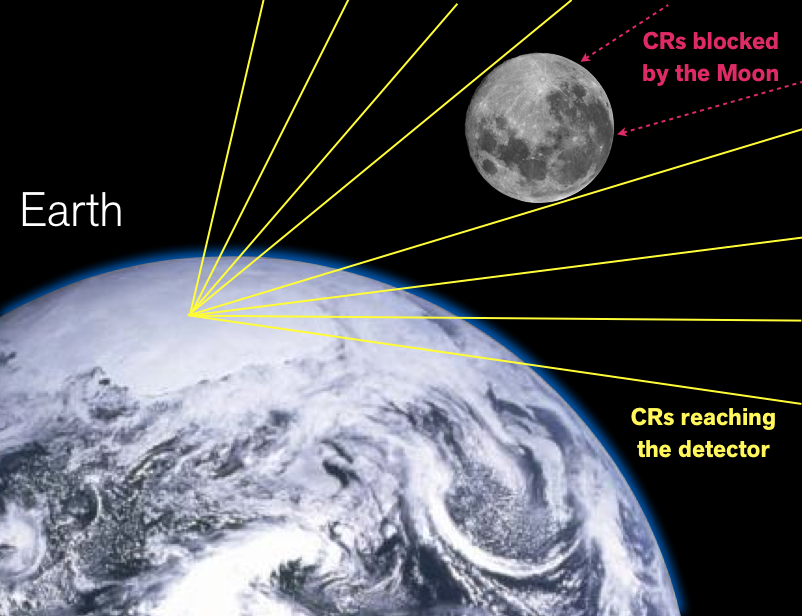
If we look – not with our eyes, but with cosmic ray detectors – in the direction of either the sun or the moon, we see a decrease in the number of cosmic rays arriving from these parts of the sky. As shown in Figure 1, the two bodies act as a barrier to the incoming particles, blocking them from reaching us and producing a significant ‘shadow’ in the cosmic ray flux. This phenomenon was first reported in 1957 by George W. Clark, and has since been spotted by a range of experiments (e.g. IceCube, HAWC, and many more). Now, the KM3NeT collaboration aims to do the same.
Searching for Shadows
The authors looked at 499.3 days of data recorded by the ORCA detector – the half of KM3NeT optimised for neutrino particle physics. They narrowed down their dataset by only including events from the direction of the sun and moon, where the shadows are expected to be found, and by focusing on atmospheric muon events travelling vertically downwards, isolating muons generated by cosmic ray interactions above the detector.
The next step was to determine whether the shadows are present in the data or not, and this was done with a likelihood ratio test. In practice, this involves choosing a small region of the sky, and evaluating two measures – the chance that the number of events seen in this region follows expectations, and the chance that the event number is lower than expected due to a shadowing effect. Comparing these two produces a quantitative measure of which scenario is more likely, allowing the authors to assess whether the shadows are indeed present or not.
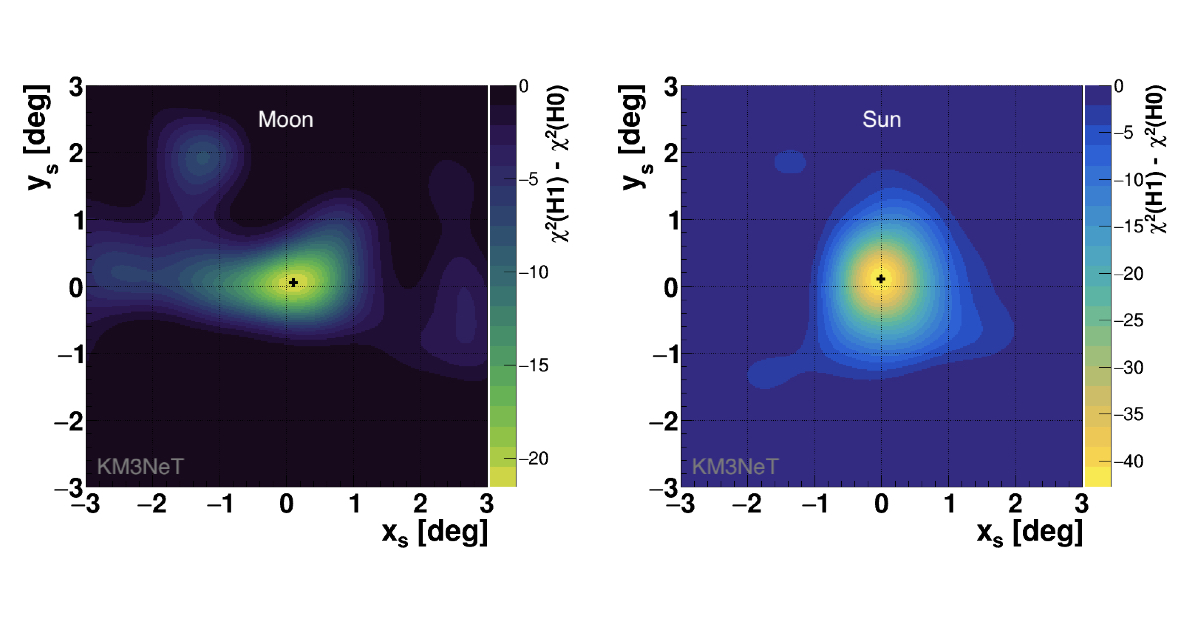
Some results of this test are shown in Figure 2, in a statistical ‘image’ of the two bodies. Demonstrated visually here, they found that data from the directions of both indeed show strong evidence of a cosmic ray deficit, with the sun casting a particularly significant shadow. From this, the authors then calculated the position of each, as seen by the detector.
But Don’t We Already Know Where the Sun is?
It’s admittedly not too difficult, in day-to-day life, to pinpoint the location of the sun. But this provides the experiment with a clearly defined reference point: comparing the calculated positions of the two bodies to the true positions allows the authors to demonstrate both that the detector is able to point back to sources, and to quantify the resolution of this pointing – pretty crucial when performing astronomy. For example, while this paper was under review, the highest ever energy neutrino was detected by ORCA’s bigger sister (ARCA), and one of the steps in understanding its cosmic origin is determining, as accurately as possible, where on the sky it originated from. And as progress continues on both ORCA and ARCA, we’ll see more and more exciting neutrinos such as these, so keep an eye out for what comes in the future!
Astrobite edited by Natalie Price and Margaret Verrico.
Featured image credit: Artist’s representation of the KM3NeT experiment, courtesy of KM3NeT. Sun and Moon retrieved from Brocken Inaglory and User:Colin, via Wikimedia Commons, CC BY-SA 4.0. Adapted by Isha Loudon.
