
Authors: Pierre Auger Collaboration
Status: Published in Physical Review Letters [closed access]
A high-energy cosmic mystery
Cosmic rays – energetic particles from space, mostly protons and atomic nuclei – arrive at Earth with energies spanning all the way from to eV. The upper end of that range represents fantastically high energies: for comparison, the highest particle energy we can reach in the world’s largest particle collider tops out around eV. That’s a factor of ten million! But what are these astronomical particle accelerators that produce such enormously energetic particles, where are they, and how do they work? All of these are very much open questions.
Extensive Air Showers: when it rains, it pours (energetic subatomic particles)
Cosmic rays with energies above roughly 1 EeV, which is eV, are aptly referred to as ultrahigh-energy cosmic rays (UHECRs). We know from observation that the higher the energy of a cosmic ray, the rarer it is: only about one eV cosmic ray will pass through any given square kilometer of the top of Earth’s atmosphere per year. But luckily, the higher the energy, the harder it is to make a sneaky entrance. When a cosmic ray comes screaming into the atmosphere and collides with a nucleus, a shower of new high-energy particles are created, which then barrel further down into the atmosphere and create their own new showers, which then continue further into the atmosphere and create their own showers…and so on until reaching the ground. This cascade of energetic particles is called an extensive air shower (EAS). The size of the shower increases with the energy of the original cosmic ray, creating a footprint at the Earth’s surface on the scale of 10 km for a UHECR. The EAS can be detected either by watching for a faint glow in the air or catching the particles that reach the ground. Thus, we detect high-energy cosmic rays by their downstream effects – and use the atmosphere as part of the detector.
The Pierre Auger Observatory, which covers an area the size of Rhode Island in the plains of Argentina and has been up and running since 2003, is built to look for UHECRs with multiple detector types. Today’s paper is brought to you primarily by Auger’s water Cherenkov detectors. These 1660 tanks of water, spaced on a grid 1.5 km apart over the aforementioned area, contain light sensors that detect the Cherenkov radiation produced when speedy EAS particles pass through the water. The air shower from a UHECR will typically hit several different tanks, and the relative signal strengths and timing can be used to reconstruct the direction and energy of the original cosmic ray.
Don’t be inclined to decline (to combine these datasets)
Auger has been up and running since 2004, and this paper examines data from the water Cherenkov detectors for the entire time period Jan. 1, 2004 to Dec. 31, 2022. That’s enough time to detect around 310,000 cosmic rays with energies above 2.5 EeV!
But there’s another step to be done before all this information can be put together, and that’s where the first angle in the title of this Astrobite comes in. here is representing the zenith angle or inclination, which is the angle away from the overhead direction that a particle was traveling. A particle with arrived vertically from overhead; is the direction of the horizon. This matters because the charged particles in air showers are subject to the Lorentz force law and will be steered by the Earth’s magnetic field. The more inclined the shower (i.e. higher ), the longer the distance it travels in the atmosphere before reaching the ground, and the longer the time geomagnetic effects have to act on it and distort the shower shape. Different methods are used for determining the energy of the original cosmic ray depending on whether the inclination was less than 60° or more than 60°. The authors need to knit together two different datasets for the different inclination ranges before they can consider all the data as a whole.
The second angle, declination or , is like latitude except for objects in the sky: an object with is overhead at the South Pole, and an object with will periodically pass overhead at the equator. The Pierre Auger Observatory is located at a latitude of -35.2°, so cosmic rays coming from can only arrive at inclinations of greater than 60°, while cosmic rays coming from parts of the sky with lower might arrive with inclinations on either side of 60°. With the ability to measure energies of UHECRs arriving at up to , Auger can see the sky from – that’s about seven-eighths of the sky by area.
Analysis #1: The energy spectrum doesn’t vary with declination
Now that they can compare all the recorded cosmic ray events on equal footing, the authors examine the shape of the energy spectrum, or how many UHECRs arrive with what energies. First, they divide the part of the sky Auger can see into five declination bands. Does the energy spectrum of the UHECRs vary over different parts of the sky, north to south? The results are plotted in figure 1, one color for each declination range. If the shapes of the spectra for the five ranges all look very similar to you, you’re right! The authors found no statistically significant differences when fitting functions for the spectrum to the different declination ranges, meaning UHECRs bombard Earth the same amount from each of these parts of the sky.
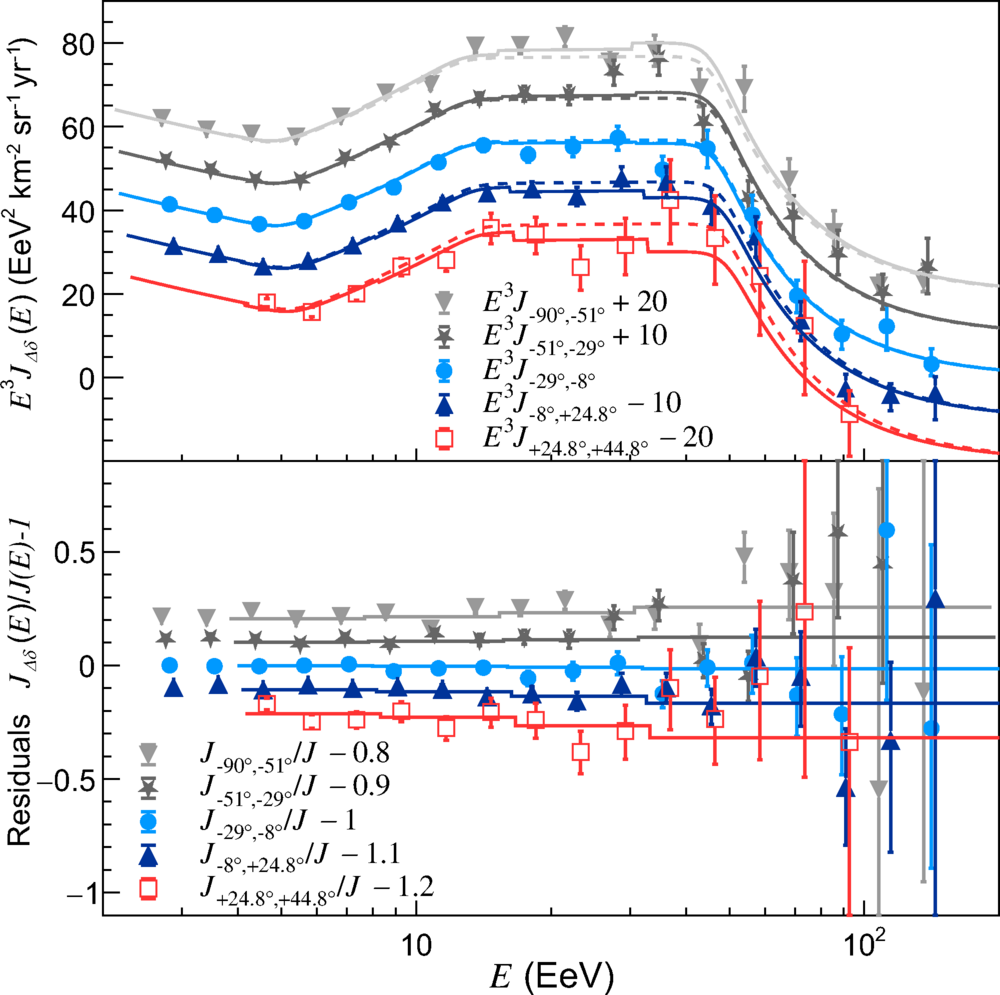
Fig. 1 (Fig. 2 in today’s paper) The data for the scaled energy spectrum in each of five declination ranges is represented by a different color of marker, while the colored lines are the fit for the whole dataset. The data and lines for different ranges are offset by the amounts listed in the legend so that the reader can see them better. The bottom panel shows the differences between data and the fit.
Analysis #2: The “instep” feature confirmed
Though the number of cosmic rays at a particular energy decreases as the energy increases, the trend isn’t one interrupted slope: instead, the rate of the decrease changes at some known energies. The first, located at around eV, is called the “knee”; two more, called the “ankle” and “toe,” are located in the UHECR region at about 5 and 45 EeV respectively. Previously, Auger had seen signs of a fourth feature in between the ankle and toe, dubbed the “instep,” near 10 EeV but didn’t yet have enough data for the preference for fitting an extra bend in the spectrum to pass the 5 threshold often used for statistical significance. Now, with the bigger dataset out to presented in this paper, the significance is above 5.5 and the authors can say the instep is definitely there. (They’d better not discover another spectral feature, or they’re going to run out of parts of the leg to name them after.)
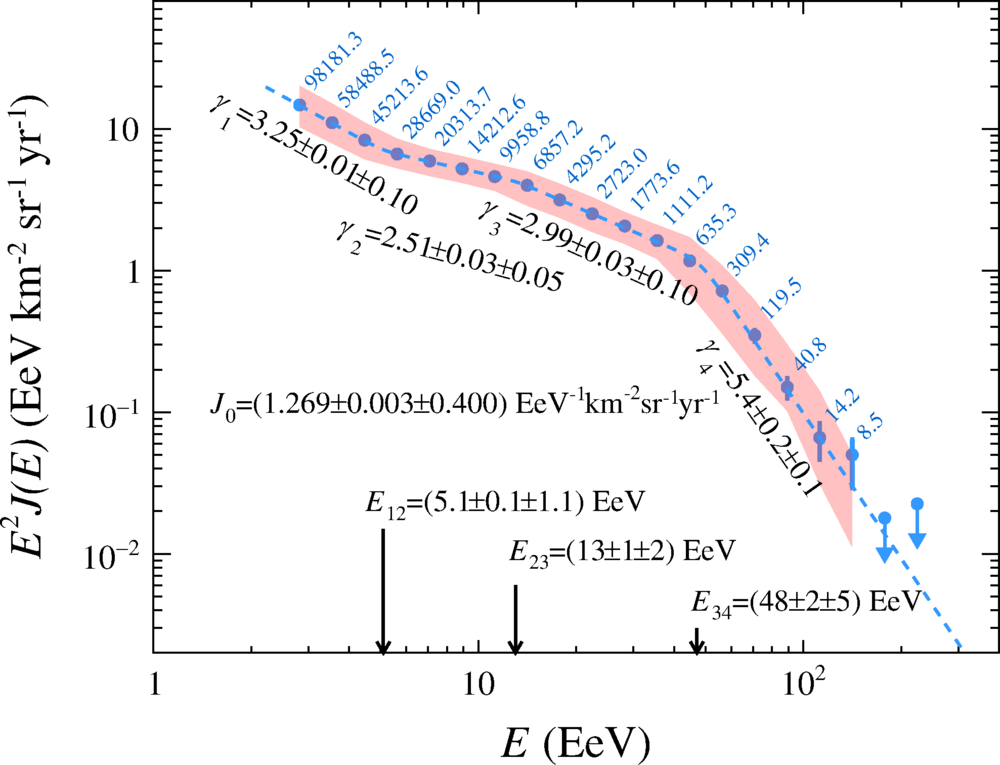
Fig. 2 (Fig. 3 in today’s paper) The scaled energy spectrum for all of the UHECRs observed by Auger. The shaded area represents the uncertainty. The three arrows at the bottom of the plot mark the three bends in the spectrum.
Keeping theories instep with the data
So, what do these two results tell us about the nature of UHECRs? First, the uniformity of the energy spectrum across declinations suggests that it’s unlikely UHECRs, and whatever processes cause the instep and other spectral features, come from only a few nearby sources; otherwise, by chance more of those sources would likely fall into one declination range than another and the spectrum would vary in height or shape between the ranges.
The authors suggest that the instep in the spectrum is consistent with theories of a turning-over of the primary composition of UHECRs from helium nuclei to heavier carbon, nitrogen, and oxygen nuclei as energy increases. In these models, different nuclei make up most of the cosmic rays in different parts of the ultrahigh energy range, and the total UHECR spectrum bends at the transitions in composition (see, for example, figure 2 in this earlier paper). Naturally, the chemical composition of UHECRs as a function of energy has implications for theories of where they could have come from and what processes could have accelerated them. The data in this paper is on UHECR energy, which can’t tell you the mass directly: a lighter particle traveling faster can have the same energy as a heavier particle traveling more slowly. But upgrades to Auger are adding instrumentation that can help better distinguish the masses of the cosmic rays, and there is so much more still to learn.
Astrobite edited by Joe Williams
Featured image credit: Tobias Schulz, CC BY-SA 4.0 https://creativecommons.org/licenses/by-sa/4.0, via Wikimedia Commons
