
Title: Possibility of the Existence of Wormholes in Nature
Authors: Leonel Bixano and Tonatiuh Matos
First Author’s Institution: Departamento de Física, Centro de Investigación y de Estudios Avanzados del IPN, Mexico City, Mexico
Status: published in The Physical Review D [closed access]
Einstein’s last unconfirmed prediction
Einstein’s equations of general relativity have a strong track record. They predicted gravitational waves, detected hundreds of times now by LIGO. They predicted black holes, and we have photographed two of them. They predicted the expansion of the universe, confirmed in 1929 and later found to be accelerating. Each of these predictions has been checked out. Each one, that is, except one: wormholes.
Today’s paper looks at this last open question. The authors present an exact, rotating wormhole solution to Einstein’s equations and argue that, under the right physical conditions, it could represent a real object in nature.
What is a wormhole, and why don’t we believe in them yet?
You have probably seen the pop-science picture: take a sheet of paper, fold it so two distant points touch, and poke a hole through both layers. The short tube connecting them is a wormhole, and its narrowest point is called the throat. First described by Einstein and Rosen in 1935 as “Einstein-Rosen bridges“, those early wormholes were unstable and could not be traveled through.
The reason physicists have been skeptical about wormholes comes down to a problem with energy. To hold the throat of a wormhole open, you would need something called exotic matter. In physics, ordinary matter (stars, gas, you, your coffee) always has a positive energy density which corresponds to positive mass. Exotic matter would have negative energy density, essentially “negative mass.” We have never observed anything like that in nature. Most wormhole solutions that physicists have found over the decades require this exotic matter to exist, which is why wormholes have stayed firmly in the category of “mathematically possible but physically unlikely.” Today’s paper offers a way around this problem.
A different set of ingredients
Instead of trying to prop open a wormhole with exotic matter, the authors add two extra physical fields to Einstein’s equations alongside gravity. The first is an electromagnetic field, the same electric and magnetic fields you encounter in introductory physics. This wormhole carries both electric and magnetic charge. The second is something called a dilaton. To understand what this is, think about temperature: at every point in a room, there is a single number (the temperature at that spot). A field like this, described by just one number at each point in space rather than having a direction like an electric field, is called a scalar field. The dilaton is a specific type of scalar field that has an important property: it is coupled to the electromagnetic field, meaning changes in the dilaton affect the electromagnetic field and vice versa. You can think of it as a kind of mediator that connects gravity and electromagnetism in a way that ordinary general relativity does not include.
Why should we care about the dilaton? Because it is not something the authors invented for convenience. It shows up naturally in several theories that physicists take seriously as candidates for deeper laws of nature. Superstring theory, which attempts to unify all fundamental forces, predicts a dilaton. So does Kaluza-Klein theory, which tries to explain electromagnetism as a consequence of a hidden extra dimension of space. And Brans-Dicke theory includes one too. If any of these theories are correct, the dilaton exists, and the kind of wormhole described in this paper becomes a natural prediction of Einstein’s equations.
The central result of the paper is that the dilaton wormhole does not need exotic matter. The authors show it satisfies the standard energy conditions that physicists use to check whether a solution is physically reasonable. This is what sets it apart from most earlier wormhole solutions.
Can you travel through a wormhole?
So we have a wormhole that does not need exotic matter, and wraps up all its spacetime problems behind its throat. The natural next question is: could anything actually travel through it? They found two main hazards:
The first hazard is tidal forces. These are the stretching and squeezing forces caused by gravity gradients, the same forces responsible for “spaghettification” near black holes. The authors compute the components of the tidal force across the entire wormhole and find that near the equatorial plane, tidal forces form a barrier-like structure that would pull apart anything approaching. But near the poles (the top and bottom of the wormhole), tidal forces are small and finite.
Figure 1 shows these tidal force maps as 3D surfaces, with the paths of photons overlaid directly on top. You can see that photons entering near the poles stay in the low-tidal-force regions and pass through the wormhole successfully. Photons entering near the equatorial plane get deflected or reflected back into the same universe. The wormhole essentially sorts its visitors: only those approaching from near the poles get through.

Figure 1: Tidal force maps for a sun-sized wormhole in the radial direction. The x and y-axis are spatial coordinates and the colored curves are the photon paths. The color bar shows the magnitude of the gravitational tidal force. The yellow curve shows the tidal force at the wormhole throat. The other colors represented different entry angles of the photon. Photons that enter near the polar axis can be seen passing through the wormhole, while those entering near the equatorial plane are deflected back. It means, the safest photon travel path is along the poles.
The second hazard is the electromagnetic field. The electric and magnetic fields are similarly strong near the equator but remain weaker near the outer edges of the black hole. The authors show that all potential paths that a photon could take to successfully avoid the wormhole also naturally avoid the areas where the magnetic and electric fields would be inescapable. To see the full picture in a simpler way, the authors draw the 3D visualization of the wormhole model shown in Figure 2. It shows that when the wormhole is approached from the pole, the throat will act like a narrow, open tunnel, but when approached near the equator, the throat is broad but closed.
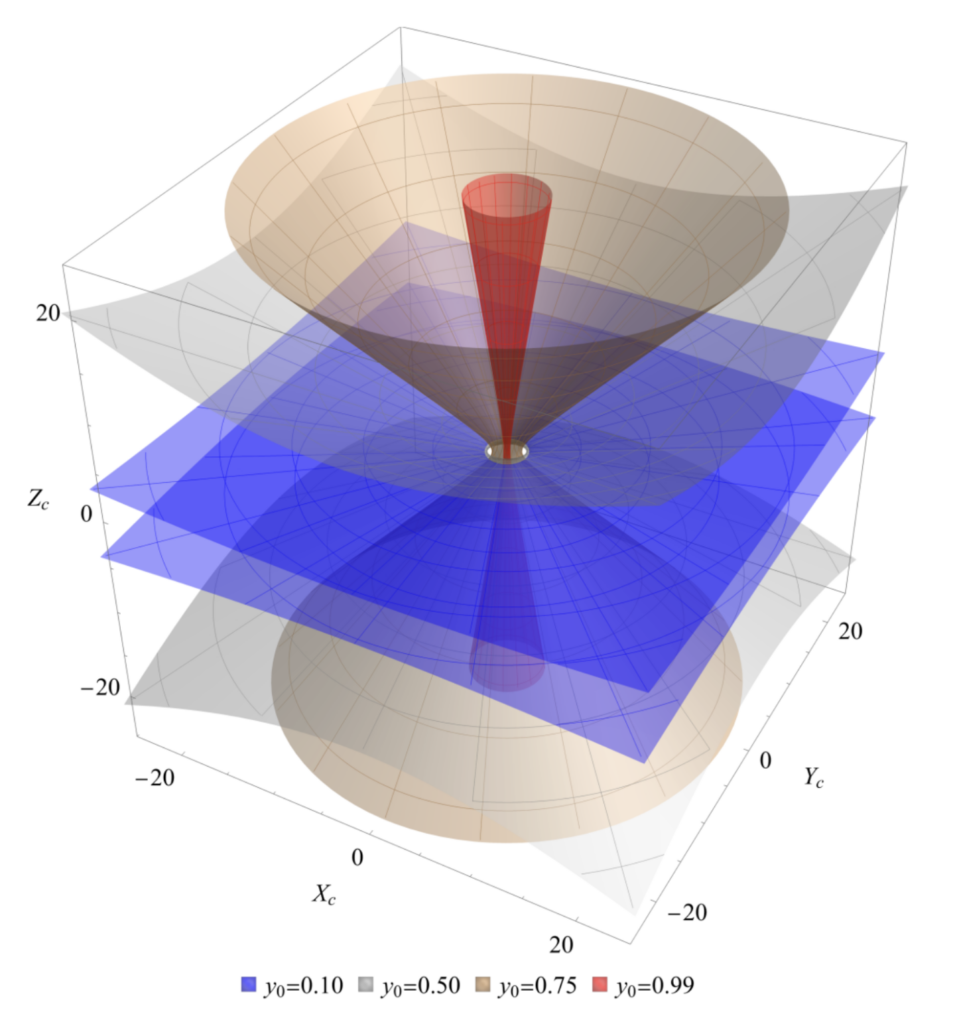
Figure 2: A 3D visualization of the wormhole’s throat depending on how you approach it. Each colored surface represents the shape of space for a different entry angle (y0). If you dive in near the poles (red cone, y0 = 0.99), the wormhole behaves like a narrow, open tunnel allowing safe passage. However, if you try to enter near the equator (blue plane, y0 = 0.10), the space flattens out into an impenetrable wall.
The big picture
This paper does not prove wormholes exist. It does not explain how one would form (that remains a separate, open question). What it does show is that there is a mathematically consistent, physically reasonable wormhole solution that satisfies energy conditions and is traversable through the poles.
The argument is conditional: if the dilaton interaction exists in nature, and it must if any theory with extra dimensions (string theory, Kaluza-Klein, Brans-Dicke) is correct, then traversable wormholes are a natural prediction of Einstein’s equations. With the Event Horizon Telescope working to image more compact objects and next-generation gravitational wave detectors on the horizon, it is not out of the question to imagine testing this. Some of the compact objects we currently classify as black holes, particularly the supermassive ones sitting in galactic centers, might be wormholes in disguise.
Astrobite edited by Kaz Gary
Featured image credit: Serat Saad

What role does rotation of the wormhole play in this picture?
We can expect effects similar to a rotating black hole. The spinning wormhole would drag space around it, so light and matter get pulled along in one direction, making one side look brighter or distorted. It can also create a region where nothing can stay still and may help support the wormhole, though it could also make it unstable.
Excellent Article— The author explained the complex topic with superb clarity.