
Title: Resource and material efficiency in the circular space economy
Authors: Zhilin Yang, Lirong Liu, Lei Xing, Adam Amara, and Jin Xuan
First Author’s Institution: Faculty of Engineering and Physical Sciences, University of Surrey, Guildford, UK
Status: available on Science Direct [open access]
Ah yes, space. You fire up a rocket, it will bring some satellite into orbit or a bunch of astronauts to a well thought-out previously determined location and voilà, mission accomplished.
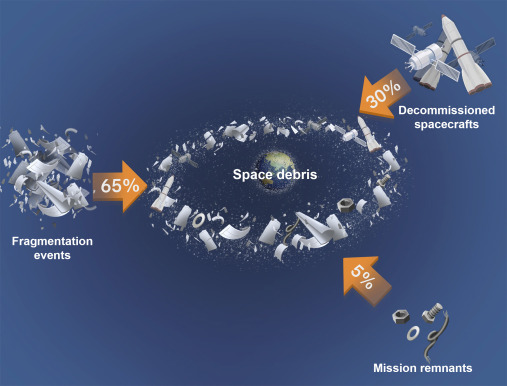
To the initiated, and to the uninitiated as well, this statement might come down as cutting the whole process short a bit. Still, everyone remembers the amazing sight of a rocket flying to space, the rocket stages decoupling along the way or the astronauts’ picture of Earth from orbit. What happens to the decoupled stages though, or to the expelled propellant? What if a satellite goes dark? Well, most of it stays ‘up there’, forming space debris (see Fig. 1). The authors of this paper exactly address what we can do with this debris and what we can do differently in the future.
Garbage In, Garbage Out
While the efforts in spaceflight are certainly not ‘GIGO’ (see paragraph title), there is a general consensus to follow a linear material flow, where you input loads of special stuff to then essentially have it discarded afterwards. Roughly, for everything involved with getting anything into space, there’s the ground system and the space system. Both use a wide range of highly specialised materials:
- Structural materials; both a rocket launch and outer space itself isn’t so kind to the materials used for all the equipment. Strong aluminium, titanium and beryllium alloys for mechanical strain and corrosion resistance are highly important. Carbon-fibre-reinforced plastics (CFRPs) could be a promising replacement for these alloys in the future.
- Ignition materials: alloys of tungsten and nickel are key here, as the rocket nozzle sees a wide range of temperatures and has to be able to deal with the thermal strain during the ignition phase.
- Electronics materials: computers, sensors, any component with some kind of processing power requires a wide range of rare earth elements in order to function.
- Energy storage materials: energy for electricity in space can be a problem, as windmills in space are not so useful (but solar panels are!), so compact and effective batteries are in wide use, requiring lithium, cobalt, nickel and silicon.
None of these are particularly easy to come by and procurement and/or production often leads to high costs, both financially and environmentally. Needless to say, all of this is strictly following the space industry’s zero-failure tolerance standard, which becomes even more stringent when astronauts are involved.
So, why don’t we start using all these materials more efficiently?
Reduce, Reuse, Recycle (not the first time you hear this?)
I get it, the people from the garbage disposal can’t or don’t want to go to space to pick up leftover metal ‘packaging’. Sure. This doesn’t mean there’s no point trying to apply R3 to the spaceflight sector (see Fig. 2 for an overview).
For spaceflight, reduce means doing more with less; increased payload and more durable spacecraft require fewer launches. Fewer launches need fewer materials, as 1 kg of payload needs 3 to 10 kg of stuff for development (design, durability, and flight testing, to name a few). Optimisation of this process can be steered with AI development. Multiple satellite launches of multimodule spacecraft drastically reduces the amount of launches as well, showing a lot of room for improvement from the ground on.
All jokes aside from the start of this paragraph, there are plans for a kind of garbage disposal crew in space already: the removeDEBRIS mission aims to use net capture, drag sail and harpoon capture techniques to fish out debris from spaceflight. Other techniques would employ lasers (it’s always lasers) to start grouping space debris together as well.
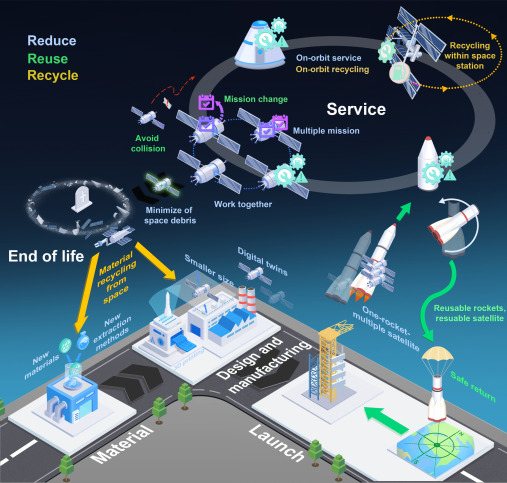
The reuse side is, admittedly, a bit more challenging than the reduce side. For ground-based reusing, there’s a great example on the market already: SpaceX’s Falcon rockets just come right back in an amazing feat of engineering. Space-based reusing entails the capture and refurbishing of satellites, space stations and of equipment left behind from previous missions: imagine talking to headquarters with the radio antenna from Sputnik I (not really though, this one got fried in the atmosphere a while ago).
For recycling in space, that’s where we know quite a lot about already. The thing is that humans need a lot of input of materials too, even astronauts, and recycling of those materials has been a long practice already. On the ground, many non-reusable materials are recycled already when they can be recovered. However, our atmosphere has this nasty habit of burning stuff up when something goes through it at high speeds (although that can be considered a good thing most of the time) making spaceflight component recovery not easy. In space itself however, there’s plenty of recyclables around, which would need recycling in space itself.
One step further is to do in-situ resource utilisation (IRSU), where extraterrestrial materials are used for space exploration.
In short, while some effort is being done for the circular space economy, there’s still quite a way to follow, with a whole array of great ideas lined up for our future on the final frontier.
Astrobite edited by Katherine Lee
Featured image credit: adopted from NASA/JPL-Caltech
