
Title: The Growth of Dust in Galaxies in the First Billion Years with Applications to Blue Monsters
Authors: Desika Narayanan, Paul Torrey, Daniel P. Stark, John Chisholm, Steven L. Finkelstein, Alex M. Garcia, Federico Marinacci, Jessica Kelley-Derzon, Laura V. Sales, Ethan Savitch, Mark Vogelsberger, and Dhruv T. Zimmerman
First Author’s Institution: Department of Astronomy, University of Florida, 211 Bryant Space Sciences Center, Gainesville, FL 32611 USA
Status: Published in The Open Journal of Astrophysics (2026 April 1) [open access]
Not that Kind of Blue Monster
The launch of JWST has allowed astronomers to probe the earliest corners of the universe like never before. However, with great angular resolution comes great enigmas. Astronomers have been able to learn more about the universe with each passing exposure, but not without unearthing new mysteries to solve. One such mystery took today’s authors to investigate Blue Monsters, a type of high redshift galaxy that is very bright in the ultraviolet, making it appear blue. The UV spectrum is highly affected by dust attenuation, meaning that by measuring the UV slope of this portion of a galaxy’s spectrum, astronomers can qualitatively compare each galaxy’s color. Since different amounts of dust contribute to differences in the galaxy’s spectra, astronomers can use a galaxy’s color to measure their dust mass.
These galaxies, found at redshifts of around 10, experience little to no reddening from dust, which implies that in the first 500 million years of the Universe, dust production had yet to take hold. However, just a few hundred million years later, similar galaxies were found to be enriched with dust, having dust masses that are several orders of magnitude higher. What could have caused this level of dust production? Today’s authors turned back the clock to model galaxy evolution in the first billion years of the Universe, determining how dust evolves, and how this affects the morphology of Blue Monsters.
Who You Gonna Call? Dustbusters!
The dust composition of a galaxy is entirely dependent on the stars within it. Several mechanisms contribute to increasing the dust mass of a galaxy. Type II supernovae are the highest producers of dust, however, hot ionized environments around the supernova can in turn lead to the destruction or erosion of said dust. In the absence of this destruction, each event can produce over a solar mass of dust! Alternatively, as stars evolve and die, they produce heavier and heavier elements through a process called cosmic recycling. Over time, the universe will be enriched with these “metals,” any element beyond helium on the periodic table, which will clump together to form dust particles.
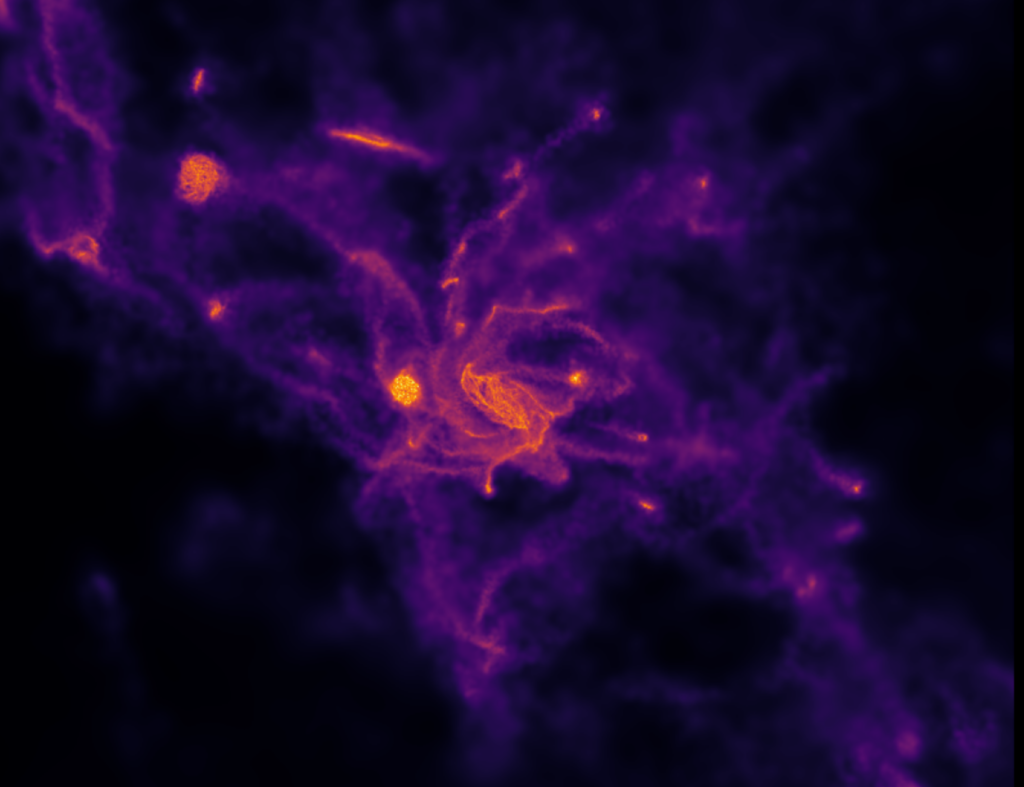
The authors modeled six galaxies over a course of 700 million years to see how their dust masses evolved over time, the final snapshot of one of these galaxies is visible in Figure 1. Their model involved slowly adding parameters to an initial run that only looked at the distribution of dark matter, until they eventually had a high-resolution model of a galaxy as it evolves over time. Through similar models, astronomers can investigate a host of galactic properties that are otherwise unobservable in high resolution in the early universe.
Done and Dusted
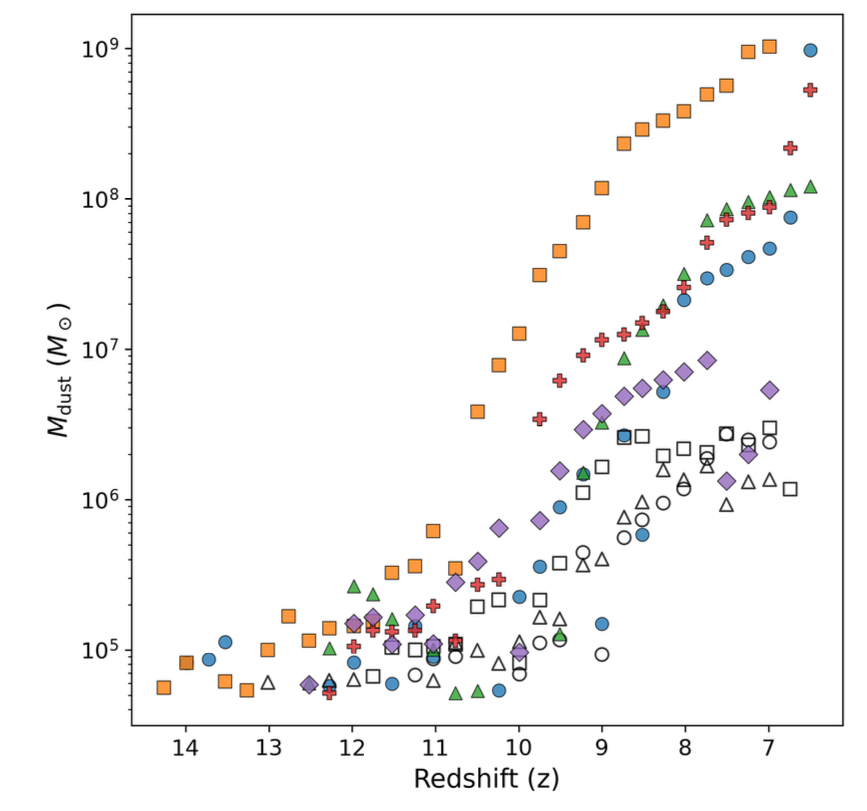
By looking at theoretical models of how a galaxy should evolve over time, the authors were able to draw conclusions about the mechanisms that drive dust growth in early galaxies. They found that early in a galaxy’s life, supernovae drive dust production, and the dust mass of a galaxy rises very slowly, as seen in Figure 2. Once enough rounds of star formation have occurred to enrich the interstellar medium with metals, the supernovae no longer dominate the dust mass of the galaxy.
They also found that the size of the dust grains themselves matters when observing these early universe galaxies. The smaller the dust grain, the easier it will grow, since it has a larger surface area compared to its mass. Over the course of the models, the distribution of the dust was skewed towards these smaller grains.
At long last, the authors were able to use this information to investigate the morphology of Blue Monsters. Surprisingly, the galaxies themselves were not actually dust free. Rather, they exist at the very beginning of dust production, where supernovae are creating the dust present in the galaxy. Rather than having no dust at all, they are just extremely lacking in the large grain size that would strongly affect the UV slope of their spectra. The Blue Monsters are not monsters at all, just young galaxies at the beginning of their life cycle.
Astrobite edited by Akshita Mittal
Featured image credit: Narayanan et al. 2026
