
Paper Title: The science from asteroid sample return missions
Authors: E. Tasker, H. C. Connolly Jr, S. Tachibana
First-author institution: Institute of Space and Astronautical Science, Japan Aerospace Exploration Agency, Yoshinodai 3-1-1, Sagamihara, Kanagawa 252-5210, Japan
Status: Accepted for publication in Contemporary Physics (Open Access)
The only thing more awesome than studying space from the ground is studying space from space. And even better than that is grabbing some rock and bringing it back to Earth for closer inspection! Unfortunately, “it’s cool” doesn’t quite get space missions funded. Fortunately, we can learn so, so much from space missions, including how and why Earth formed and is habitable for Humanity, which funding bodies like. In fact, asteroids in the Solar System may be partly responsible for where life on Earth originally came from…
Surely we can just study the Earth, though? I mean, it’s right here, and it actually has life on it! Unfortunately, geological evolution and tectonic activity over billions of years, as well as life itself, has basically wiped out the conditions of the early proto-Earth. That’s a good thing, too, or we would be living in a fiery, hellish landscape. To understand where Earth comes from, we must instead turn to the leftovers from the planet formation process when the sun was forming: asteroids.
Going to asteroids and studying how they are made up is tricky business, but fortunately doesn’t require a crew of oil drillers. We have pulled off three asteroid sample retrieval missions with space probes. Today’s paper summarises these missions, critical to learning about our astrophysical ancestry, and what we have learned from them.
Let’s go to an asteroid!
Pitstop number 1: Asteroid Itokawa. Named after Hideo Itokawa, considered the “father” of Japanese rocket engineering, the Hayabusa’s journey to this asteroid was fraught with peril. A solar flare fried electrical equipment on its way out; it was stranded for 30 minutes after landing on the asteroid; and the craft became unresponsive for 7 weeks on the trip back. Despite these setbacks, Hayabusa’s surface sample returned to Earth and we learned a lot.
Itokawa is not a solid rock but a porous rubble-pile – the sample was more dense than the asteroid’s bulk density (i.e. the total mass divided by its volume), indicating that 40% of its volume was just empty space.
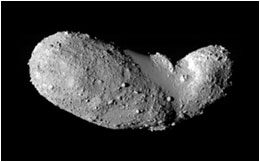
The Hayabusa snapped a few images of Itokawa (one is in Figure 1), and they suggest that it was not formed in the shape it is now – it is possibly a contact binary, similar to the asteroid Arrokoth visited by the New Horizons probe in 2019, where two asteroids slowly came together and created Itokawa. So, how do we find out the story of Itokawa’s formation?
The genius strategy was to analyse the composition of the rock. Each lobe of the asteroid is similar, suggesting each lobe came from the same parent body. Plus, analysis of the minerals and isotopes inside Hayabusa’s sample suggests that the parent body was heated to nearly 800 Celsius from radioactive isotopes such as Aluminium-26, an isotope that was abundant in the early Solar System. This lets us date the parent body to have formed only two million years after the sun formed. Later, it was destroyed in a collision, and Itokawa formed loose from the rubble. Momentum from the sun’s light then pushed Itokawa into a near-Earth orbit, which made it a good target for Hayabusa.
The Origins of Asteroids…
Pitstops number 2 and 3: Ryugu and Bennu, visited by Hayabusa2 and OSIRIS-REx. Like Itokawa, both Ryugu and Bennu are rubble piles which have a large portion of their volume taken up by the void of space.
Both Ryugu and Bennu are thought to have similar dynamical histories, originating from the same region of space. And if they are both rubble piles… could they share the same asteroid parent which later shattered to form the two asteroids? This is an interesting hypothesis, and it may be the case! The story is summarised in Figure 2.
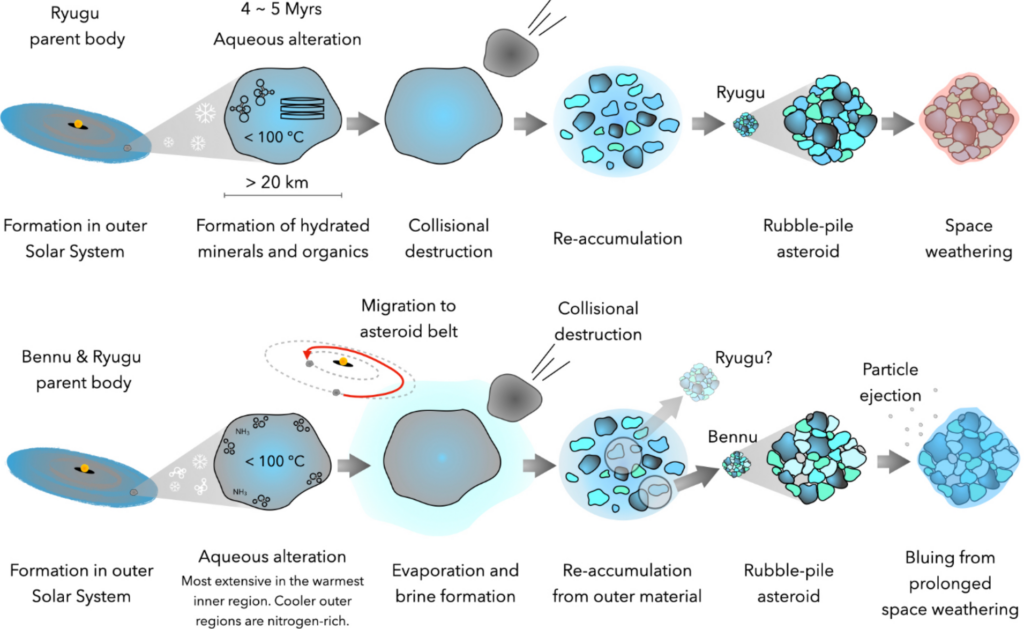
Ryugu has both CO2 and water ice, meaning the parent body must have formed between 3 and 4 AU from the Sun (where the temperature was right for these ices to exist). Ryugu even has magnetite crystals that retain a memory of the magnetic field from the collapsing gas cloud that formed the Sun! Much of the material has also experienced aqueous alteration, where water-rich fluids chemically meld with rocks to alter their composition.Bennu, however, does not have aqueously altered rocks, but contains a high concentration of salts and phosphates, which would have precipitated as water disappeared from the rock. This left salt-rich brines, and, coupled with the high quantity of ammonia on the asteroid, may have led to the creation of amino acids.
… and Life on Earth?
33 amino acids, including 14 of the amino acids key to biological life on Earth, were found on Bennu. Ryugu also contains all five core nucleobases for RNA and DNA, also key for life on Earth. It is entirely possible that the progenitor chemistry for terrestrial life came from space, borne out of chemistry on space rocks. Asteroids similar to the parent body that later shattered into Ryugu and Bennu may have been incorporated into Earth during its formation. Since these rocks and chemistry came from the interstellar medium… could other planets have experienced the same fate as Earth?
To know the full story, we must return to asteroids. Fortunately, there are probes already on the way: Tianwen-2 will visit Kamo’oalewa in 2027, and other probes like JAXA’s Martian Moons eXploration (MMX) probe will visit Mars’ moon Phobos and further lift the veil on the Solar System’s history, as well as Humanity’s astrophysical ancestry.
Astrobite edited by Elise Koo.
Featured image credit: JAXA, University of Tokyo, Kochi University, Rikkyo University, Nagoya University, Chiba Institute of Technology, Meiji University, University of Aizu, AIST.

How do spacecraft collect samples from the surface of an asteroid?
The spacecraft literally land on the asteroid! The Hayabusa probe was meant to fire a projectile at Itokawa’s surface to release material that the probe could capture, but changes in the mission plan prevented this. Hayabusa2 successfully used a projectile, whereas OSIRIS-REx fired a stream of nitrogen gas to release material.